
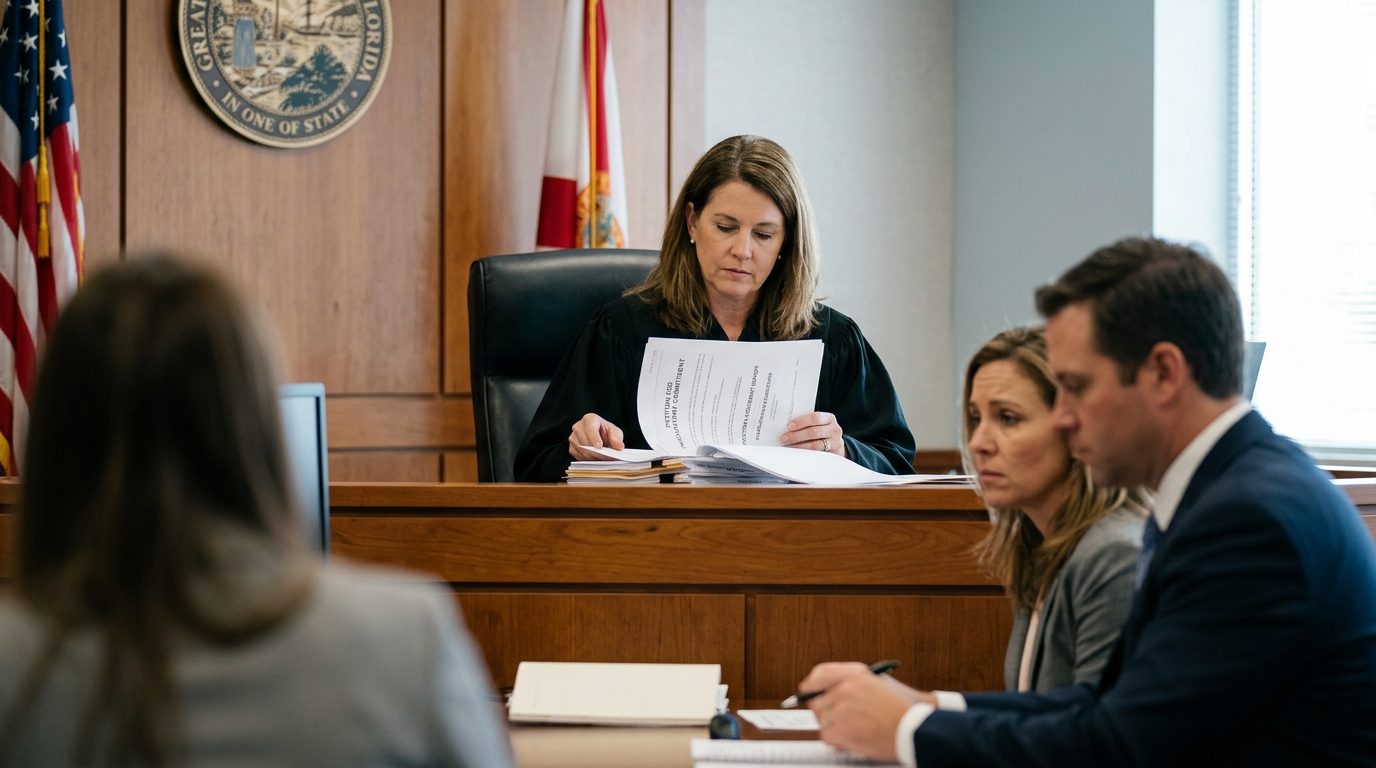
Marchman Act & Guardianship | South Florida
When a Parent's Addiction Puts Children at Risk, Know Your Options
Robinson Casey focuses on Marchman Act petitions and guardianship matters for families across South Florida and statewide. Start with a free, confidential first consultation with no obligation to continue.
By Richard J. Casey III, Esq. · Published October 20, 2026
Here is the short answer to parent with addiction caring for children Florida what to do: protect the children first, write down what you see, and learn your legal options before a crisis forces a decision. Florida law lets certain relatives ask a court for help. The steps must happen in order, so this guide walks through them in plain language.
Start With the Children’s Immediate Safety
If a child is in immediate danger, call 911 before anything else. Immediate danger includes a parent who is unconscious, driving impaired with children in the car, or threatening to hurt someone.
Once the children are safe, start a written record. Write down dated, factual notes: what you saw or heard, who was present, and what happened next. Keep what you saw separate from what others told you.
Record whether children were left alone, or without food, medicine, or a safe place to sleep. Note who in the family or among friends could take the children on short notice, and write down their phone numbers.
Keep this record in one place, such as a notebook or a secure file on your phone. Add to it each time something new happens. Specific facts carry more weight than general worry.
If a parent's addiction has you worried about the children in their care, you don't have to sort out the legal options alone, and our team is ready to talk. Talk it through with our team — the first consultation is free, confidential, and carries no obligation.

How a Parent’s Addiction Affects Children
Children who live with active addiction often face unpredictable routines and missed care. Their days can change without warning, and adults may not notice the signs right away.
Common signs include pulling away from friends, a drop in school performance, sleep changes, and sudden mood swings. Some children also take on adult jobs, such as caring for younger siblings or getting themselves to school.
Children should never be asked to keep secrets about a parent’s drug use, handle a parent’s medication, or carry messages between adults. Those burdens can strain a child for years.
When a parent’s addiction affects the children’s care, the matter can reach the child welfare system. Careful notes help you explain what is happening.
Helping a Child Who Lives With a Parent’s Addiction
Tell the child, in simple words, that the addiction is not their fault and that fixing it is not their job. Repeat this often, because children tend to blame themselves.
Keep the child’s routines steady. Set regular times for school, meals, and bedtime. Routine gives a child a sense of what comes next, even when a parent’s behavior changes.
Give the child one or two trusted adults they can reach, such as a teacher, a school counselor, a coach, or a relative. Make sure the child has that person’s number and knows where to go.
Teach the child when to call 911. A child should call for help if a parent is hurt, unresponsive, or threatening anyone. Practice this calmly, not as a scare tactic. Let the child ask questions and answer them honestly, in words that fit their age.
Talking With the Parent Without Enabling the Addiction
Enabling means making it easier for the addiction to continue. Common examples include covering for the parent, paying for needs without conditions, or ignoring unsafe behavior to keep the peace.
Pick a calm moment to talk, ideally when the parent is sober. Avoid the conversation during an argument or right after an incident.
Describe specific behaviors and how they affect the children. For example, say “You didn’t pick Maya up from school on Tuesday.” Avoid labels, which tend to shut the conversation down.
Decide ahead of time what you will and will not do, and state it in a sentence or two. You might say you will not give money that goes toward drugs, and you will keep the children safe.
Follow through, even when it is hard. Mixed responses, such as a threat one day and a rescue the next, tend to keep the cycle going.
Building a Safety Plan for the Children
A safety plan is a written list of who to call, where to go, and where key papers are kept. Write it before a crisis, not during one.
List emergency contacts. Include school staff, the children’s pediatrician, nearby relatives or friends, and the local non-emergency police number. Keep a paper copy too, in case a phone is lost or the battery dies.
Pick two or three safe places where the children can go quickly, such as a grandparent’s home or a neighbor’s house. Walk the children through the route, and practice it if you can.
Keep copies of birth certificates, insurance cards, school records, and any custody or guardianship papers in one secure place. Store a second copy with a trusted adult outside the home.
Review the plan every few months. Update phone numbers and addresses when they change, so the plan stays useful.
Florida Legal Options When a Parent Cannot Safely Care for Children
Florida law offers several paths. These include guardianship for the children and Marchman Act petitions for treatment, and the right path depends on the facts of your family’s situation.
A guardian can be appointed for a minor. Under Florida law, a parent, brother, sister, next of kin, or other person interested in a minor’s welfare may petition the court. Fla. Stat. § 744.3021 A guardian for a minor has the authority of a plenary guardian.
Parents are usually the natural guardians of their children. Fla. Stat. § 744.301 says the parents jointly hold that role during minority, unless their parental rights have been terminated under chapter 39. If a child is the subject of a chapter 39 proceeding, the parents may act as natural guardians unless the court division with jurisdiction over guardianship matters finds that it is not in the child’s best interests. If a marriage ends and neither parent gets parental responsibility, neither may act as natural guardian.
When there is imminent danger, a court can act fast. A court may appoint an emergency temporary guardian before the full case is decided, but only if it finds that imminent danger could seriously impair a person’s health or safety.
Limited, plenary, and mental health guardianship each carry a different scope. The right type depends on the children’s ages, the parent’s condition, and any existing court orders.
Not sure what your next step is?
Talk it through with our team — the first consultation is free, confidential, and carries no obligation.
How Involuntary Treatment Works Under the Marchman Act
The Marchman Act lets certain people ask a Florida court to order an assessment and, if the legal criteria are met, involuntary treatment for substance use.
For an adult respondent, the petition may be filed by a spouse or legal guardian, any relative, a service provider, or an adult with direct personal knowledge of the person’s impairment and treatment history. Florida law allows any relative of an adult respondent to file a petition for involuntary treatment services, so a grandparent or adult sibling can be a petitioner when the parent is the respondent.
Fla. Stat. § 397.675 The statute also says mere refusal to receive services is not, by itself, evidence of lack of judgment with respect to the person’s need for such services. Under Fla. Stat. § 397.675, a person meets the criteria for involuntary admission only if there is good faith reason to believe the person is substance abuse impaired, or has a substance use disorder and a co-occurring mental health disorder, and, because of it, has lost the power of self-control over substance abuse and also either: (a) is in need of substance abuse services and has judgment so impaired by substance abuse that the person cannot appreciate the need for those services or make a rational decision about them; or (b) without care or treatment, is likely to suffer from neglect or refuse to care for himself or herself in a way that poses a real and present threat of substantial harm, and it is not apparent that the harm can be avoided through the help of willing, able, and responsible family members or friends or other services; or there is a substantial likelihood that the person has inflicted, threatened or attempted to inflict, or, unless admitted, is likely to inflict physical harm on himself, herself, or another.
The petition goes to the clerk in the county where the person is located. J.P. v. J.N.
The court must set a hearing within 10 court working days unless a continuance is granted. Under Fla. Stat. § 397.697, when the court finds that the conditions for involuntary treatment services have been proved by clear and convincing evidence, it may order the respondent to receive involuntary treatment services from a publicly funded licensed service provider for a period not to exceed 90 days. J.J.J. v. D.G.
Taking Care of Yourself as the Caregiver
Caring for children while a parent is in active addiction is exhausting. It’s common to feel guilt, anger, and fear at the same time. Those feelings don’t mean you are failing.
Find at least one person you can talk to honestly. It might be a friend, a faith leader, a counselor, or a relative who knows the situation. Saying it out loud often makes the next step clearer.
Protect your own sleep, health, and work. A worn-down caregiver has less to give the children, and the children need you steady.
Set limits on what you can take on. You can say no to rescue requests that put your own household at risk. Children need a steady adult more than a perfect one.
Keep a simple log of the time and money you spend on the children’s needs. That record can help if the matter reaches a court.
Talk With Robinson Casey About Your Family’s Situation
If you’re watching a parent’s addiction put children at risk, you are already doing the hard work of gathering facts and asking how to protect them. That is a sound place to start.
Robinson Casey limits its practice to Marchman Act petitions and guardianship matters. The practice serves families across South Florida, including Miami-Dade County, and statewide. Richard J. Casey III, Esq. is the responsible attorney.
Quick Answers
Can a grandparent file a Marchman Act petition in Florida?
Yes, for an adult respondent the statute allows any relative to file.
Does the parent have a right to a lawyer?
Yes. The respondent has the right to counsel at every stage, and the court can appoint one for a person who cannot afford it.
How long does emergency temporary guardianship last?
Its authority expires 90 days after appointment or when a guardian is appointed, whichever comes first.
If a parent’s addiction has you worried about the children in your care, you don’t have to face the legal questions alone. Call (561) 849-4149 or contact us online to request a free, confidential initial consultation, with no obligation to continue. Bring your notes and papers so the conversation can focus on your family.
Matters We Handle
Marchman Act Petitions
Petitions asking the court to order assessment and treatment for an adult with a substance use disorder, where the family needs a legal path to act.
Guardianship Matters
Emergency temporary, plenary, limited, and mental health guardianships, handled with attention to the needs of the children and the family.
Involuntary Commitment for Addiction
Court-supervised processes for individuals whose substance use places themselves or others in danger.
Why Families Call Robinson Casey
A Focused Practice
Our work centers on Marchman Act petitions and guardianship matters, the areas where families in crisis most often need help.
Free, Confidential First Consultation
Talk through your situation at no cost and with no obligation to continue.
Support for Your Whole Family
Our team supports the attorney and the families we serve, keeping communication clear from the first call onward.
South Florida and Statewide
We serve families in Miami-Dade and across South Florida, and we take matters throughout Florida.
Don't Wait Until the Situation Becomes a Crisis
Children's safety can change quickly when a parent's addiction escalates.
Talk With Richard J. Casey III, Esq. About Your Family's Situation
Related practice areas
- Involuntary Commitment for Addiction in Florida
- Involuntary Commitment For Addiction in Miami Dade
- Involuntary Commitment For Addiction in South Florida
- Involuntary Addiction Treatment and Gun Ownership in Florida