
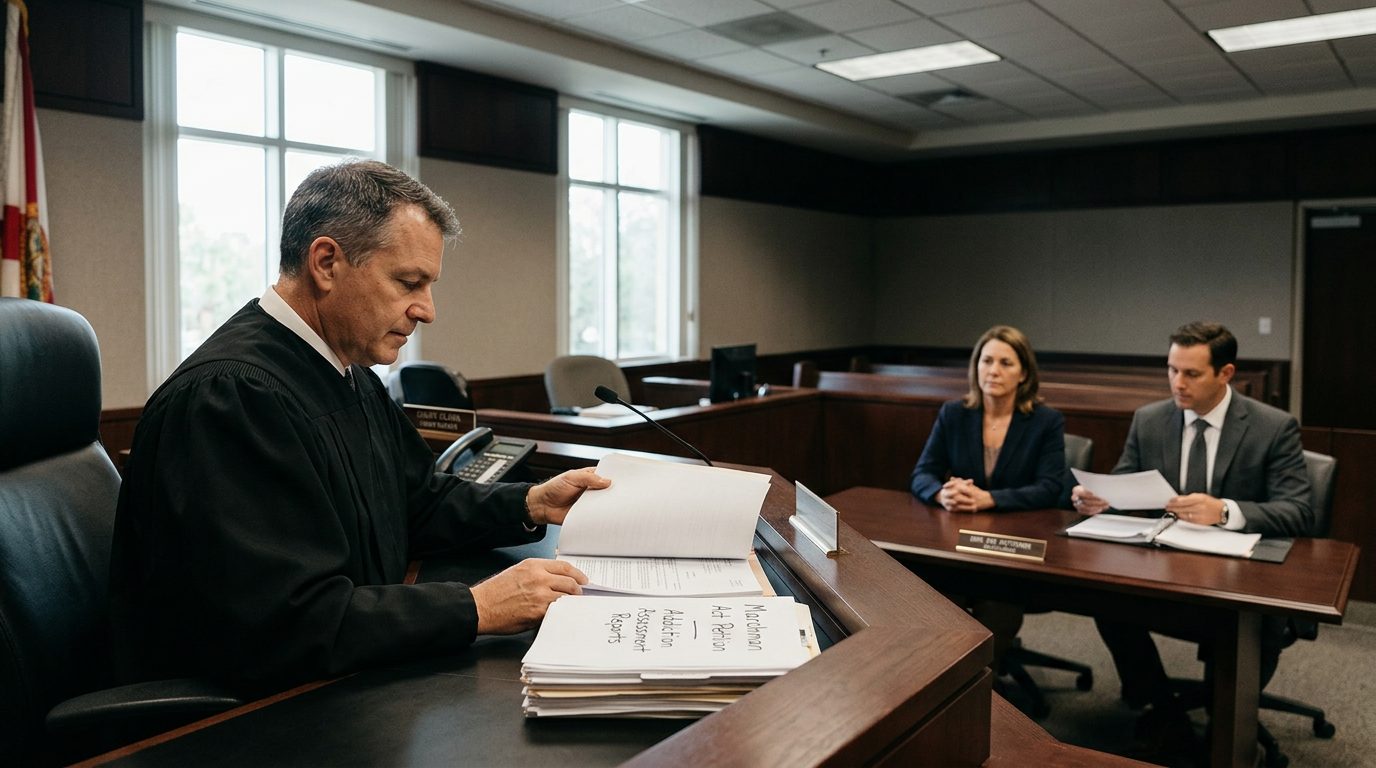
Involuntary Commitment for Addiction
File for Involuntary Commitment in Florida
When a family member's addiction requires immediate intervention, Robinson & Casey helps you petition the court for involuntary commitment.
By Richard J. Casey III, Esq. · Published October 03, 2026
Involuntary Commitment for Addiction in Florida: Filing Process & Legal Guide
When a family member’s addiction becomes dangerous and they refuse voluntary treatment, involuntary commitment may be a legal option. Florida law allows family members, caregivers, and healthcare providers to file a court petition for involuntary commitment when an adult poses imminent danger to themselves or others due to substance use disorder. This guide explains what involuntary commitment is, how the filing process works, what to expect, and how Robinson & Casey helps families navigate this difficult decision.
If you're watching a family member's addiction create real danger—and they've refused help—families in your situation reach out to us regularly to understand whether involuntary commitment is the right step. Talk it through with our team — the first consultation is free, confidential, and carries no obligation.

What Is Involuntary Commitment for Addiction?
Involuntary commitment for addiction—also called involuntary admission—is a court-ordered placement in a treatment facility when an individual refuses voluntary help and their substance use creates serious, immediate risk of harm. Unlike voluntary treatment, the person does not consent to admission. A judge must order it based on evidence presented in a court hearing.
Who can file a petition:
- Family members (spouse, parent, adult child, sibling)
- Caregivers or healthcare providers
- Law enforcement officers
- Any concerned party with direct knowledge of the person’s behavior
When involuntary commitment applies:
Involuntary commitment is appropriate when an adult refuses voluntary treatment AND their addiction has created imminent danger to themselves or others. Imminent danger means a substantial likelihood of serious bodily harm in the near future—not a theoretical risk months away, but a real, present threat.
Legal basis:
Involuntary commitment for addiction in Florida is governed by Florida Statutes Chapter 397, which establishes grounds and procedures for involuntary admission to substance abuse treatment facilities. The statute requires clear and convincing evidence of imminent danger, inability to care for oneself, or likelihood of serious deterioration without intervention.
What Involuntary Commitment Covers
Understanding what involuntary commitment actually does helps set realistic expectations.
The process includes:
- Immediate evaluation: Law enforcement locates the person and transports them to a designated receiving facility for medical and psychiatric assessment.
- Initial 72-hour hold: The facility evaluates the person’s condition, substance use history, medical needs, and risk level.
- Treatment planning: If commitment is warranted, the facility develops a treatment plan addressing specific needs.
- Court hearing: Within 5 business days, a judge holds a hearing. The person has the right to legal representation and to contest the commitment.
- Ongoing commitment: If the court finds grounds exist, commitment can extend for weeks or months, depending on the court’s order.
What involuntary commitment does NOT cover:
Involuntary commitment does not guarantee a specific treatment outcome, length of stay, or recovery. The court orders commitment based on imminent danger—not on likelihood of success. Treatment quality, the person’s willingness to engage, and post-discharge support all affect outcomes beyond the court’s control.
Legal Grounds for Filing a Petition
Florida courts require petitioners to prove one or more specific grounds for involuntary commitment. Vague concerns are not enough; you must provide factual, dated allegations.
The legal grounds are:
- Imminent danger to self: The person’s substance use creates substantial likelihood of serious bodily harm—repeated overdoses, unsafe behavior while intoxicated, or threats of self-harm.
- Imminent danger to others: The person poses a credible threat of harm to family, caregivers, or the public—driving while severely intoxicated, violent behavior while using, or specific threats.
- Inability to care for self: The person cannot obtain food, shelter, or necessary medical care due to addiction—they are homeless, malnourished, or neglecting critical health needs.
- Likelihood of serious deterioration: Without intervention, the person’s physical or mental health will worsen significantly in the near future.
Documentation required:
Courts expect specific facts: dates of incidents, what happened, who witnessed it, police reports, prior treatment attempts, hospitalizations, or medical evaluations. General statements like “he’s using too much” are insufficient. Bring documentation—police reports, medical records, text messages, or written accounts of specific events.
Step-by-Step Filing Process
Here’s what happens from the moment you contact an attorney to the court hearing.
Step 1 – Consultation and case review
You meet with an attorney to describe the situation and provide specific examples of dangerous behavior. The attorney asks detailed questions: When did dangerous behavior start? What specific incidents occurred? Who witnessed them? Has the person been arrested, hospitalized, or treated before? Are there medical records or police reports?
Step 2 – Petition preparation
The attorney drafts a formal petition for involuntary commitment. This document states the legal grounds, describes specific incidents with dates, and explains why the person poses imminent danger. The petition must meet the court’s evidentiary standard.
Step 3 – Filing with the court
The petition is filed in the circuit court in the county where the person resides or is currently located. The court reviews the petition to determine whether probable cause exists to proceed.
Step 4 – Law enforcement coordination
If the court finds probable cause, law enforcement is notified to locate the person and transport them to a designated receiving facility. This may happen within hours or a few days.
Step 5 – Initial evaluation (72-hour hold)
The receiving facility conducts a medical and psychiatric assessment. The person is observed, evaluated for substance use and mental health issues, and a preliminary treatment plan is developed.
Step 6 – Court hearing
Within 5 business days of admission, a hearing is held. You may testify about specific incidents and grounds for involuntary commitment. The person has the right to an attorney and can present evidence and witnesses to contest the petition.
Step 7 – Judge’s decision
The judge determines whether clear and convincing evidence supports commitment. If yes, the judge issues an order. If no, the person is released.
Step 8 – Ongoing commitment or release
If ordered, the person enters the designated treatment facility. If denied, they are released. You may explore other legal options.
Timeline:
From petition filing to initial court hearing typically takes 5 to 10 business days. In crisis situations, the process may move faster. If the person cannot be located, the timeline may extend.
What to Expect During the Process
Families often have concerns about what the process will feel like and what role they’ll play.
Emotional difficulty
Filing a petition against a family member’s will is emotionally heavy. The person may feel betrayed or angry, at least initially. Many people later recognize that intervention was necessary and even lifesaving. The legal process is separate from the family relationship.
Legal representation for the respondent
The person subject to the petition (called the respondent) has the right to legal representation. If they cannot afford an attorney, the court appoints one. This ensures fairness and protects their rights.
Your role as petitioner
You may be asked to testify at the hearing about specific incidents, dates, and behavior that support the grounds for involuntary commitment. Be prepared to describe what you witnessed, when it happened, and why you believe the person poses imminent danger.
Confidentiality
Court proceedings are generally confidential. Medical records are protected by privacy law. This is not a public matter.
No guarantee of outcome
The court makes the final decision based on evidence. If the judge finds grounds are not proven, the petition may be denied and the person released. This does not mean you made the wrong decision; it means the evidence presented did not meet the legal standard.
Treatment placement
If commitment is ordered, the court and receiving facility determine where the person will receive treatment and what the treatment plan will include. You may be invited to participate in treatment planning.
Not sure what your next step is?
Talk it through with our team — the first consultation is free, confidential, and carries no obligation.
Robinson & Casey’s Approach to Involuntary Commitment Cases
Robinson & Casey focuses exclusively on involuntary commitment petitions and guardianship matters. This is the firm’s core work, not a side practice.
How the firm supports families:
- Focused practice: Involuntary commitment and guardianship are all the firm does, which means deep knowledge of Florida law and procedure.
- Experience with Florida law: The firm is deeply familiar with Florida Statutes Chapter 397 and involuntary admission procedures across South Florida and statewide.
- Established court relationships: Working relationships with judges, receiving facilities, and court staff streamline the filing process and ensure petitions meet local standards.
- Compassionate guidance: Attorneys understand the emotional weight of these decisions and communicate clearly with families about what to expect.
- Detailed case preparation: Petitions are drafted with specific, factual allegations—not generic language—to meet the court’s legal standard.
- Responsive service: Families often reach out in crisis situations. The firm prioritizes urgent matters and works quickly.
Common Questions
Q: Will my family member be angry with me?
Possibly, at first. Many people later recognize that intervention saved their life. Over time, anger often gives way to gratitude.
Q: What if the court denies the petition?
If grounds are not proven, the person is released. You may explore other options, including limited guardianship or voluntary treatment programs. An attorney can discuss alternatives.
Q: Can I file anonymously?
No. You must be identified as the petitioner. However, your address may be kept confidential in some circumstances; ask your attorney.
Q: How much does this cost?
Attorney fees vary based on case complexity. Contact Robinson & Casey for a consultation and fee discussion.
Q: What happens after commitment is ordered?
The person enters the designated treatment facility. Family involvement in treatment planning is encouraged. Ask the facility about family sessions and aftercare planning.
Q: Can the person be released before the court hearing?
Only if the facility determines commitment is no longer necessary or if the person voluntarily admits to treatment and the facility accepts them.
Q: Do I need a lawyer to file?
You can file a petition yourself, but an attorney ensures the petition meets legal standards, includes specific factual allegations, and increases the likelihood of success.
How Robinson & Casey Supports You
Initial consultation
A detailed discussion of your situation, the person’s behavior, prior treatment attempts, and whether legal grounds exist for involuntary commitment.
Petition drafting
The attorney prepares a thorough, fact-specific petition that clearly establishes grounds for involuntary commitment under Florida law.
Court filing and coordination
The firm handles all paperwork, court filings, and coordination with law enforcement and receiving facilities.
Representation at hearing
An attorney represents you at the court hearing, presents evidence, answers the judge’s questions, and advocates for the commitment order.
Post-commitment support
Guidance on next steps, treatment options, family involvement in treatment planning, and any follow-up legal matters.

Schedule Your Consultation
If you’re watching a family member’s addiction create real danger—and they’ve refused help—families in your situation reach out to us regularly to understand whether involuntary commitment is the right step. Robinson & Casey can help you understand your options, explain the filing process, and guide you through it.
Schedule a consultation or call Robinson & Casey at (561) 849-4149.
Bring specific examples of dangerous behavior, dates of incidents, any police reports, medical records, or documentation of prior treatment attempts. The firm serves families across South Florida and statewide.
Time-Sensitive Matter
Involuntary commitment petitions require prompt legal action. The sooner you contact an attorney, the sooner you can move forward with protecting your family member.
What Happens in an Involuntary Commitment Case
Petition Filed
Your attorney prepares and files a petition with the court, detailing the grounds for involuntary commitment based on addiction and imminent danger.
Court Hearing
A judge reviews evidence and testimony. The court determines whether involuntary commitment is warranted under Florida law.
Treatment Ordered
If the petition is granted, your family member is committed to a treatment facility for evaluation and care.
Ongoing Support
Robinson & Casey guides you through the process and answers questions as your family member receives treatment.
Why Choose Robinson & Casey
Focused on Marchman Act & Guardianship
Robinson & Casey focuses exclusively on Marchman Act petitions and guardianship matters—we know this area of law inside and out.
Experienced with Involuntary Commitment
We have handled involuntary commitment petitions for families across South Florida and statewide, understanding the nuances of each case.
Family-Centered Approach
We recognize how difficult this decision is. Our team works compassionately with families to navigate the legal process.
Direct Access to Your Attorney
When you call Robinson & Casey, you reach the firm that will handle your case—not a referral service or answering service.
Common Questions
Will my family member be angry with me?
Possibly, at first. Many people later recognize that intervention saved their life. Over time, anger often gives way to gratitude.
What if the court denies the petition?
If grounds are not proven, the person is released. You may explore other options, including limited guardianship or voluntary treatment programs. An attorney can advise you on next steps.
Is involuntary commitment the same as guardianship?
No. Involuntary commitment focuses on immediate treatment for addiction. Guardianship is a longer-term legal arrangement that gives you decision-making authority. Both may be relevant to your situation.
How long does the process take?
The timeline depends on court schedules and case specifics. Robinson & Casey will keep you informed and work efficiently to move your petition forward.
Ready to Take the Next Step?
Related practice areas
- Emergency Temporary Guardianship Costs & Fees FL
- Financial Guardianship Rights for Mental Health | Florida