
Marchman Act & Guardianship | Miami-Dade & South Florida
Does Florida Have a Law to Force Addiction Treatment?
Families facing a loved one's addiction often ask what the law allows when the person refuses help. Here is an overview of the options Florida courts consider, and how Robinson Casey can help you decide what to do next.
Casey III, Esq. · Published November 8, 2026
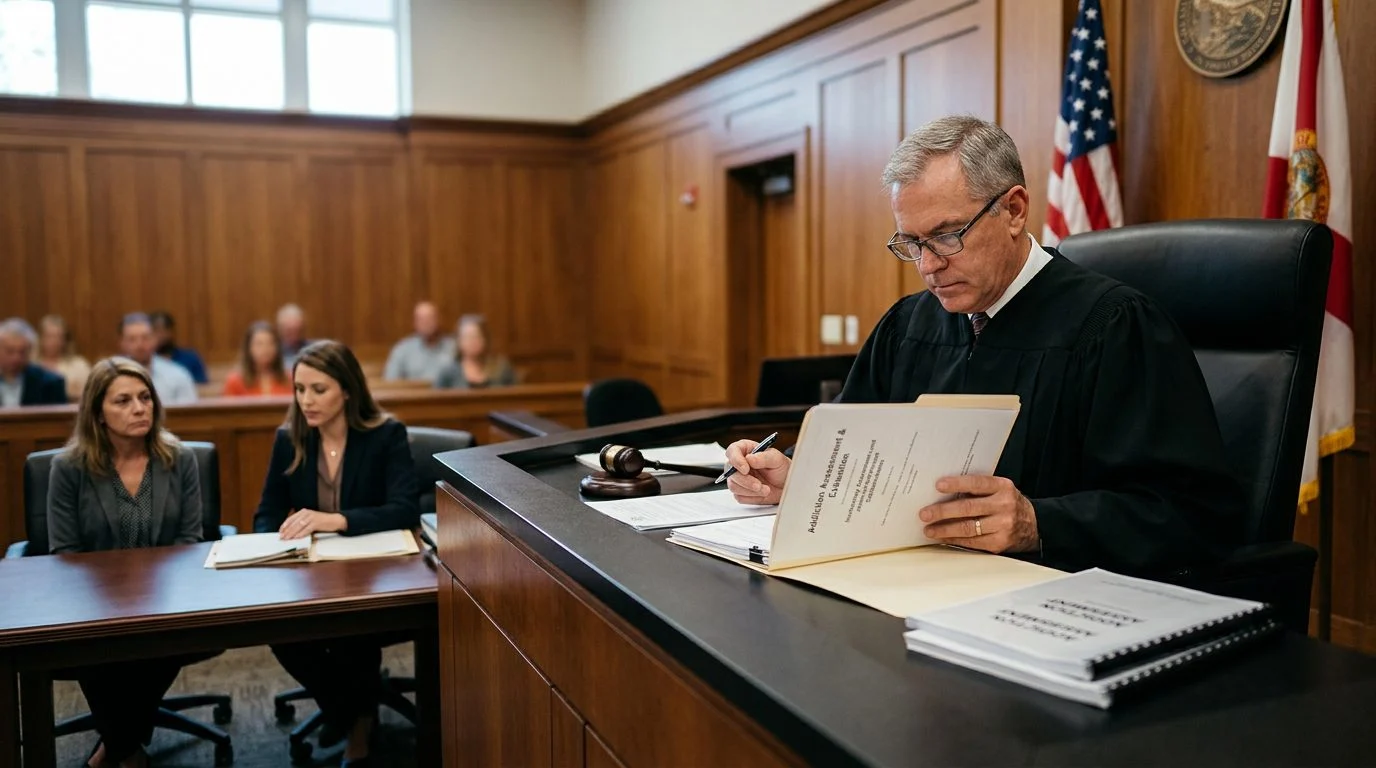
Does Florida have a law to force addiction treatment? Yes. The Marchman Act, found in Chapter 397 of the Florida Statutes, lets a court order involuntary assessment and treatment for substance abuse impairment. The court does this only when the statute’s criteria are met, and the judge decides whether they are.
The Short Answer: Yes, Florida Has the Marchman Act
Florida law allows certain people to ask a court for involuntary treatment of a person who is substance abuse impaired. The request is made through a formal written petition. Filing a petition does not make treatment automatic. The judge must find that the statute’s standard is met.
The criteria appear in Fla. Stat. § 397.675.
If you’re worried about someone who keeps refusing help, this law may be part of what you’re weighing. Many people find the process confusing at first. This page explains it in plain terms. For a broader overview, see involuntary commitment for addiction in Florida.

What the Marchman Act Covers
The Marchman Act deals with substance abuse impairment. It sets out who may start a case, what a petition must say, and how the court handles the case from filing through hearing. It also gives an adult a way to seek voluntary admission to treatment, which is covered below.
The Act does not cover every problem a family faces. Guardianship is a separate court process. It deals with a different question: whether a person can make certain decisions for themselves. This page covers only the substance abuse petition process. Guardianship matters are discussed on other pages.
Who May File a Petition and What It Must Say
For an adult, a petition may be filed by the person’s spouse or legal guardian, any relative, a service provider, or an adult with direct personal knowledge of the person’s impairment and treatment history. Fla. Stat. § 397.68112 lists these petitioners. For a minor, the petitioner is a parent, legal guardian, or service provider.
A petition must name the person being petitioned about, called the respondent. It must also name the petitioner and state how they are related. It must include the factual allegations that support the request. Fla. Stat. § 397.68141 says those facts must give reasons. The reasons must show the person is substance abuse impaired and has lost self-control. They must also show either a risk of physical harm or that refusing care comes from impaired judgment.
A petition may include a report from a qualified professional who examined the person within 30 days before filing. If the person was never assessed, or refused an assessment, the petition must say so.
Filing takes place with the clerk of the court. The petition must be filed in the county where the person is located. The clerk may not charge a fee to file it. Fla. Stat. § 397.681 sets out these rules.
Location matters. In J.P. v. J.N., the Fifth District Court of Appeal held that filing in the wrong county is a venue problem, not a lack of jurisdiction. Venue is the place where a case is heard. See J.P. v. J.N., 225 So. 3d 410 (Fla. 5th DCA 2017).
Finally, the court, not the petitioner, decides whether the statutory standard is met. The result depends on the court’s discretion and the facts presented.
Voluntary Treatment Comes First: How the Two Paths Differ
Voluntary treatment starts when the person asks a service provider for admission. Fla. Stat. § 397.601 says a person who wants treatment may apply to a service provider for voluntary admission.
The involuntary path is different. It starts with a petition to the court. The judge then decides whether the statutory criteria are met.
| Voluntary admission | Involuntary treatment | |
|---|---|---|
| Who starts it | The person applies | A petitioner files with the court |
| Court involved | No | Yes |
| What drives entry | The person’s application | A court finding on the statutory criteria |
This page does not assume a required order of steps. Which path fits depends on the person’s situation. The court’s findings also matter. Some families try voluntary options first, and some cannot. Your facts decide what applies.
How the Court Process Generally Unfolds
A Marchman case generally moves through several stages: filing, notice, a possible emergency order, assessment, and a hearing.
When a petition is filed, the court must decide right away whether the person has a lawyer or whether appointing one is appropriate. Fla. Stat. § 397.68151 also says the court schedules a hearing within 10 court working days, unless a continuance is granted. A copy of the petition and the hearing notice must go to the respondent and others the statute lists.
In an emergency, the court may act on the petition alone. Fla. Stat. § 397.6818 allows an ex parte order, meaning one entered without the other side present, for assessment and stabilization. That order does not require an attorney to be appointed first. It must be carried out while the hearing is pending. The same section says a service provider may not hold the person for more than 72 hours of observation, unless an exception applies, such as a court-granted extension after a hearing.
If the court finds the conditions proven by clear and convincing evidence, it may order treatment. Fla. Stat. § 397.697 says that order may last for a period not to exceed 90 days. At the end of that period, Fla. Stat. § 397.6977 says the person is automatically discharged unless a motion for renewal was filed.
The court has discretion over scheduling, orders, and relief. No particular result is assured.
Rights of the Person Named in a Petition
The person named in a petition has the right to counsel at every stage of the case. Fla. Stat. § 397.681 says the person may waive that right only if present and the court finds the waiver knowing, intelligent, and voluntary. The Second District Court of Appeal has also held that a Marchman respondent has a constitutional due process right to counsel, in Hillsborough County v. Albrechta.
The person generally must attend the hearing. The court can excuse attendance only for a knowing, intelligent, and voluntary waiver, or if presence is inconsistent with the person’s best interests or likely to be injurious. Fla. Stat. § 397.6957 also says testimony is taken under oath. The person may refuse to testify.
One issue is still developing. In J.C. v. State, the Fifth District reversed when a trial court called and questioned the only witness after the petitioner was absent. In C.W.R.K., the Fifth District reaffirmed that rule in 2024. The Fourth District reached a different result in J.J.J. v. D.G. and certified conflict. Later statutory changes may also affect it.
Having a lawyer does not decide the case. The court still applies the statute to the facts.
Not sure what your next step is?
Talk it through with our team — the first consultation is free, confidential, and carries no obligation.
Common Questions Families Ask About Addiction and Treatment
Many questions here have no legal answer. The answers below stick to what the law says and what it does not promise.
Do addicts ever change?
Recovery looks different for each person. No legal process can promise a particular recovery result. A court order also does not promise one.
What is a recovery group?
A recovery group is a meeting where people with shared experience support one another. Some people use these groups for ongoing support. This page does not recommend any specific program.
Does Florida have a law to force addiction treatment in an emergency?
Yes, in limited circumstances. The hearing must still be scheduled under § 397.68151.
How do I explain addiction to someone who doesn’t understand?
Many families describe specific events they have seen, rather than labels. The legal process runs separately from personal conversations. The court decides what evidence is enough.

Talk Through Your Situation With Robinson Casey
If you’re watching a family member turn down help, you may feel stuck between waiting and acting. You may be asking whether a Marchman Act petition is even an option for your situation.
Richard J. Casey III, Esq., the responsible lawyer for this page, focuses on Marchman Act petitions and guardianship matters in Florida through Robinson Casey. The firm serves families in South Florida and statewide. If you want to talk through the facts of your situation, call (561) 849-4700 or request a consultation.
This page is general information, not legal advice. Your facts decide what applies. No lawyer can promise how a court will rule. Some matters may be referred to another lawyer or firm, and that will be discussed with you.
How Robinson Casey Helps Families
A Focused Practice
Robinson Casey focuses on Marchman Act petitions and guardianship matters, so our work centers on these court proceedings for families across South Florida and statewide.
A Free, Confidential First Consultation
Your first consultation is free and confidential, with no obligation to continue. It is a chance to ask questions and understand your options.
Support Staff You Can Reach
Our assistants and office staff help keep your case organized and your questions answered throughout the process.
Direct Contact
Call (561) 849-4700 to speak with our team about your family's situation.
Every Family's Situation Is Different
This page provides general information only. The steps available in your case depend on the specific facts, and only a conversation about those facts can tell you what may apply.
Court Options We Handle
Marchman Act Petitions
A petition asks a Florida court to review whether a family member may need assessment and treatment for substance use. Our attorneys guide families through each step of the filing.
Involuntary Commitment for Addiction
Where a court finds that a person meets the statutory criteria, it may order treatment. We explain how this process works and what to expect in court.
Guardianship Matters
We handle plenary, limited, and mental health guardianship.
Emergency Temporary Guardianship
We help families understand when this option may be appropriate.