
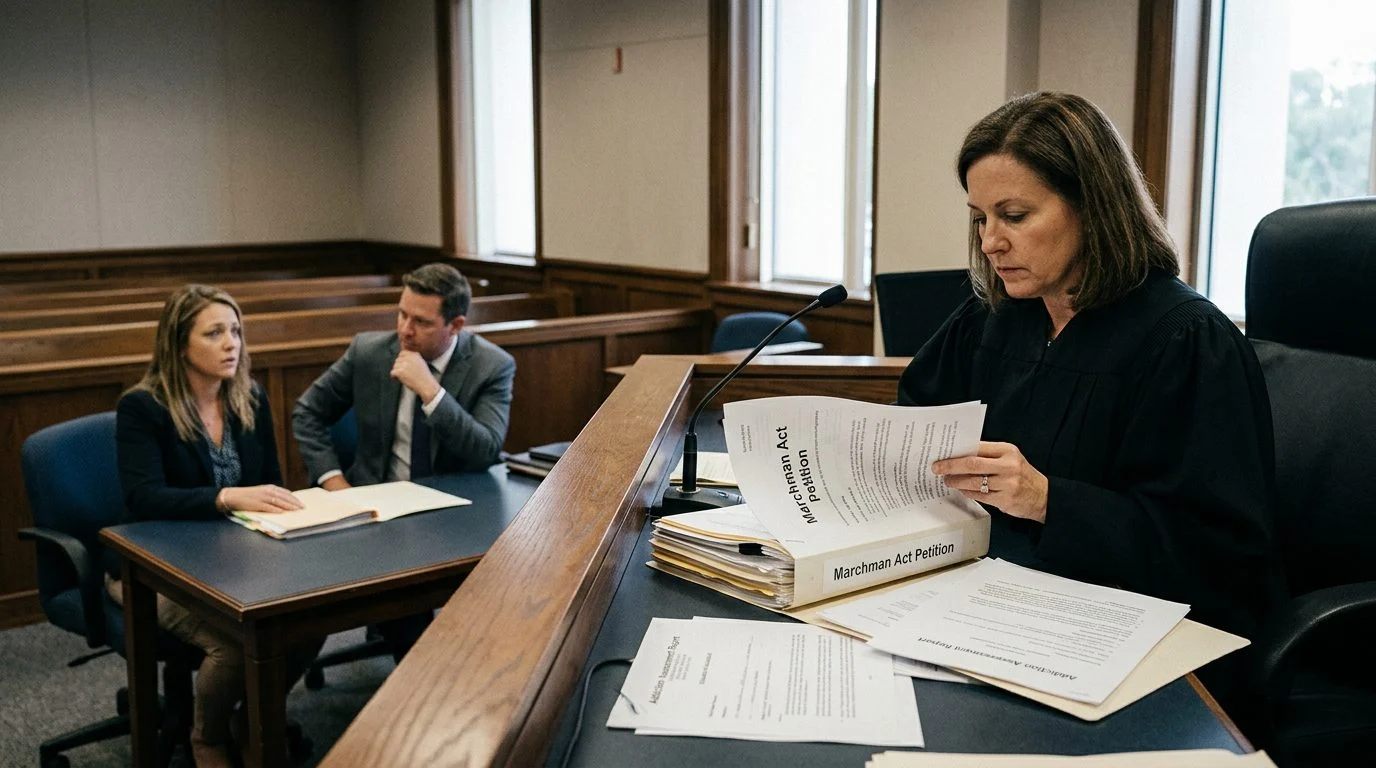
Marchman Act & Guardianship | Miami-Dade and South Florida
Guardianship and Marchman Act Help for Adult Addiction in Florida
Robinson Casey focuses on Marchman Act petitions and guardianship matters for families across South Florida and throughout the state. Start with a free, confidential first consultation with no obligation to continue.
By Richard J. Casey III, Esq. · Published October 24, 2026
If an adult you love is using drugs or alcohol in a way that puts them at risk, you have two main court routes in Florida. One is the Marchman Act. The other is guardianship. The Marchman Act asks a judge to order assessment and treatment for substance use. Guardianship asks a judge whether an adult can make certain decisions and, if not, who should make them. This guide explains both so you can see which facts point where.
Two Court Routes for an Adult With Addiction in Florida
The Marchman Act and guardianship are separate court processes. They answer different questions, so the right route depends on what is going wrong.
Questions about the Marchman Act often come from families worried about a loved one’s substance use. Involuntary admission for substance abuse treatment in Florida depends on whether the person meets the specific statutory criteria for involuntary admission. Those criteria center on substance use and the loss of self-control.
Guardianship works differently. A judge decides whether an adult lacks capacity to make certain decisions. The court must find that by clear and convincing evidence before it removes any right. See Fla. Stat. § 744.331. Then the court names a guardian to make those decisions.
This page is for families facing one of these situations:
- An adult who refuses help while actively using, with safety risks.
- An adult who cannot manage money, housing, or medical choices because of addiction.
- An adult who has both problems at once.
Which route fits depends on the facts. Many families need to understand both.
If you're weighing a Marchman Act petition or guardianship for someone you love, our team can talk through the facts with you. Talk it through with our team — the first consultation is free, confidential, and carries no obligation.

How the Marchman Act Works: Requirements and Who Can File
A spouse, legal guardian, relative, service provider, or an adult with direct personal knowledge of the adult’s substance abuse impairment and prior course of assessment and treatment can file a Marchman Act petition. Families often ask what information to gather before speaking with an attorney about a Marchman Act matter. See Fla. Stat. § 397.68112.
A spouse, legal guardian, relative, service provider, or adult with direct personal knowledge of the respondent’s substance abuse impairment and prior course of assessment and treatment may file the petition (see § 397.68112), and it goes to the clerk of the court in the county where the adult is located (see § 397.681). The clerk may not charge a filing fee for it. See Fla. Stat. § 397.681. Location matters. In J.P. v. J.N., the Fifth District held that filing in the wrong county did not take away the circuit court’s jurisdiction. The case still shows why you should confirm where the adult is when you file.
The alleged impaired person is named as the respondent, and the petition must also name the petitioner and state their relationship to the respondent (see § 397.68141). It must also give facts showing why the petitioner believes the adult is impaired and has lost self-control, and either that the adult has inflicted or is likely to inflict physical harm on himself, herself, or others unless the court orders involuntary services, or that the adult’s refusal of care is based on judgment so impaired that he or she cannot appreciate the need for care or make a rational decision about it (see § 397.68141). See Fla. Stat. § 397.68141. An assessment done within 30 days before filing can be attached. If there was no assessment, the petition must say so.
In an emergency, the petition must also describe the respondent’s exigent circumstances and include a request for an ex parte assessment and stabilization order that must be executed pursuant to s. 397.6818. The court can enter an ex parte order for assessment and stabilization, relying solely on the contents of the petition and without appointing an attorney, when the petitioner asserts that emergency circumstances exist, or when the court determines on review of the petition that an emergency exists. A provider generally may hold the adult for no more than 72 hours of observation. See Fla. Stat. § 397.6818.
Thin facts can sink a petition. In D.H. v. K.J.R., the Second District held the trial court erred when the petition did not show a good-faith reason to believe the criteria were met.
Guardianship Options When Capacity Is the Core Problem
Guardianship fits when a judge finds an adult cannot make certain decisions. Florida law recognizes several types.
- Plenary guardianship. This is one of the guardianship matters Robinson Casey handles. Families considering this option often want to understand how it differs from other guardianship types.
- Limited guardianship. The court removes only the rights the adult cannot exercise. The adult keeps the rest. See Fla. Stat. § 744.331.
- Emergency temporary guardianship. This is a short-term appointment. The court must find imminent danger that health or safety will be seriously impaired, or that property is at risk. Notice must reach the adult and their attorney at least 24 hours before the hearing, unless the petitioner demonstrates that substantial harm to the alleged incapacitated person would occur if the 24-hour notice is given. The authority ends after 90 days or when a guardian is appointed, whichever comes first, but it may be extended for another 90 days if the emergency conditions still exist. See Fla. Stat. § 744.3031.
- Mental health guardianship. Families facing a loved one’s mental health crisis often have questions about this option. That can happen alongside addiction.
Guardianship has firm limits. A person under guardianship keeps rights, including the right to a qualified guardian and to continuing review of restrictions. A guardian also cannot commit the ward to a facility, institution, or licensed service provider without specific court authority and a formal placement proceeding, such as a Marchman Act case under chapter 397. See Fla. Stat. § 744.3215.
The court order defines the guardian’s authority. Read it closely to see what it allows and what it does not.
Marchman Act vs. Guardianship: Choosing Between Them
Choose the Marchman Act when substance use and safety are the main problem. Choose guardianship when a court determines the adult is incapable of exercising certain rights and finds there is no alternative to guardianship that will sufficiently address the adult’s problems; a guardian is then appointed to exercise those rights. A guardian may not be appointed if the court finds such an alternative exists.
- Main question: The Marchman Act asks whether the adult meets substance-use criteria. Guardianship asks whether the adult lacks capacity for specific rights.
- Who starts it: The Marchman Act has a named list of eligible petitioners. A guardianship petition can be executed by an adult person. See Fla. Stat. § 744.3201.
- Outcome: A Marchman order centers on treatment for up to 90 days. A guardianship order removes specific rights and names a guardian.
Here are two examples. An adult who is actively using and refuses assessment points toward the Marchman Act. An adult who cannot handle finances or medical decisions, and who is not in active use, points toward guardianship. Some families face both problems. Their facts may support one route, the other, or both.
Before you choose, list the adult’s specific risks and decisions. Write down dates, incidents, and past treatment attempts. A clear list makes the next conversation with a lawyer more useful. For a deeper look at the comparison, read Marchman Act vs Guardianship for Addicted Adults in Florida.
What to Expect: Steps in a Florida Marchman Act or Guardianship Case
A case moves from a filed petition to a hearing and then to a court order. Set deadlines shape each step.
- Gather facts. Collect dates, incidents, treatment history, and the names and addresses of people with knowledge of the facts.
- File the petition. A Marchman petition goes to the clerk in the county where the adult is located. A guardianship petition must be verified and must list the next of kin. See Fla. Stat. § 744.3201.
- Schedule and assess. In a Marchman case, the court generally sets a hearing within 10 court working days unless a continuance is granted. See Fla. Stat. § 397.68151. The adult generally needs a clinical assessment before any involuntary order. See Fla. Stat. § 397.6957.
- Hold the hearing. The court hears all relevant evidence, and witnesses may attend remotely and, as appropriate, testify under oath by audio-video technology, but a witness who plans to attend and testify remotely must give the parties all relevant documents by the close of business on the day before the hearing. The court hears family members who know the adult’s history.
- Receive the order. If the court finds the conditions proved by clear and convincing evidence, it may order involuntary treatment for up to 90 days. The court keeps jurisdiction to monitor compliance. See Fla. Stat. § 397.697.
Timelines vary by county, the facts, and the court’s calendar. Emergency requests move faster than standard ones.
Questions Families Ask Before Filing
The main questions are who can file, what the court must find, what it costs, and how fast it moves.
What are the requirements for the Marchman Act in Florida?
A petitioner with a listed relationship or personal knowledge must file with the clerk in the county where the adult is located. The petition must state facts showing impairment and loss of self-control.
Can you file for guardianship without a lawyer in Florida?
Yes. An adult person may execute a petition to determine incapacity. Many families still choose to talk with a lawyer first because the rules are detailed.
How long does it take to Marchman Act someone in Florida?
A Marchman hearing is generally set within 10 court working days unless a continuance is granted. Emergency and guardianship timelines depend on the county and the court’s schedule.
Does the Marchman Act cost money in Florida?
The clerk may not charge a filing fee for a Marchman petition. Service fees may be waived for a petitioner found indigent. Other costs depend on the case.
Is an adult always forced into treatment?
No. The court must find the conditions proved by clear and convincing evidence. The adult has the right to counsel and generally must be present at the hearing.
Not sure what your next step is?
Talk it through with our team — the first consultation is free, confidential, and carries no obligation.

Why Families Work With Robinson Casey
Robinson Casey focuses on Marchman Act petitions and guardianship matters. The firm serves families across South Florida and statewide.
Richard J. Casey III, Esq. is the responsible lawyer for this page. Our team includes assistants and office staff who help with case administration. Because the practice is limited to these two areas, the work stays centered on these court processes.
Your first consultation is free, confidential, and carries no obligation to continue.
If you’re weighing a Marchman Act petition or a guardianship for someone you love, you don’t have to sort out the court rules alone. Call (561) 849-4149 or request a consultation to talk through the facts.
Why Families Work With Robinson Casey
A Focused Practice
Our practice limits its work to Marchman Act petitions and guardianship matters, so every case is handled within the areas we know well.
Free First Consultation
Your initial consultation is free, confidential, and carries no obligation to continue. Talk through your situation before you decide on next steps.
South Florida and Statewide
We serve families in Miami-Dade and across South Florida, and we assist clients in matters throughout Florida.
Supported by Our Team
Our assistants and office staff help keep your matter organized, so you always know where things stand and who to contact.
Act Early, and Ask Questions Sooner
Addiction and mental health crises can escalate quickly. Gathering the facts and speaking with a lawyer early can help you understand the options available to your family. Contact our office to discuss your situation before it reaches a crisis point.
Matters We Handle
Marchman Act Petitions
Guidance on filing a petition under the Florida Marchman Act for an adult whose substance use is putting their safety or health at risk.
Guardianship Matters
Help with plenary and limited guardianship petitions, so a court can appoint a guardian for an adult who needs help making decisions.
Emergency Temporary Guardianship
Assistance when an adult faces an urgent situation and a guardian must be appointed on a temporary basis while the case proceeds.
Mental Health and Involuntary Commitment
Support for mental health guardianship and involuntary commitment matters connected to addiction, from first questions through court proceedings.