
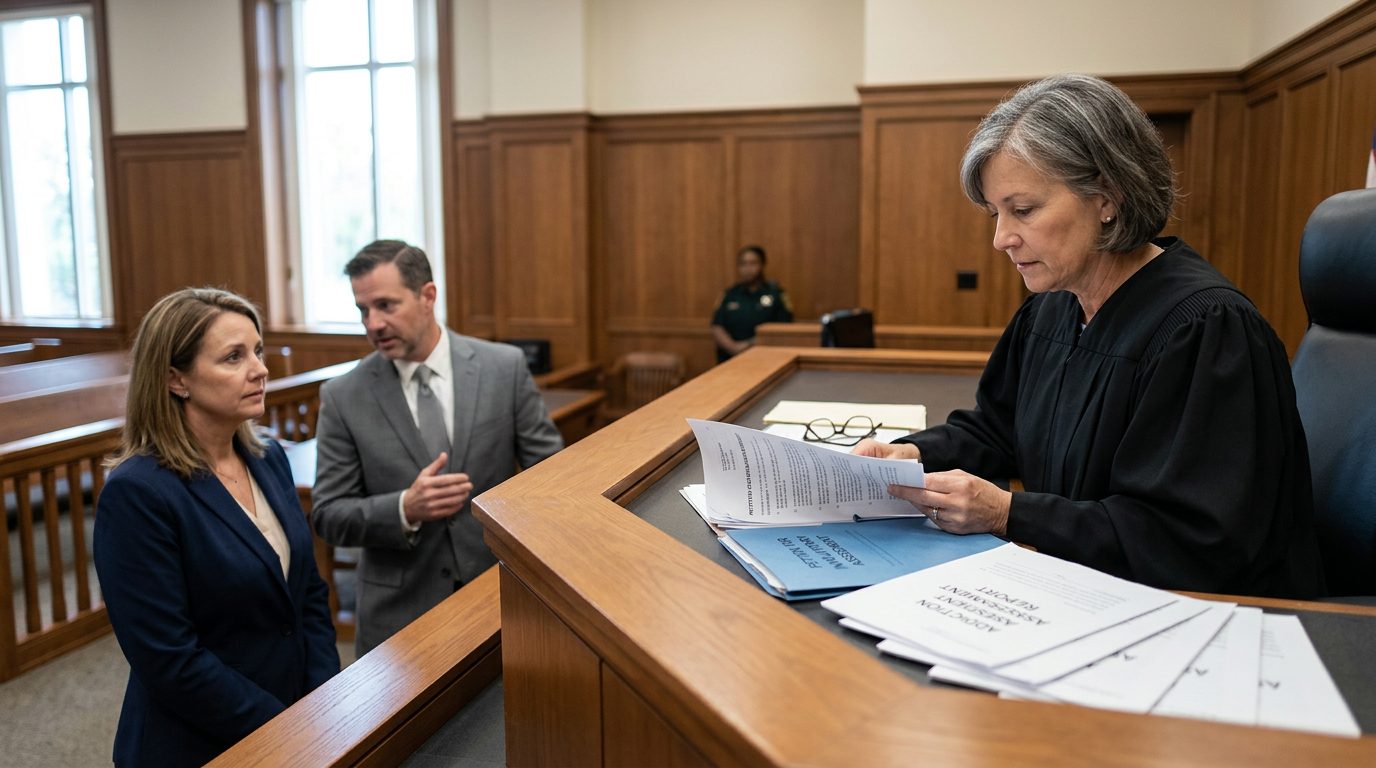
Florida Marchman Act and Guardianship Guide
Marchman Act or Guardianship for Addiction: Understanding Your Options in Florida
Robinson Casey focuses exclusively on Marchman Act petitions and guardianship matters. Learn how these two paths differ, then speak with Richard J. Casey III, Esq. about your family's situation.
By Richard J. Casey III, Esq. · Published October 17, 2026
The Marchman Act and guardianship are two separate Florida court routes. Under Fla. Stat. § 744.331, notice of the filing of a petition to determine incapacity, with copies of the petitions, must be served on and read to the alleged incapacitated person, and copies must also be given to that person’s attorney and served on all next of kin identified in the petition. Which route fits depends on the facts, and the court decides.
Two Florida processes, two different legal tracks
The Marchman Act and guardianship are separate statutory schemes. They don’t work the same way, and they answer different questions.
One of the criteria in section 397.675 is that the person has lost the power of self-control with respect to substance abuse. The section lists other criteria that must also be met, and the court decides whether they are. It covers involuntary assessment, stabilization, and treatment for substance-use impairment. Guardianship of an adult found incapacitated is addressed in chapter 744, Florida Statutes.
A family may look at one track, the other, or both. The court decides which, if either, applies. Other requirements may apply to each route.
If your question centers on court-ordered treatment, start with our parent guide on involuntary commitment for addiction.
If your adult child's drinking or drug use is putting their safety or money at risk, our team can help you sort out which route fits your facts. Talk it through with our team — the first consultation is free, confidential, and carries no obligation.

Side-by-side comparison of the two routes
The Marchman Act asks whether an adult meets substance-use criteria. Guardianship and capacity research asks whether an adult is incapacitated and needs someone to hold decision-making authority.
| Point | Marchman Act (ch. 397) | Guardianship (ch. 744) |
|---|---|---|
| Governing statute | § 397.675 sets involuntary admission criteria | § 744.334 sets petition contents for a guardian |
| Primary subject | Substance-use impairment | An adult’s incapacity and the authority a court assigns |
| Question for the court | Whether criteria for involuntary treatment are met | Whether the adult is incapacitated and what authority a guardian needs |
| Who may file, as the statute states | For an adult: spouse or legal guardian, any relative, a service provider, or an adult with direct personal knowledge (§ 397.68112) | An adult may execute a petition to determine incapacity |
| What the petition must show | Factual allegations of the need for services (§ 397.68141) | Verified facts, the extent of guardianship sought (plenary or limited), and why alternatives fall short (§ 744.334) |
| Range of orders | Involuntary treatment for up to 90 days when proved by clear and convincing evidence (§ 397.697) | Appointment of a guardian with rights removed and delegated as the court orders (§ 744.3215) |
| What it does not address | Appointing a guardian to hold an adult’s rights | Court-ordered substance-use treatment as such |
It does not list every required finding. Other requirements may apply, and the court decides. Hearing and order timing depend on the court’s schedule and discretion.
What the Marchman Act addresses under chapter 397
A Marchman Act petition asks a court to consider whether an adult’s substance-use impairment calls for assessment, stabilization, or involuntary treatment. The criteria appear in § 397.675. Florida Marchman Act overview
The statute requires a good faith reason to believe the person is substance abuse impaired. The person must also have lost the power of self-control with respect to substance abuse. The statute says “mere refusal to receive such services does not constitute evidence of lack of judgment.”
When a petitioner asserts emergency circumstances, the court may rely solely on the petition. Under § 397.6818, the court may then enter an ex parte order without appointing an attorney. A provider may not hold the person for more than 72 hours of observation, unless listed exceptions apply.
The court decides how these points apply to a given case.
What guardianship under chapter 744 addresses
Guardianship under chapter 744 is a probate court process. A judge may appoint a guardian for an adult found incapacitated, and the court sets the scope of that authority.
An adult may execute a petition to determine incapacity. The petition must be verified and must state the facts behind the belief of incapacity. Under § 744.334, the petition must also state whether the guardianship is plenary or limited. Fla. Stat. § 744.334 refers to any other type of guardianship under part III of this chapter, and a petition must state the extent of guardianship desired, either plenary or limited.
Emergency temporary guardianship works differently. Under § 744.3031, a court may appoint an emergency temporary guardian after a petition is filed. The court must find that imminent danger appears. The statute says the emergency authority expires 90 days after appointment or when a guardian is appointed, whichever occurs first. It may be extended for another 90 days if emergency conditions still exist.
A guardian is a fiduciary. Under § 744.361, the guardian may exercise only the rights removed from the ward and delegated to the guardian. Guardianship focuses on the adult’s rights and decisions. A Marchman petition focuses on substance-use treatment.
Which situations point toward each route
A situation centered on substance-use impairment may point toward the Marchman Act track. That fits when the question is assessment, stabilization, or treatment. A situation centered on an adult’s broader ability to manage personal or financial decisions may point toward guardianship.
Take two examples. In the first, an adult’s drinking has led to dangerous driving, and the adult refuses help. Refusal alone does not show lack of judgment under the statute. So the facts about impairment and harm matter a great deal.
In the second, an adult’s drug use has led to lost income, unpaid bills, and confusion about money. The main concern is the adult’s capacity to manage property and decisions. That concern may point toward guardianship.
Neither route is better. Each fits a different set of facts, and the court decides.
When the two tracks overlap and how the court decides
One situation can touch both chapters.
A guardian may not commit a ward to a facility without specific court authority, and without formal placement proceedings under chapter 393, 394, or 397 (§ 744.3215).
Not sure what your next step is?
Talk it through with our team — the first consultation is free, confidential, and carries no obligation.

Questions to bring to a consultation
Before you call, gather a few facts. Write down recent substance-use events and any safety concerns you have seen. Collect any court papers, orders, or notices you have received. Note where the adult is living now, because location can matter to where a petition is filed.
Under § 397.68111, the statute addresses who may be the subject of a petition for involuntary treatment. Its listed alternative conditions, such as an assessment by a qualified professional within the period the statute specifies, apply in addition to the requirement that the person reasonably appears to meet the criteria of § 397.675. Other requirements may also apply, and the court decides whether the petition should be granted. Bring any assessment records you have. Other requirements may apply.
Consider a parent deciding whether a Marchman petition or a guardianship filing fits an adult child whose drinking puts the child’s safety and bank account at risk. Sorting the facts above is a useful first step.
The first consultation is free, confidential, and carries no obligation to continue. To talk through your situation, call Robinson Casey at (561) 849-4149 or request a consultation.
This page is the responsibility of Richard J. Casey III, Esq., of Robinson Casey.
Frequently asked questions
Who can file a Marchman Act petition?
For an adult, § 397.68112 lists a spouse or legal guardian, any relative, a service provider, or an adult with direct personal knowledge. Other requirements may apply, and the court decides.
How long can involuntary treatment last?
Under § 397.697, the court may order treatment for up to 90 days when clear and convincing evidence supports it.
How long does emergency temporary guardianship last?
Under § 744.3031, the authority expires 90 days after appointment or when a guardian is appointed, whichever comes first.
How the two paths differ
Marchman Act petitions
It is generally focused on addiction and treatment, not on managing a person's overall affairs.
Guardianship proceedings
Courts may tailor guardianships to be full, limited, temporary or focused on mental health needs.
The court decides
Each path has its own requirements, and other requirements may apply. Who may file, what evidence is considered and what the court orders depend on the statute and on the court's discretion and the facts of each case.
Families and loved ones
Many questions arise when a loved one's addiction or health puts them at risk. Understanding the differences between these processes is a useful first step before deciding how to proceed.
Important information
This page is general information, not legal advice. Every case is different, and no result can be promised. Other requirements may apply, and the court decides based on the law and the evidence presented.
Matters we handle
Emergency temporary guardianship
Information on temporary guardianship requests that a court may consider when a person's immediate needs call for it.
Mental health guardianship
Support for families navigating guardianship matters connected to a person's mental health, with each case decided by the court.