
Marchman Act Attorney · Miami-Dade
Intervention or Court Order? Understand Your Options Before You Decide
Robinson Casey focuses on Marchman Act petitions and guardianship matters for families in Miami-Dade, South Florida, and across the state.
How Robinson Casey Approaches Your Matter
Confidential Conversations
Your first consultation is free, confidential, and carries no obligation to continue.
Clear Explanations
We walk you through the difference between a voluntary professional intervention and a court-filed Marchman Act petition.
Built Around Families
Our team works with spouses, relatives, and guardians who are facing difficult decisions about a loved one's care.
Direct Access
Call (561) 849-4700 to speak with our team about your family's situation.
Casey III, Esq. · Published November 7, 2026
Intervention vs Court Order for Addiction in Florida
If your loved one's drinking or drug use has become dangerous, you don't have to weigh these two paths alone. Call us to talk through your family's facts. Talk it through with our team — the first consultation is free, confidential, and carries no obligation.

Where Your Family Stands Right Now
A professional intervention is a planned, family-led meeting that asks your loved one to accept treatment. A Marchman Act petition is a request to a court, and a judge decides whether to order help. Both paths aim at getting your loved one into care, but they work in very different ways.
Maybe your loved one’s drinking or drug use has become dangerous. Maybe they keep refusing help, and you feel you have run out of options. Many families reach this point worn out and scared, while trying to make a decision for someone who has not asked for it.
This page compares the two paths so you can understand the choice before you decide anything. It covers who decides, whether a court is involved, what each step requires of you, and what to prepare. It is written for adult family members, including parents, spouses, adult children, and siblings.
Robinson Casey focuses on Marchman Act petitions and guardianship matters. This page explains the court path in plain language, and it also explains the voluntary path so you can compare them side by side.
What a Professional Intervention Is
A professional intervention is a planned meeting that family members organize, often with a trained interventionist. Its goal is to persuade a loved one to accept treatment. Everything about it is voluntary.
Preparation is the heart of an intervention. Family members decide in advance what each person will say. They describe specific events, not general labels, and they agree on how the family will respond. Many families also line up a treatment placement before the meeting, so a yes can turn into a next step that same day.
Families should settle consequences before the meeting. Any consequence the family names, such as changing money support or living arrangements, is one they must be ready to carry out. A threat the family won’t follow usually weakens the message and makes the next conversation harder.
No court is involved in an intervention. No judge reviews it, and no court order is issued. If your loved one says no, the meeting ends there, and the family cannot require treatment through that meeting alone. That limit is the most important thing to understand about this path.
What the Marchman Act Is and What a Petition Does
The Marchman Act is the Florida law that lets a court order assessment and treatment for a person with substance abuse impairment. It is a court process, not a criminal one, and a petition is the written request that starts it.
A petition must be filed with the clerk of the court in the county where the person is located. The clerk may not charge a fee to file it. The alleged impaired person is named as the respondent. Fla. Stat. § 397.681 sets out these rules.
Location matters. The petition belongs in the county where the person is physically located when filed.
Who may file depends on the relationship. For an adult respondent, a spouse or legal guardian, any relative, a service provider, or an adult with direct personal knowledge of the impairment may file. Fla. Stat. § 397.68112 lists these petitioners.
Intervention vs Court Order Addiction Florida: Key Differences
Short answer: an intervention depends on your loved one’s choice, while a Marchman Act petition puts the decision with a judge. The table below shows the main differences.
| Question | Professional intervention | Marchman Act petition |
|---|---|---|
| Who makes the decision | Your loved one, after a family meeting | A judge, after a court hearing |
| Is a court involved | No | Yes |
| Is a court order issued | No | Possibly, if the statutory criteria are met |
| Does the loved one get notice | No formal notice process | Yes, the respondent receives a copy of the petition and a notice of hearing |
| If the loved one refuses | The meeting cannot compel treatment | The court process continues under the statute |
The notice rule comes from Fla. Stat. § 397.68151. It requires a copy of the petition and notice of hearing to go to the respondent and other specified people.
The biggest difference is the power to decide. An intervention is persuasion. A court petition asks a judge to make findings under the statute.
Signs an Intervention May Not Be Enough
Short answer: an intervention may not be enough when your loved one refuses planned conversations or when use puts someone at serious risk. These are questions to talk through with a lawyer, not a checklist that gives you an answer on its own.
Families often ask themselves a few questions:
- Has your loved one turned down every planned conversation or meeting?
- Does the use put your loved one or someone else at immediate risk of physical harm?
- Have earlier voluntary attempts, such as a treatment program, stalled or ended early?
Florida’s involuntary admission criteria focus on impairment and loss of self-control. The person must have lost the power of self-control with respect to substance use, and must also either need substance abuse services with judgment so impaired that they cannot appreciate that need or make a rational decision about it, or be likely to neglect themselves or inflict harm, under Fla. Stat. § 397.675. Under Fla. Stat. § 397.675, a person meets the criteria for involuntary admission if there is good faith reason to believe that the person is substance abuse impaired or has a substance use disorder and a co-occurring mental health disorder and, because of such impairment or disorder, has lost the power of self-control with respect to substance abuse and either (2)(a) is in need of substance abuse services and, by reason of substance abuse impairment, is so impaired in judgment that he or she is incapable of appreciating that need and of making a rational decision about it, although mere refusal to receive such services does not constitute evidence of lack of judgment about that need; or (2)(b) without care or treatment, is likely to suffer neglect or refuse to care for himself or herself, that neglect or refusal poses a real and present threat of substantial harm to his or her well-being, and it is not apparent that such harm may be avoided through the help of willing, able, and responsible family members or friends or the provision of other services, or there is a substantial likelihood that the person has inflicted, or threatened or attempted to inflict, or, unless admitted, is likely to inflict, physical harm on himself, herself, or another.
The statute also says that mere refusal to receive services does not, by itself, show a lack of judgment about the need for services. Fla. Stat. § 397.675 reads: “(b) Without care or treatment, is likely to suffer from neglect or refuse to care for himself or herself; that such neglect or refusal poses a real and present threat of substantial harm to his or her well-being; and that it is not apparent that such harm may be avoided through the help of willing, able, and responsible family members or friends or the provision of other services, or there is substantial likelihood that the person has inflicted, or threatened to or attempted to inflict, or, unless admitted, is likely to inflict, physical harm on himself, herself, or another.” That matters. Your loved one’s “no” alone does not settle the question.
For a fuller look at when involuntary treatment comes up, read signs an adult child needs treatment.
Not sure what your next step is?
Talk it through with our team — the first consultation is free, confidential, and carries no obligation.
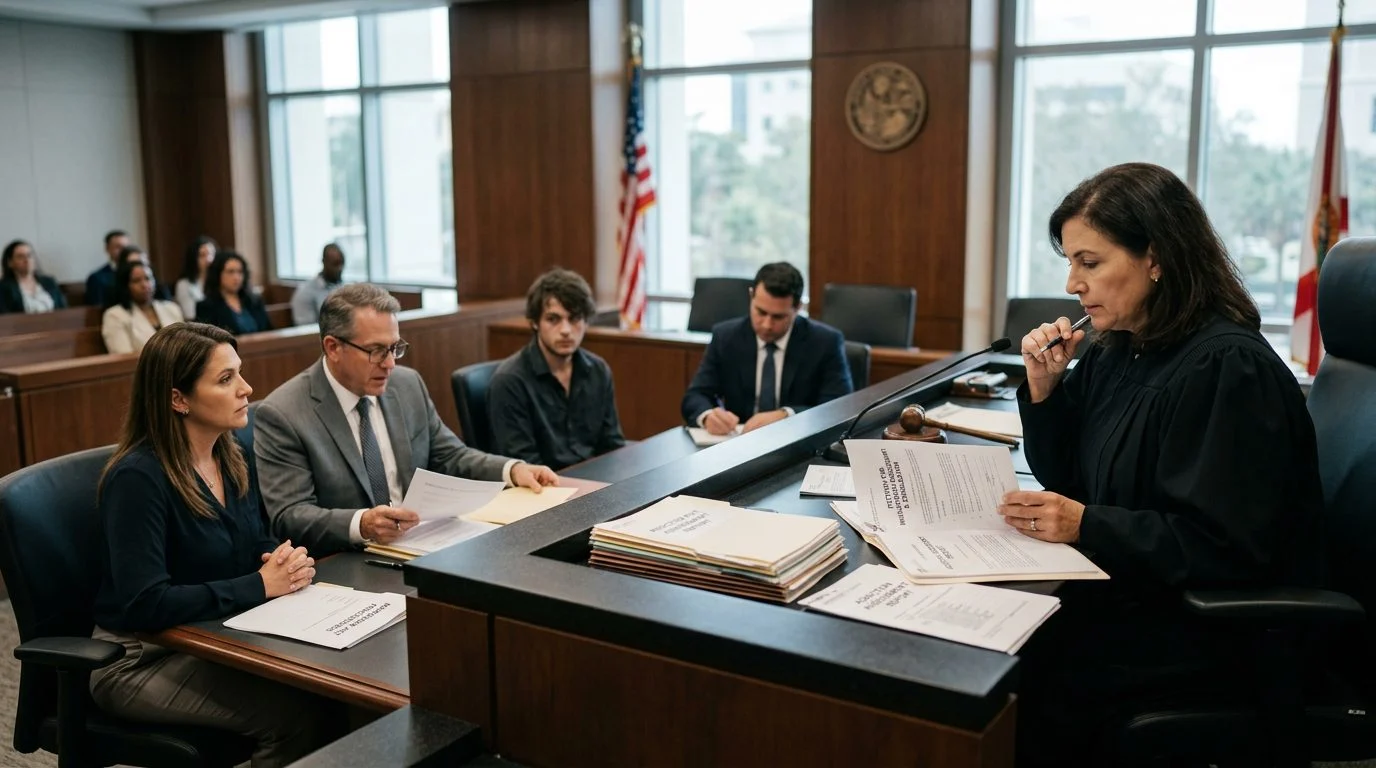
How a Marchman Act Case Moves Through Court
Short answer: a Marchman Act case starts with a petition, moves to a hearing, and ends with a judge’s findings and any order. The court, not the family, makes those findings.
After filing, the court must schedule a hearing within 10 court working days unless a continuance is granted. Fla. Stat. § 397.68151 sets this timing.
The standard rule in Fla. Stat. § 397.68151 is a hearing within 10 court working days unless a continuance is granted, but in an emergency the court can act sooner. In an emergency, the court may rely solely on the petition’s contents and, without the appointment of an attorney, enter an ex parte order for assessment and stabilization under § 397.6818(1), which must be executed during the period when the hearing on the petition for treatment is pending. Separately, under Fla. Stat. § 397.68151, upon the filing of a petition the court shall immediately determine whether the respondent is represented by an attorney or whether appointing counsel is appropriate. Fla. Stat. § 397.6818 covers this step.
For an ex parte order when the respondent does not appear, the court acts after reviewing the petition, testimony and evidence, and must reasonably believe the respondent meets the commitment criteria and that a substance abuse emergency exists; under § 397.6818(4), the order is valid for 90 days. In J.C. v. State, the Fifth District reversed an order where the trial court questioned the only witness when the petitioner was absent. Florida districts have split on that question, and the Fourth District has certified conflict in J.J.J. v. D.G.. In C.W.R.K. v. Stewart Marchman Act Behavioral Healthcare, the appellate court held that the trial court failed to follow the governing statute when, with the petitioner absent, it called and questioned the health care professional who executed the involuntary services certificate.
The Loved One’s Rights During a Court Process
Short answer: the person named in a petition has rights, including counsel, notice, and a hearing. These rights keep the process fair to both the family and the loved one.
A respondent has the right to counsel at every stage of the proceeding. The respondent may give up that right only if present and the court finds the waiver is knowing, intelligent, and voluntary.
A person who cannot afford a lawyer may apply to the court for one.
At the hearing, the respondent must be present unless a valid waiver applies or presence would be harmful. Testimony is taken under oath, and the respondent may refuse to testify.
The court may hear testimony from family members who know the respondent’s history. That is why firsthand facts matter more than rumor or secondhand accounts. Court petitions and related records are also confidential. Fla. Stat. § 397.6760 covers that protection.
Can the Two Paths Work Together?
Short answer: many families try a planned intervention first and consider a court petition if the loved one still refuses or the danger grows. The right order depends on the facts, timing, and urgency of your situation.
Some families decide that waiting for a planned meeting is not safe. If anyone faces immediate danger, contact emergency services right away. Do not wait for a family meeting or a court date.
The most common mistake is waiting too long while the danger grows. The second is relying on general statements, such as “he’s always been like this,” instead of specific dated events. A court needs facts it can check.
The statute also limits what a petition can say. It must state the reasons for your belief about impairment and about the loss of self-control. Fla. Stat. § 397.68141 lists those requirements.
For a plain-language look at how a court record may affect daily life, read how a court record affects daily life.
What to Gather Before Making the Call
Short answer: write down dated facts, the people who were present, and any injuries, overdoses, or police contact. Keep your records in one place.
Start with a simple written timeline. For each event, note the date, what was said or done, who was there, and any injury, overdose, or police contact. Stick to what you saw or heard yourself.
Save records you already have. These can include text messages, photos, emergency visit paperwork, and the names of people who saw what happened. Note any assessments your loved one has had or refused.
A petition must say whether your loved one was assessed before filing, and if not, whether they refused. Those details come from Fla. Stat. § 397.68141.
Treatment program records may carry federal privacy protections. Those rules generally require consent or a court order before records are shared. Read the federal addiction record privacy rules for the details.
Preparing these notes does not commit you to any course of action. It simply helps you describe the situation clearly, whether you choose an intervention or a court path.
Local Context for Miami-Dade and South Florida Families
Short answer: Florida’s Marchman Act is the same statewide law, but families file through their local clerk’s office. The Miami-Dade Clerk of Courts provides that guidance.
A petition must be filed with the clerk of the court in the county where the person is located, and the courts have jurisdiction of involuntary treatment petitions for substance abuse impaired persons.
Families in Miami-Dade can read the Miami-Dade guide to involuntary treatment for more local detail.
Robinson Casey serves families across South Florida and statewide. Responsible attorney for this page: Richard J. Casey III, Esq.
If your loved one's drinking or drug use has become dangerous, you don't have to weigh these two paths alone. Call us to talk through your family's facts. Talk it through with our team — the first consultation is free, confidential, and carries no obligation.

Taking the Next Step
Choosing between an intervention and a court petition is hard, especially while you watch someone you love struggle. You don’t have to sort out the path on your own.
Quick Answers
Is a professional intervention legally binding?
No. An intervention is voluntary, and no court order is issued through it.
Who can file a Marchman Act petition for an adult?
A spouse or legal guardian, any relative, a service provider, or an adult with direct personal knowledge may file.
Can a respondent refuse to testify?
Yes. The respondent may refuse to testify at the hearing.
Robinson Casey offers a free first consultation, which is confidential and carries no obligation to continue (Spanish: consulta inicial gratuita, confidencial y sin compromiso). Call (561) 849-4700 or visit our contact page to talk through the facts of your family’s situation.
If Someone Is in Immediate Danger
If a person's safety is at risk, call 911 right away. Do not wait for an intervention to be arranged when there is an emergency.
Matters Robinson Casey Handles
Marchman Act Petitions
Court filings under Florida's Marchman Act concerning an adult's substance use and need for assessment or treatment.
Involuntary Commitment for Addiction
Guidance on court-ordered substance use assessment and treatment proceedings in Florida.
Guardianship Matters
Plenary, limited, and mental health guardianship petitions for adults who need a court-appointed decision-maker.
Emergency Temporary Guardianship
Urgent guardianship filings for situations where an incapacitated person needs immediate protection while a case proceeds.