
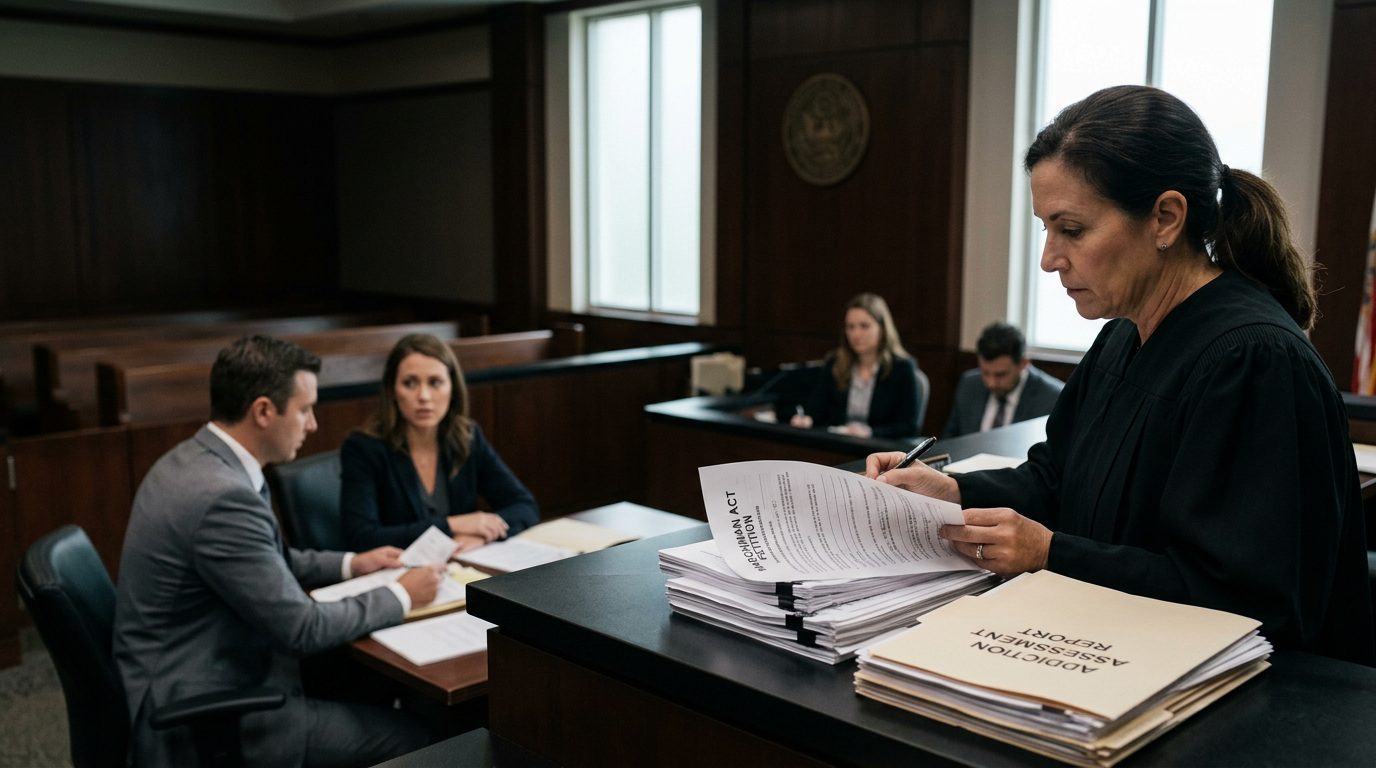
Marchman Act & Guardianship | Miami-Dade and South Florida
Robinson Casey focuses exclusively on Marchman Act petitions and guardianship matters for families across South Florida and statewide. Our first consultation is free and confidential.
By Richard J. Casey III, Esq. · Published October 18, 2026
A Marchman Act case is about an adult’s treatment, not custody. A Marchman Act petition asks a Florida court to assess and treat an adult whose substance use is impaired. It does not, by itself, decide where a child lives. But the same family facts can matter in a custody or parenting-time dispute, so timing and records count. This page explains how a Marchman Act child custody question differs from the treatment process when a parent has an addiction in Florida.
How the Marchman Act Works in Florida
The Marchman Act is Florida’s civil court process for assessing and treating an adult with a substance use problem. Under the current text, a judge may act when there is a good faith reason to believe the person is substance abuse impaired, or has a substance use disorder and a co-occurring mental health disorder, and has lost the power of self-control (Fla. Stat. § 397.675).
The person must also meet one of two tests. Either the person cannot understand the need for help or make a rational choice about it, or the person is likely to neglect self-care in a way that poses a real and present threat of substantial harm that cannot be avoided through willing, able, and responsible family members or friends or other services, or there is a substantial likelihood the person has inflicted, or threatened or attempted to inflict, or unless admitted is likely to inflict, physical harm on himself, herself, or another. The statute also says that mere refusal of services is not, by itself, evidence of impaired judgment.
For an adult, the list of people who may file includes a spouse or legal guardian, any relative, a service provider, or an adult who has direct personal knowledge of the impairment and of the person’s prior course of assessment and treatment (Fla. Stat. § 397.68112). The petition goes to the clerk of the county where the person is located (Fla. Stat. § 397.681).
In an emergency, the court may rely solely on the petition and, without appointing an attorney first, enter an ex parte order for the person’s involuntary assessment and stabilization while the treatment hearing is pending (Fla. Stat. § 397.6818). If the court later finds the conditions proved by clear and convincing evidence, it may order treatment for up to 90 days (Fla. Stat. § 397.697).
If a parent's drug or alcohol use is putting your children at risk and that parent refuses help, our team can walk you through your options, and you don't have to face it alone. Talk it through with our team — the first consultation is free, confidential, and carries no obligation.

Does a Marchman Act Case Affect Child Custody?
No, not automatically. A Marchman Act case is about the adult’s treatment. Custody and parenting time for children are decided separately, in family court. The petition asks for treatment. It is not a custody order.
The two tracks can overlap, though. Facts about a parent’s drug or alcohol use can come up in both. Treatment records have limits. Federal law keeps substance use treatment records confidential. Except with the patient’s consent or a court order granted after an application showing good cause, neither those records nor testimony relaying the information in them may be disclosed or used against the patient in civil, criminal, administrative, or legislative proceedings conducted by any Federal, State, or local authority.
Florida law does not restrict reporting suspected child abuse or neglect to authorities. Even when a report of suspected child abuse and neglect is made, the provider’s original substance abuse records remain protected, including their use in civil or criminal proceedings that arise from that report.
How Florida Courts Weigh Substance Abuse in a Parenting Decision
Courts in custody and time-sharing cases look at each child’s needs and each parent’s ability to meet them. Substance use is one fact among many. The judge weighs it against the whole record.
Evidence can include a parent’s treatment participation, sobriety history, and specific safety concerns. An example is a child left alone while a parent is impaired. Specific, dated facts are easier for a judge to weigh than general labels. How time-sharing is set or changed depends on the facts.
The person who files a Marchman petition carries the burden of proof. If the court finds that the conditions for involuntary treatment services have been proved by clear and convincing evidence, it may order the respondent to receive involuntary treatment services from a publicly funded licensed service provider for a period not to exceed 90 days (Fla. Stat. § 397.697(1)(a)).
A parent who seeks involuntary admission of a minor must take part in all aspects of treatment, as the provider’s director decides (Fla. Stat. § 397.6759). Outcomes vary by case. No article can predict how a particular judge will rule.
When an Adult Child or Spouse Refuses Treatment
But refusal alone is not enough. The petition must contain the name of the respondent, the name of the petitioner, and the relationship between them, along with the factual allegations explaining the reasons for the petitioner’s belief that the respondent is substance abuse impaired and has lost the power of self-control because of that impairment (Fla. Stat. § 397.68141). It must also explain the risk of physical harm, or why refusal reflects impaired judgment.
A petition may include a report from a qualified professional who examined the person within 30 days before filing. If the person was not assessed or refused evaluation, the petition must say so.
Many families feel stuck because the adult insists nothing is wrong. Our guide on an adult child who denies a problem covers that situation.
The Act covers both inpatient and outpatient treatment. Outpatient treatment requires support from a case manager or a responsible person the court appoints. Unless an exception applies, the person must also have an assessment from a qualified professional or licensed physician expressly recommending outpatient services, the services must be available in the county, and it must appear likely that the person will follow the plan (Fla. Stat. § 397.697).
How Guardianship Can Fit Alongside a Marchman Act Case
Guardianship is a different tool. A Marchman petition deals with substance use treatment.
Robinson Casey limits its practice to Marchman Act petitions and guardianship matters. That includes emergency temporary, limited, plenary, and mental health guardianships.
A court may appoint an emergency temporary guardian only after a petition for determination of incapacity has been filed, and only when it specifically finds imminent danger that the person’s physical or mental health or safety will be seriously impaired, or that the person’s property is in danger of being wasted, misappropriated, or lost, unless immediate action is taken (Fla. Stat. § 744.3031). Notice of the petition and hearing must be served on the alleged incapacitated person and on that person’s attorney at least 24 hours before the hearing is commenced, unless the petitioner demonstrates that substantial harm to the alleged incapacitated person would occur if the 24-hour notice is given. In an incapacity case, each member of the examining committee must file his or her report with the clerk of the court within 15 days after appointment (Fla. Stat. § 744.331).
Some families face both issues. The two tools can be used together, depending on the adult’s condition and the family’s goals. Their purpose, timing, and required findings differ, so the choice needs care.
Practical Steps for Protecting Children During a Parent’s Crisis
Start a written record now. A petition must explain the reasons behind the family’s belief about impairment and risk. Specific facts do that job better than general worry.
Gather dates and times of concerning incidents, text messages and voicemails, and school or medical notices. Note who was present. Write down each child’s routine, caregivers, school, and medical needs.
Keep a simple timeline. Write what you saw or heard, when it happened, and who else was there. Leave out guesses.
Follow every existing court order exactly. Keep conversations with the children calm and steady. Don’t ask them to carry the adult’s problem.
If child welfare is already involved, the Guardian ad Litem materials explain that parental drug abuse can lead to court-ordered services and drug testing in dependency cases (Guardian ad Litem practice guide).
Not sure what your next step is?
Talk it through with our team — the first consultation is free, confidential, and carries no obligation.

Talk With Robinson Casey About Your Family’s Situation
Reading about a parent’s addiction while your children are at home is hard. You may not know which step fits yet, and that’s normal.
Does a Marchman Act case change custody automatically?
No. The petition asks for treatment, and custody is decided separately in family court.
Who can file a Marchman Act petition for an adult?
For an adult respondent, a spouse or legal guardian, any relative, a service provider, or an adult who has direct personal knowledge of the impairment and of the prior course of assessment and treatment may file.
Does the adult get a lawyer?
Yes. The person named in the petition has the right to counsel at every stage, which the person may waive only if present and the court finds the waiver made knowingly, intelligently, and voluntarily. If the court believes the person needs or desires counsel, the court shall appoint one, whatever the person’s wishes, and an indigent respondent may receive court-appointed counsel.
If a parent’s drug or alcohol use is putting your children at risk and that parent refuses help, our team can walk you through your options, and you don’t have to face it alone. Call (561) 849-4149 or request a consultation. The first consultation is free, confidential, and carries no obligation to continue. Richard J. Casey III, Esq., is the responsible lawyer for this page.
Matters We Handle
Marchman Act Petitions
Petitions asking a Florida court to assess and treat an adult whose substance use is impaired, including involuntary commitment for addiction.
Guardianship Matters
Guardianship attorney services covering emergency temporary, plenary, and limited guardianship, along with mental health guardianship.
Emergency Situations
Emergency temporary guardianship matters that require prompt attention when a family member's safety or well-being is at immediate concern.
How Robinson Casey Works With Families
Built Around Your Family
We listen first to the people closest to the situation and explain the process in plain language.
Organized Records
We help you gather and organize the court, treatment, and family documents that matter most.
Clear Communication
You will know what to expect at each step, with direct answers to your questions.
Statewide Reach
Serving families in Miami-Dade, across South Florida, and throughout the state.