
Marchman Act Petitions · South Florida & Statewide
Caring for an Adult Child Who Lives in Another State? Here's How a Marchman Act Petition Can Work.
Robinson Casey focuses on Marchman Act petitions and guardianship matters for families across South Florida and statewide. Your first consultation is free, confidential, and carries no obligation to continue.
By Richard J. Casey III, Esq. · Published October 28, 2026
When Your Adult Child Is Hundreds of Miles Away
The answer depends on where your child is physically located when the petition is filed.
Maybe the call came from a hospital in another state. Maybe it came from a jail, or from a police department far away. Or maybe there has been only silence since the last relapse. You’re at home, trying to work out what can be done from a distance.
Your fears are probably specific. You worry about an overdose that doesn’t end well. You worry about an arrest, or about your child sleeping in a car or a shelter. You’ve already paid for treatment, tried interventions, and held firm on boundaries. Your child still keeps getting worse, and you’re worn out.
This page answers one legal question: can Florida’s Marchman Act reach an adult who lives outside Florida?
If your adult child lives in another state and you aren't sure what a Florida petition could mean for them, you don't have to work through it alone; call Robinson Casey at (561) 849-4149 to talk through the facts. Talk it through with our team — the first consultation is free, confidential, and carries no obligation.

What the Marchman Act Is in Florida
The Marchman Act is a Florida court process for people whose substance use has caused them to lose the power of self-control. It sits in Chapter 397 of the Florida Statutes. The Marchman Act’s rules on who may file, where, and what a judge must find are set out in several sections; the linked Chapter 397 section protects the rights of individuals receiving substance abuse services, such as dignity and communication.
A case begins with a petition, which is a written request asking a judge to act. The person the petition is about is called the respondent. For an adult, Section 397.68112 allows a spouse or legal guardian, any relative, a service provider, or an adult who has direct personal knowledge of the respondent’s substance abuse impairment and his or her prior course of assessment and treatment to file. A parent is a relative, so a parent may file.
The criteria are the center of the case. Section 397.675 says a person qualifies if there is good faith reason to believe the person is substance abuse impaired. The person must also have lost self-control because of that impairment. The person must then either need services and lack the judgment to see that need, or, without care, be likely to neglect himself or herself in a way that poses a real and present threat of substantial harm, where it is not apparent that such harm may be avoided through the help of willing, able, and responsible family members or friends or the provision of other services; or be substantially likely to harm self or others. Fla. Stat. § 397.675 reads: “(b) Without care or treatment, is likely to suffer from neglect or refuse to care for himself or herself; that such neglect or refusal poses a real and present threat of substantial harm to his or her well-being; and that it is not apparent that such harm may be avoided through the help of willing, able, and responsible family members or friends or the provision of other services, or there is substantial likelihood that the person has inflicted, or threatened to or attempted to inflict, or, unless admitted, is likely to inflict, physical harm on himself, herself, or another.”
One detail surprises many parents. The same statute says mere refusal to receive services does not by itself show a lack of judgment.
For the full overview, read our involuntary commitment for addiction guide.
Can a Florida Marchman Act Reach an Adult Child Who Lives in Another State?
A Florida petition is filed in the county where the adult child is physically located. That location is the first fact to check. Section 397.681 requires involuntary treatment petitions to be filed with the clerk of the court in the county where the person is located. The clerk may not charge a fee for filing that petition.
For a child outside Florida, the question gets harder. A Florida court’s power over someone who is outside the state is a legal question. It turns on where the child is, where you live, and what the facts show.
A Florida case shows how location works in practice. In J.P. v. J.N., the respondent was physically in one county while the petition was filed in another. The Fifth District Court of Appeal held that the wrong filing did not take away the circuit court’s jurisdiction. However, the filing of the petition in the wrong county did not divest the circuit court in Putnam County of jurisdiction. (J.P. v. J.N., 225 So. 3d 410 (Fla. 5th DCA 2017))
A child who is in Florida when you file raises different questions than a child who lives in another state. Florida petitions also depend on proof. Our guide to evidence for a Marchman Act petition explains what a petition generally rests on.
How Out-of-State Families Use the Marchman Act
Out-of-state families usually face one of three situations. A Florida parent may have an adult child living in another state. An adult child may travel into Florida during a crisis. Or a family may be split across state lines, with a child in a hospital in one state and parents in another. In each case, the child’s physical location and the parent’s own location both matter.
A Florida petition does not change the law of the state where your child lives. Before acting, families should understand which court handles which part of the matter.
Some out-of-state matters need a lawyer licensed in the other state. When that happens, the matter may be referred to another lawyer or firm. The family should know which lawyer handles each part.
Co-occurring conditions add another layer. Section 397.675 covers a person who has a substance use disorder and a co-occurring mental health disorder. If your child has both, our guide on psychosis, drug use and involuntary treatment in Florida covers that overlap.
Before You Talk: Decide What the Conversation Is For
Before any legal step, you may still talk with your adult child. An adult child makes many decisions for themselves. Your strongest tool is a clear, factual message, not a claim of authority over their life.
Decide what the talk is for before you start. Name the specific event that worries you, such as the overdose or the hospital visit. Name one next step you want, such as an assessment. Pick a calm moment, not the middle of a crisis. Our guide on talking with your adult child before a petition walks through how to open that conversation.
Be clear about who decides. A parent cannot order an adult child into treatment alone. Under Section 397.697, a court may order involuntary treatment services when the conditions are proved by clear and convincing evidence. Legal process exists for the case where a child refuses help.
Common Approaches That Tend to Shut the Conversation Down
Ultimatums without a plan, threats to cut off money or housing, public arguments, and lectures after every relapse often end the conversation. Each one leaves a parent with no next step to follow through on.
A calm, specific message usually leaves more room. Say what you saw, what worries you, and what you will do next. Only promise what you can actually carry out. A demand you can’t follow through on weakens the rest of what you say.
Keep a written record. Write down dates, hospital and police contacts, names of staff you spoke with, and what your child said. Those facts matter if the family goes to court. The court hears relevant evidence, including testimony from family members familiar with the respondent’s prior history (Section 397.6957).
Not sure what your next step is?
Talk it through with our team — the first consultation is free, confidential, and carries no obligation.
How a Marchman Act Case Generally Moves Through Court
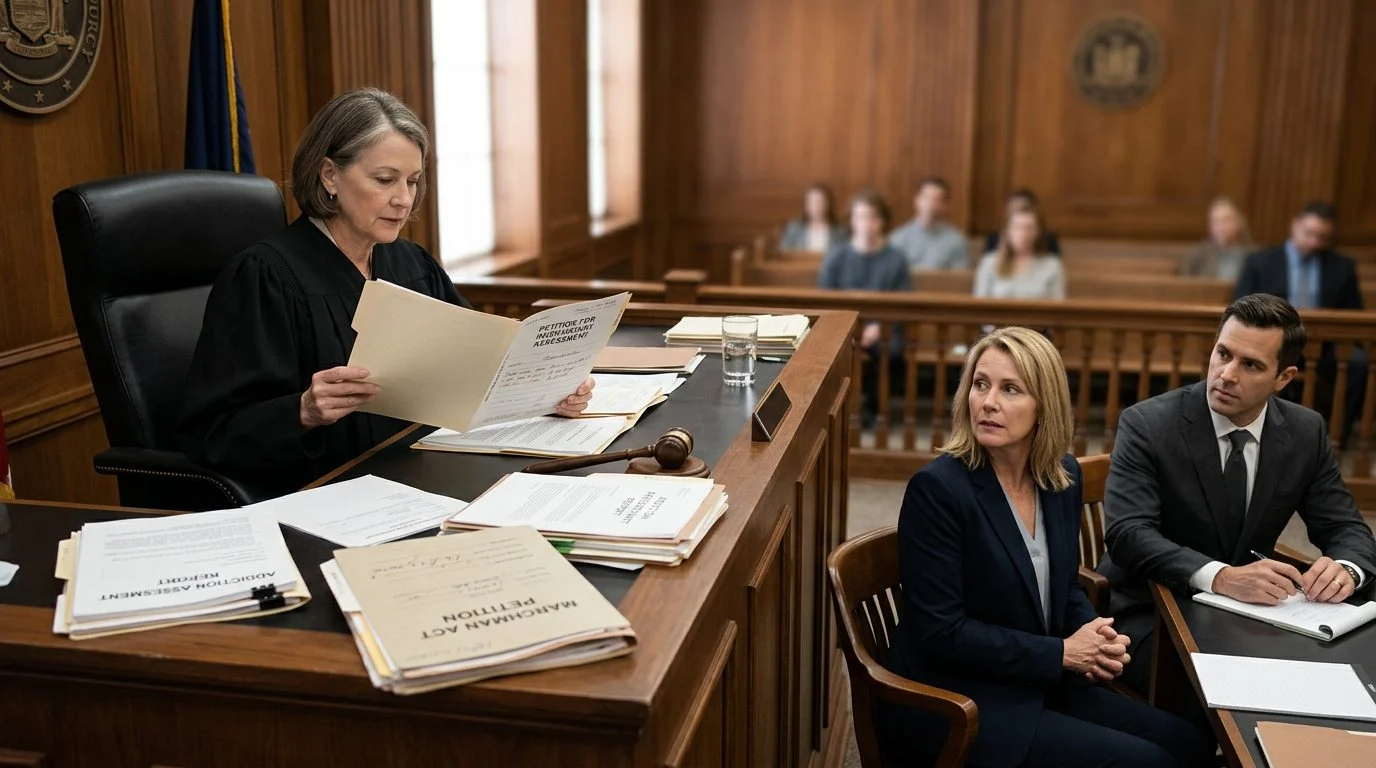
A Marchman Act case generally moves from a filed petition to a hearing, with orders in between, as Chapter 397 sets out. Timing and results turn on the court and the facts. No one can predict how a specific case will proceed.
The court must schedule a hearing within 10 court working days unless a continuance is granted (Section 397.68151). The respondent may waive counsel only if present and the court finds the waiver knowing, intelligent, and voluntary (Section 397.681). A respondent who cannot afford a lawyer may ask for appointed counsel (Section 397.681).
Section 397.681 does not address how testimony is taken; it provides that a respondent has the right to counsel at every stage of a judicial proceeding relating to a petition for involuntary treatment. The respondent may refuse to testify at the hearing (Section 397.6957). In an emergency, a court may enter an ex parte order, one entered without a hearing for the other side, for assessment and stabilization without first appointing an attorney (Section 397.6818).
Case law also matters. In the Fifth District, a court may not call and question the professional when the petitioner is absent, according to the Fifth District opinion in C.W.R.K.. The Fourth District opinion in J.J.J. reached a different result and certified a conflict. That point is not settled across Florida, and the 2024 amendments may affect the dispute.
Court records are confidential. Under Section 397.6760, petitions for involuntary assessment and stabilization, court orders, and related records that are filed with or by a court under this part are confidential and exempt from public records rules. Guardianship is a different tool.

Not Sure What Your Next Step Is?
The next step is to put your child’s facts in one place. You don’t have to sort them out alone. You may be at home, trying to decide what can be done for someone you love who is far away.
Bring the specifics: where your child is now, what happened most recently, what treatment was tried, and any hospital or police contact. Those details shape whether a Florida petition fits the situation. If your child is in immediate danger, the Florida Department of Health notes that Florida residents can contact 988 for immediate crisis support.
Can a Florida Marchman Act petition reach an adult child in another state?
The answer turns mainly on where the child is physically located when the petition is filed. Petitions go to the clerk in the county where the person is located.
Who can file a Marchman Act petition for an adult?
A parent is a relative.
Does an adult child have a right to a lawyer?
Yes. The respondent has the right to be represented by counsel in any judicial proceeding for involuntary treatment services, and can ask the court to appoint an attorney if unable to pay.
Families in Miami-Dade can also read our Miami-Dade page. If you are weighing a Florida petition for a child in another state, call Robinson Casey at (561) 849-4149 or request a consultation. The first consultation is free, confidential, and comes with no obligation to continue.
How Robinson Casey Supports Families
A Focused Practice
Robinson Casey limits its practice to Marchman Act petitions and guardianship matters, so your questions are handled by a firm that works in these areas every day.
Confidential Conversations
Families often share painful and private details. Our consultations are confidential, so you can speak openly about your situation.
Clear Explanations of the Process
We walk you through the petition process in plain language, so you understand what is involved before you decide on a next step.
Across South Florida and Statewide
We serve families in Miami-Dade and throughout South Florida, and we help families with matters across Florida.
Support for the Whole Family
Our team works with families through difficult decisions, keeping communication clear and respectful at every stage.
Every Situation Is Different
Details such as where your adult child is physically living can affect how a Marchman Act petition or guardianship matter proceeds. Share your facts with us so we can discuss your options.
Matters We Handle
Marchman Act Petitions
Guidance on filing a petition under the Florida Marchman Act for a loved one struggling with substance use.
Involuntary Commitment for Addiction
Help understanding involuntary commitment proceedings and what they may involve for your family.
Guardianship Matters
Support with plenary, limited, and mental health guardianship matters across Florida.
Emergency Temporary Guardianship
Assistance with urgent guardianship needs when a family faces an immediate concern.