
Marchman Act Evidence | South Florida & Statewide
Building a Clear Record for Your Marchman Act Petition
Learn which records and witnesses can support a Marchman Act petition, and how Robinson Casey focuses on helping families gather and organize what the court needs to see.
By Richard J. Casey III, Esq. · Published November 1, 2026
If your adult child keeps getting worse, you may be asking what evidence is needed for a Marchman Act Florida petition. The short answer: the court needs facts. Those facts usually come from clinical findings, medical and treatment records, witness accounts, police and court records, and a dated family timeline.
Richard J. Casey III, Esq., is responsible for this page.
Why Evidence Matters When a Family Files a Marchman Act Petition
A petition has to rest on specific facts from the very first step. Evidence is not something you add later.
Many parents reach this point after years of paying for treatment and setting boundaries. A recent overdose, hospital stay, or disappearance can push a family to look for a legal path. The Marchman Act is a Florida court process for assessment and treatment of substance use.
The statute lists what a petition must include. It names the respondent (the person the petition is about), the petitioner (the person filing), and their relationship. It also lists the facts showing why the petitioner believes the respondent is impaired, has lost self-control over substance use because of that impairment, and either has caused or is likely to cause physical harm to self or others, or refuses care because substance use has so impaired their judgment that they cannot appreciate their need for care. Fla. Stat. § 397.68141 sets out those requirements.
For the full process, read our Marchman Act overview.
If you're holding discharge papers and worrying about a child who keeps getting worse, you don't have to sort through them alone. Talk with our team about what you have. Talk it through with our team — the first consultation is free, confidential, and carries no obligation.

What the Court Looks For: Impairment and Serious Risk
The court looks for impairment, loss of self-control, and a serious risk or a lack of judgment about treatment. Fla. Stat. § 397.675 sets out these criteria.
The petitioner needs a good-faith reason to believe the person is impaired. The impairment must have caused the person to lose the power of self-control over substance use.
The statute then gives two paths. The person needs services but cannot appreciate that need. Or, without care or treatment, the person is likely to neglect their own care or refuse to care for themselves, and that neglect or refusal poses a real and present threat of substantial harm that cannot apparently be avoided through willing, able, and responsible family members or friends or other services; or there is a substantial likelihood the person has inflicted, threatened, or attempted physical harm on themselves or others, or, unless admitted, is likely to inflict such harm. Refusing services alone does not prove a lack of judgment.
Timing matters too. Fla. Stat. § 397.68111 states these timing rules.
Medical and Treatment Records That Show the Pattern
Emergency room, detox, and treatment records can show a pattern over time. Useful records often include:
- Emergency and hospital records for overdoses or medical complications
- Detox and stabilization admission papers
- Prior inpatient and outpatient treatment history
- Discharge notes, prescription histories, and appointment letters
Dates matter. Several admissions across a few months tell a clearer story than one visit. Gather what you already have and bring it to your consultation.
Treatment records can be harder to use. Under 42 C.F.R. § 2.64, a court may authorize use of patient records in a noncriminal case only after a good-cause finding. That means other ways of getting the information are unavailable or ineffective, and the public interest outweighs the potential injury to the patient.
Doctors and Licensed Professionals Who Examine the Person
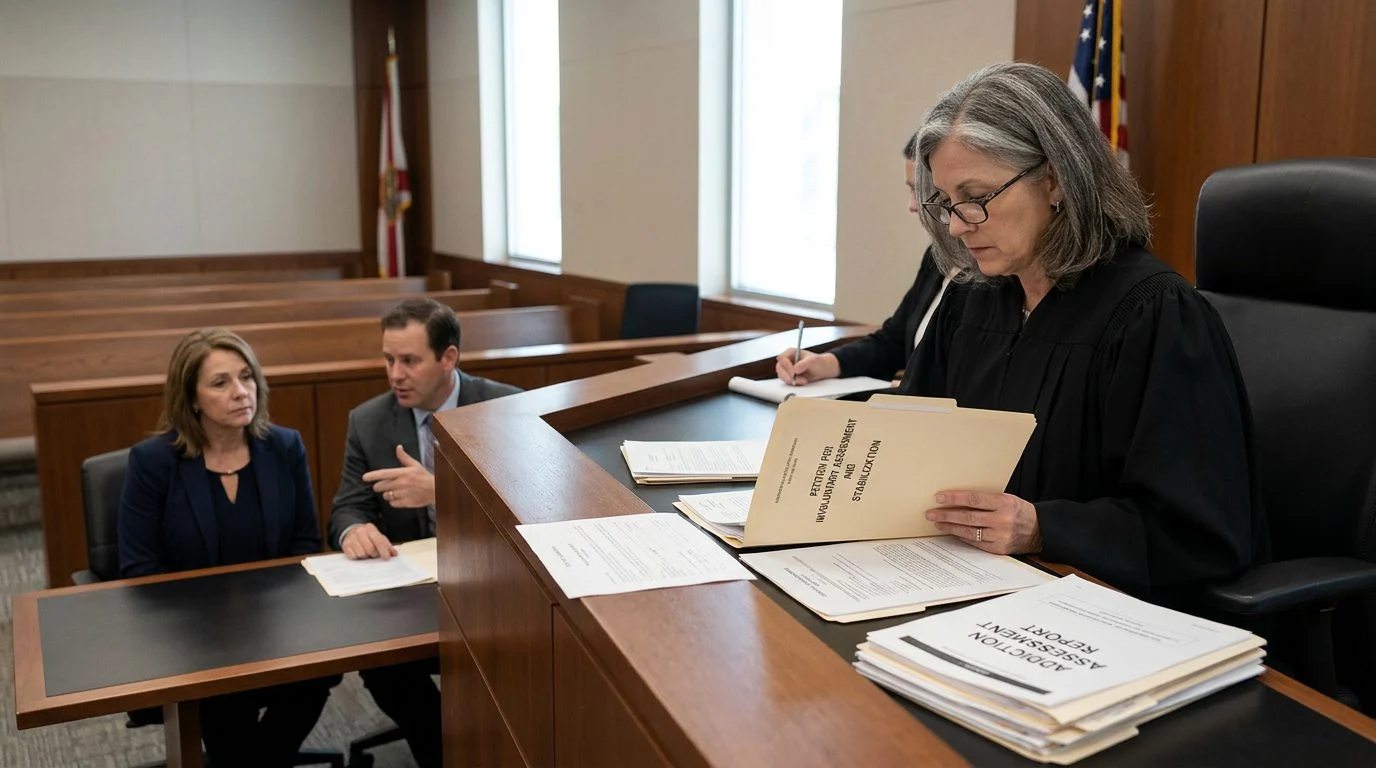
A clinical assessment by a qualified professional is often the central medical evidence. The petition may include a report from a professional who examined the person within 30 days before filing. Fla. Stat. § 397.68141 says the report should include findings and treatment recommendations. If the person was not assessed or refused, the petition must say so.
Under Fla. Stat. § 397.6957, the court must hear and review all relevant evidence, including the results of the assessment completed by the qualified professional, and any treatment order must include findings on the respondent’s need for treatment and on less restrictive alternatives. Under Fla. Stat. § 397.6957, the respondent must be present at the hearing unless the court finds that the respondent knowingly, intelligently, and voluntarily waives the right to be present, or, after receiving proof of service and evaluating the circumstances of the case, that the respondent’s presence is inconsistent with his or her best interests or is likely to be injurious to self or others.
The report must reach the clerk by the close of business the day before the hearing. It must recommend a level of treatment and note any co-occurring mental health needs. A report that omits a treatment recommendation, or that recommends no treatment, leads to dismissal of the petition.
Give the evaluator your dated observations in writing. A clinician’s opinion is only as strong as the facts behind it.
Witnesses: Family, Friends, Employers, and Others Who Saw the Conduct
People who saw the conduct firsthand can give sworn testimony about specific events. At the hearing, the court hears family members familiar with the person’s history and how it relates to their current condition. Testimony is taken under oath, and the proceedings are recorded.
Firsthand accounts are more useful than what someone else told you. Write down who saw what, when, and where, while the details are fresh. Stick to facts and avoid guessing.
Witnesses matter because the petitioner carries the burden of proof. In J.C. v. State, the Fifth District reversed when the trial court questioned the only witness after the petitioner was absent. The Fourth District reached a different result in J.J.J. v. D.G. and certified conflict.
Police, Incident, and Court Records
Police reports, arrest records, and court files can document incidents tied to safety and risk. Examples include a welfare check, a property damage report, or a missing-person report. Keep copies of each report, with case numbers and dates. Don’t rely on memory alone.
Marchman Act records are protected. Under Fla. Stat. § 397.6760, petitions, court orders, and related records are confidential. The clerk may not publish personal identifying information on a public docket.
If your child also has a pending criminal case, ask counsel how that affects the petition.
Not sure what your next step is?
Talk it through with our team — the first consultation is free, confidential, and carries no obligation.
The Family’s Own Timeline and Documentation
A dated timeline shows what happened and what the family already tried. Start with the first warning signs and move forward to the latest crisis. For each entry, note the date, what happened, who was present, and where.
Add these items:
- Texts and voicemails that show the person’s condition
- Photos, with dates as the phone recorded them
- Receipts for treatment and medication costs
- Notes on past interventions, boundaries, and what followed
Keep originals. Don’t edit, crop, or delete anything. Share the full set with counsel, not only the helpful items.
A petition’s facts can be verified by a written declaration. Under Fla. Stat. § 92.525, the signer declares that the facts stated are true under penalties of perjury. Fla. Stat. § 92.525 reads: “(2) A written declaration means the following statement: “Under penalties of perjury, I declare that I have read the foregoing [document] and that the facts stated in it are true,” followed by the signature of the person making the declaration, except when a verification on information or belief is permitted by law, in which case the words “to the best of my knowledge and belief” may be added.” Knowingly making a false declaration is a third-degree felony. Check every date before you sign.
How the Evidence Is Used: Hearings and the Respondent’s Rights
Under Fla. Stat. § 397.6975, a court may order renewed involuntary treatment services for a period not to exceed an additional 90 days, and the renewal petition must be filed before the court-ordered services period expires.
For a petition to renew involuntary treatment services, the court must immediately schedule a hearing within 10 court working days, to be held not more than 15 days after filing of the petition, under Fla. Stat. § 397.6975. Fla. Stat. § 397.6975 reads: “The hearing is conducted pursuant to ss. 397.6957 and 397.697 and must be held before the circuit court unless referred to a magistrate.” The respondent must receive a copy of the petition and notice of the hearing, under Fla. Stat. § 397.68151.
The respondent has the right to counsel at every stage of the proceeding, however the respondent may waive that right if the respondent is present and the court finds the waiver is made knowingly, intelligently, and voluntarily, under Fla. Stat. § 397.681. The Second District has also held that this right is grounded in due process. See Hillsborough County v. Albrechta.
In an emergency, the court may enter an ex parte order without appointing an attorney, under Fla. Stat. § 397.6818. The Second District held the trial court erred in one such order where the petition did not establish a good-faith reason to believe the criteria were met. See D.H. v. K.J.R.. How a case turns out depends on the facts of that case.

Gaps in the Record, Medication-Assisted Treatment, and Talking Through Your Own Situation
Most families don’t have a complete file. Missing pieces are common, and they don’t mean you have nothing to say. Write down what you could not get and when you asked for it.
If the person takes prescribed medication for opioid use disorder, such as methadone or buprenorphine, that fact affects how the evidence is read. Raise it with counsel before you file.
What is a Marchman Act petition in practice? It is a set of facts, records, and sworn accounts put before a judge. Families who have tried everything else often feel they are doing it alone.
What evidence is needed for a Marchman Act Florida petition?
The petition needs facts showing impairment, loss of self-control, and serious risk or lack of judgment about treatment.
Does a Marchman Act petition need a doctor’s report?
It may include a report from a qualified professional who examined the person within 30 days before filing. If there is none, the petition must say so.
Can a family member testify?
Yes. The court must hear and review all relevant evidence, including testimony from family members familiar with the person’s history.
Are Marchman Act court records public?
Petitions and related records are confidential under Florida law.
If you are holding the records, the timeline, and the worry about a child who keeps getting worse, you don’t have to sort it out alone. Richard J. Casey III, Esq., and our team can review what you have. Our first consultation is free, confidential, and comes with no obligation to continue. Call (561) 849-4700 or request a consultation.
How Robinson Casey Approaches Your Matter
Organized Records
We help you sort medical, treatment, and incident records so the important facts are easy to follow.
Witness Coordination
We help identify people who have seen the concerns firsthand and prepare their information for the case.
Clear Communication
You will know what information we are gathering, why it matters, and what comes next.
Confidential First Step
Your free first consultation is confidential and carries no obligation to continue.
Keep Everything You Have
Do not alter, discard, or throw away documents, messages, or notes that relate to the situation. Write down dates and names while they are fresh, and bring them to your consultation.
Common Types of Evidence
Medical and Treatment Records
Hospital, emergency, and treatment program records can show the history of care and the person's response to it.
Witness Accounts
Family members, friends, employers, and others who have observed the concerns can provide detailed, first-hand information.
Incident and Police Reports
Reports from law enforcement or emergency responders can document specific events and the circumstances around them.
Professional Examination Reports
A written report from a qualified professional who has examined the person can help the court understand the person's condition.