
Marchman Act Petitions | Miami-Dade and South Florida
Marchman Act Petition Evidence: What Florida Families Need
Learn what kinds of evidence support a Marchman Act petition for substance use, and how Robinson Casey helps families organize it.
By Richard J. Casey III, Esq. · Published October 25, 2026
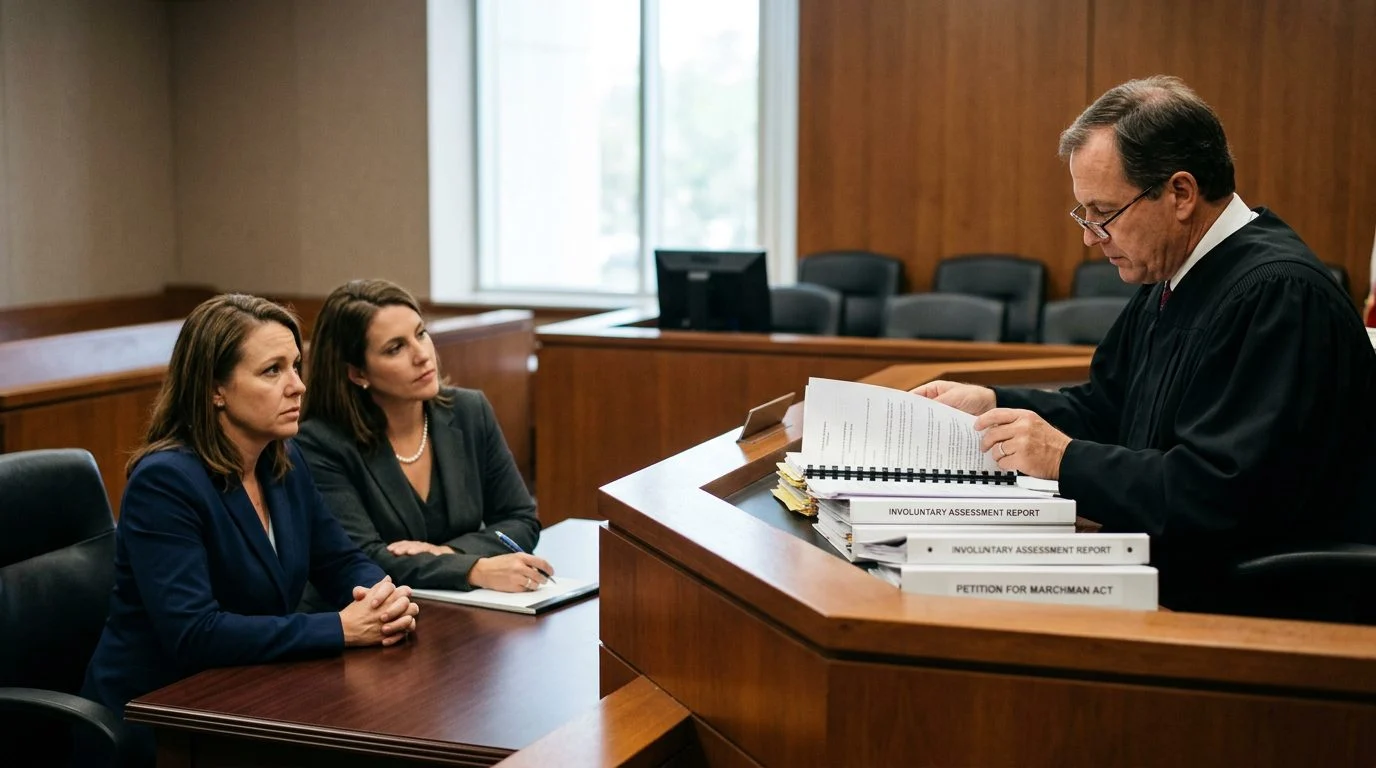
A Marchman Act petition asks a Florida court to order help for a person whose substance use puts them or others at risk. The petition must rest on facts. If you’re asking what evidence do I need for a marchman act petition florida, the short answer is a clear, sworn account of specific behavior, the reasons you believe impaired judgment is involved, and any records you have. This guide walks through each category, using the Florida statutes that set out what a petition must say.
Who Files a Marchman Act Petition and What It Must Show
For an adult, a petition can be filed by a spouse or legal guardian, any relative, a service provider, or an adult with direct personal knowledge of the person’s impairment and prior assessment and treatment (Fla. Stat. § 397.68112).
It needs the respondent’s name, the petitioner’s name, the relationship between them, the respondent’s attorney’s name if known, and factual allegations giving the reasons behind each belief (Fla. Stat. § 397.68141). Those reasons cover why the person seems impaired, why that impairment has caused a loss of self-control, and either why the person has inflicted or is likely to inflict physical harm on himself, herself, or others unless the court orders services, or why the person’s refusal to get care is based on judgment so impaired that he or she cannot appreciate the need for care or make a rational decision about it.
The clerk may not charge a filing fee for the petition (Fla. Stat. § 397.681). Under Fla. Stat. § 397.681(1), such petitions must be filed with the clerk of the court in the county where the person is located. In Miami-Dade, the Miami-Dade Clerk’s mental health court page directs adult petitions to the Probate Court.
If you're worried about someone you love and unsure what proof a court would need, we're glad to talk it through with you. Talk it through with our team — the first consultation is free, confidential, and carries no obligation.

The Affidavit: Firsthand Observations Carry the Petition
The strongest petitions rest on sworn statements from people who saw the behavior themselves. Many people call this an affidavit. When a document must be verified, Florida law allows a signed written declaration with set wording (Fla. Stat. § 92.525). Under Fla. Stat. § 92.525(2), a written declaration is the statement “Under penalties of perjury, I declare that I have read the foregoing [document] and that the facts stated in it are true,” followed by the declarant’s signature. It must be printed or typed at the end of or immediately below the document and above the signature. The words ‘to the best of my knowledge and belief’ may be added only when a verification on information or belief is permitted by law.
Knowingly making a false declaration is a crime. It is perjury by false written declaration, a third-degree felony (Fla. Stat. § 92.525). Sign only what you know is true.
Write down dates, places, what you saw or heard, and what the person said. A label like “addicted” or “out of control” is hard for a judge to test. A sentence such as “On June 3, he drove with our child in the back seat and nearly hit a guardrail” gives the court something to weigh. Describe only what you saw or learned directly. Don’t guess about use you never saw.
Evidence of Substance Use and Impairment of Judgment
The core test is impaired self-control or judgment, not drinking or drug use alone. A person must have lost the power of self-control with respect to substance use (Fla. Stat. § 397.675). The person must also either be unable to appreciate the need for help and make a rational decision about it (mere refusal alone is not evidence of that), or be likely to neglect themselves in a way that poses a real and present threat of substantial harm, and it is not apparent that such harm may be avoided through the help of willing, able, and responsible family members or friends or the provision of other services; or there is a substantial likelihood the person has inflicted, threatened, or is likely to inflict physical harm on himself, herself, or another.
Evidence of impairment includes missed meals, unpaid rent, skipped medical care, unsafe driving, and children left without supervision. Money that disappears and lost jobs also matter. Attach a date and a result to each example.
Evidence of use can include what you saw, containers or other items you found, and statements the person made to you. Police or emergency room contacts with report numbers help too. Quote words exactly as they were said.
Recent, specific examples usually give a petition more support than a general history. Families dealing with fentanyl can read our fentanyl Marchman Act guide for more detail.
Evidence the Person Refused or Could Not Accept Voluntary Treatment
Refusing help is not enough by itself. The statute says that “mere refusal to receive such services does not constitute evidence of lack of judgment” (Fla. Stat. § 397.675). Fla. Stat. § 397.675 reads: “(b) Without care or treatment, is likely to suffer from neglect or refuse to care for himself or herself; that such neglect or refusal poses a real and present threat of substantial harm to his or her well-being; and that it is not apparent that such harm may be avoided through the help of willing, able, and responsible family members or friends or the provision of other services, or there is substantial likelihood that the person has inflicted, or threatened to or attempted to inflict, or, unless admitted, is likely to inflict, physical harm on himself, herself, or another.” Refusing help is not enough by itself: the statute says that “mere refusal to receive such services does not constitute evidence of lack of judgment” (Fla. Stat. § 397.675). Fla. Stat. § 397.675 reads: “(b) Without care or treatment, is likely to suffer from neglect or refuse to care for himself or herself; that such neglect or refusal poses a real and present threat of substantial harm to his or her well-being; and that it is not apparent that such harm may be avoided through the help of willing, able, and responsible family members or friends or the provision of other services, or there is substantial likelihood that the person has inflicted, or threatened to or attempted to inflict, or, unless admitted, is likely to inflict, physical harm on himself, herself, or another.” A petition relying on refusal must show that the refusal reflects impaired judgment, while a petition may instead rely on a risk of harm.
Useful documents include offers of help the person turned down, with dates. Texts and emails that show those offers help. So do records of past treatment and how it ended, and statements the person made about treatment. A short earlier treatment can still show a pattern.
It may include a professional’s certificate or report from an exam done within 30 days before filing (Fla. Stat. § 397.68141). Link each refusal either to a risk of physical harm to self or others unless the court orders services, or to a refusal based on judgment so impaired by substance abuse that the person is incapable of appreciating his or her need for care and of making a rational decision about that need.
Records, Messages, and Third-Party Witnesses
Texts, call logs, and photos carry weight because they show dates. Keep the originals. Screenshot messages with the date visible, and don’t edit or summarize them. Employer or school notices, police report numbers, and hospital discharge papers also help.
Neighbors, coworkers, and relatives who saw the behavior can serve as witnesses. The court hears testimony from family members familiar with the person’s history and how it relates to the current condition (Fla. Stat. § 397.6957).
The clerk may not publish personal identifying information in a public file (Fla. Stat. § 397.6760). Medical and treatment records have their own privacy rules, so don’t assume you can get them without a legal basis.
Assessment Versus Admission: Different Stages, Different Proof
Many cases start with an assessment. The respondent must be present at the hearing on a treatment petition unless the court finds he or she knowingly, intelligently, and voluntarily waives the right to be present or, upon receiving proof of service and evaluating the circumstances of the case, that his or her presence is inconsistent with his or her best interests or is likely to be injurious to self or others (Fla. Stat. § 397.6957), and the qualified professional’s clinical assessment must be filed with the clerk no later than the close of business the day before the hearing (Fla. Stat. § 397.6957).
In an emergency, the court may rely solely on the petition’s contents and enter an ex parte order for assessment and stabilization (Fla. Stat. § 397.6818). Emergency petitions need specific facts.
If the court finds that proof, it may order up to 90 days of treatment (Fla. Stat. § 397.697).
A Fourth District court disagreed and certified conflict in J.J.J. v. D.G. The 2024 statutory amendments may affect that dispute.
Not sure what your next step is?
Talk it through with our team — the first consultation is free, confidential, and carries no obligation.
Common Questions About Marchman Act Petitions
Whether a filed petition can be withdrawn depends on where the case stands and what the court has already ordered.
Is refusing treatment enough to file?
Does the person have a right to a lawyer?
Yes. The respondent has the right to counsel at every stage. A respondent who desires counsel and is unable to afford private counsel has the right to court-appointed counsel (Fla. Stat. § 397.681).
How is a Marchman Act different from a Baker Act?
The Marchman Act covers substance use. The Baker Act is a separate Florida law for mental health crises. Guardianship is a separate court process from a Marchman Act petition.

Talk With a Florida Marchman Act Attorney Before You File
Watching someone you love struggle with substance use is frightening. Reading about court evidence while you worry about them is a heavy load. You don’t have to sort it out alone. Richard J. Casey III, Esq. is the attorney responsible for this page. Robinson Casey focuses on Marchman Act petitions and guardianship matters for families across Miami-Dade, South Florida, and statewide. Bring your dated notes and documents, and we can review them against these rules. The first consultation is free, confidential, and comes with no obligation to continue. To get started, call (561) 849-4149 or use the contact form.
How Robinson Casey Helps Families
A Focused Practice
Robinson Casey focuses on Marchman Act petitions and guardianship matters for families in South Florida and across Florida.
A Confidential First Step
Your free first consultation is confidential and carries no obligation to continue.
Clear Guidance on Evidence
We help you understand what information to gather and how to organize it before a petition is filed.
Respect for Your Family
We understand how difficult it is to seek help for someone you love, and we approach every matter with care.
Common Types of Evidence Families Gather
Observed Behavior
Dated notes describing specific incidents, changes in behavior, and how substance use has affected daily life at home and at work.
Records and Documents
Medical, pharmacy, employment, or police records that reflect substance use or related harm, where available.
Prior Treatment History
Information about past detox, rehabilitation, or counseling, including what was tried and how the person responded.
Witness Accounts
Statements from family members, friends, or others who have seen the person's condition firsthand.
Start Organizing Early
Notes, records, and witness accounts are easier to gather and organize when they are collected early. Robinson Casey offers a free first consultation that is confidential and carries no obligation to continue. Call (561) 849-4149 to discuss your family's situation with Richard J. Casey III, Esq.