
Marchman Act Petitions · South Florida
What a Judge Looks for in Marchman Act Evidence
Robinson Casey focuses on Marchman Act petitions and guardianship matters for families across South Florida and statewide. Here is how evidence is typically presented, and how to start a conversation with our team.
Casey III, Esq. · Published November 6, 2026
For a Marchman Act petition, that means proof that your loved one is substance abuse impaired, has lost the power of self-control over substance use, and meets one more ground. General worry is not enough. This guide explains each type of proof and how to organize it.
Robinson Casey focuses on Marchman Act petitions and guardianship matters, serving families in Miami-Dade, across South Florida, and statewide. Richard J. Casey III, Esq. is the lawyer responsible for this page. For the basics of Marchman Act representation, see our Marchman Act attorney guide.
What the Judge Must Find Under the Marchman Act
The judge must find a good faith reason to believe your loved one meets the criteria in Fla. Stat. § 397.675. The first part is substance abuse impairment, or a substance use disorder with a co-occurring mental health disorder. The second part is loss of the power of self-control over substance use.
The statute then requires one more ground. Before a court may order involuntary treatment services, the conditions for that treatment must be proved by clear and convincing evidence, under Fla. Stat. § 397.697. That is a high bar, so the facts you gather matter.
If you are trying to protect a loved one whose substance use has become dangerous, we can talk through your dated notes and your questions with you. Talk it through with our team — the first consultation is free, confidential, and carries no obligation.

Evidence of Substance Abuse Impairment and Lost Self-Control
Strong evidence shows a pattern of use that continues even after it has cost your loved one something real. Record the substance, how often it is used, and how the amount or frequency has changed over time. Then list the losses that followed, such as a lost job, a missed court date, a damaged relationship, or an overdose.
Dated examples work far better than broad labels. “Always drinks” tells a judge little. A note such as “On March 3, after drinking all afternoon, your loved one drove home and hit a mailbox” gives the judge something concrete to weigh. Also record failed attempts to stop, relapses after treatment, and promises to quit that were broken. Each one shows a pattern.
Clinicians look at symptoms, daily functioning, and other conditions when they assess substance use disorder, according to this clinical assessment review. Your notes can follow the same areas: what your loved one does, how they function day to day, and what other health problems are present.
Evidence of Incapacity and Impaired Judgment
Incapacity evidence shows that your loved one cannot understand they need help, or cannot make a sound choice about getting it. Refusing help alone does not prove this. The statute says mere refusal to receive services does not, by itself, show lack of judgment about the need for services, per Fla. Stat. § 397.675.
So focus on how judgment works in daily life. Useful observations include denial that a problem exists even when the evidence is clear, confusion about money, missed medical appointments or prescriptions, and turning down help the family offered. Write down what your loved one said, what they did, and the date.
A note like “After the hospital discharged them, they said they were fine and left before the follow-up visit” shows judgment at work. Specific decisions carry more weight than labels such as “not thinking straight.”
Evidence of Neglect or a Substantial Threat of Serious Harm
The statute asks whether, without care or treatment, your loved one is likely to neglect themselves, whether that neglect poses a real and present threat of substantial harm, and whether that harm could be avoided through willing, able, and responsible family members or friends or other services. Fla. Stat. § 397.675 reads: “(b) Without care or treatment, is likely to suffer from neglect or refuse to care for himself or herself; that such neglect or refusal poses a real and present threat of substantial harm to his or her well-being; and that it is not apparent that such harm may be avoided through the help of willing, able, and responsible family members or friends or the provision of other services, or there is substantial likelihood that the person has inflicted, or threatened to or attempted to inflict, or, unless admitted, is likely to inflict, physical harm on himself, herself, or another.”
The statute also covers a substantial likelihood that your loved one has inflicted, threatened, or attempted to inflict physical harm on themselves or another, or is likely to inflict it unless admitted. Under Fla. Stat. § 397.6957, one way to meet the burden at the treatment hearing is to show by clear and convincing evidence that your loved one is substance abuse impaired and has a history of not complying with substance abuse treatment, that because of this impairment they are unlikely to voluntarily take part in the recommended services or are unable to decide for themselves whether services are necessary, and that, without services, they are likely to neglect or refuse to care for themselves, that this poses a real and present threat of substantial harm to their well-being, and that there is a substantial likelihood they will cause serious bodily harm to themselves or another in the near future, as evidenced by recent behavior.
Examples a family might record include driving while impaired, threats made to family or neighbors, falls, overdoses, and violent episodes. Neglect examples include running out of food, going without shelter, or skipping care for a known medical condition. For each event, write the date, the place, what happened, and who saw it. A witness’s name and phone number is worth far more than “the neighbors know.”
What a Petition and Supporting Affidavit Need to Say
A petition must name your loved one as the respondent and name the petitioner. It must state their relationship and list the factual allegations that show the need for services. Under Fla. Stat. § 397.68141, it must also state why you believe your loved one is impaired, why that impairment has caused loss of self-control, and why they pose a risk or refuse care because of impaired judgment.
For an adult, only certain people may file. Under Fla. Stat. § 397.68112, a spouse or legal guardian, any relative, a service provider, or an adult who has direct personal knowledge of your loved one’s substance abuse impairment and prior course of assessment and treatment may file. A report from a qualified professional who examined your loved one within 30 days before filing may accompany the petition. If there was no assessment, or your loved one refused one, the petition must say so.
Facts must be exact. State only what you saw or heard yourself, with dates.
Location matters too. However, the filing of the petition in the wrong county did not divest the circuit court in Putnam County of jurisdiction, as stated in J.P. v. J.N..
Witnesses, Records, and Other Proof a Judge May Consider
Testimony from people who saw events firsthand can carry real weight. Under Fla. Stat. § 397.6957, the court reviews all relevant evidence, including testimony from family members who know your loved one’s history and how it connects to their current condition. Employers, friends, and neighbors who saw a specific event can also testify.
Witnesses may attend remotely and testify under oath by audio-video technology. A witness who plans to do so must give the parties all relevant documents by the close of business the day before the hearing. The court may also order drug tests.
Records can support what witnesses say. Useful examples include law enforcement reports, emergency room records, prior treatment history, and medical or pharmacy information the family lawfully holds. The clinical report must reach the clerk by the close of business the day before the hearing and must include a treatment recommendation. If that recommendation is missing, the petition is dismissed.
Put everything on one timeline in date order. Label each document and match it to a line on the timeline. A judge can follow a clear chronology much faster than a stack of loose papers.
Not sure what your next step is?
Talk it through with our team — the first consultation is free, confidential, and carries no obligation.
How the Court Reviews the Evidence at a Hearing
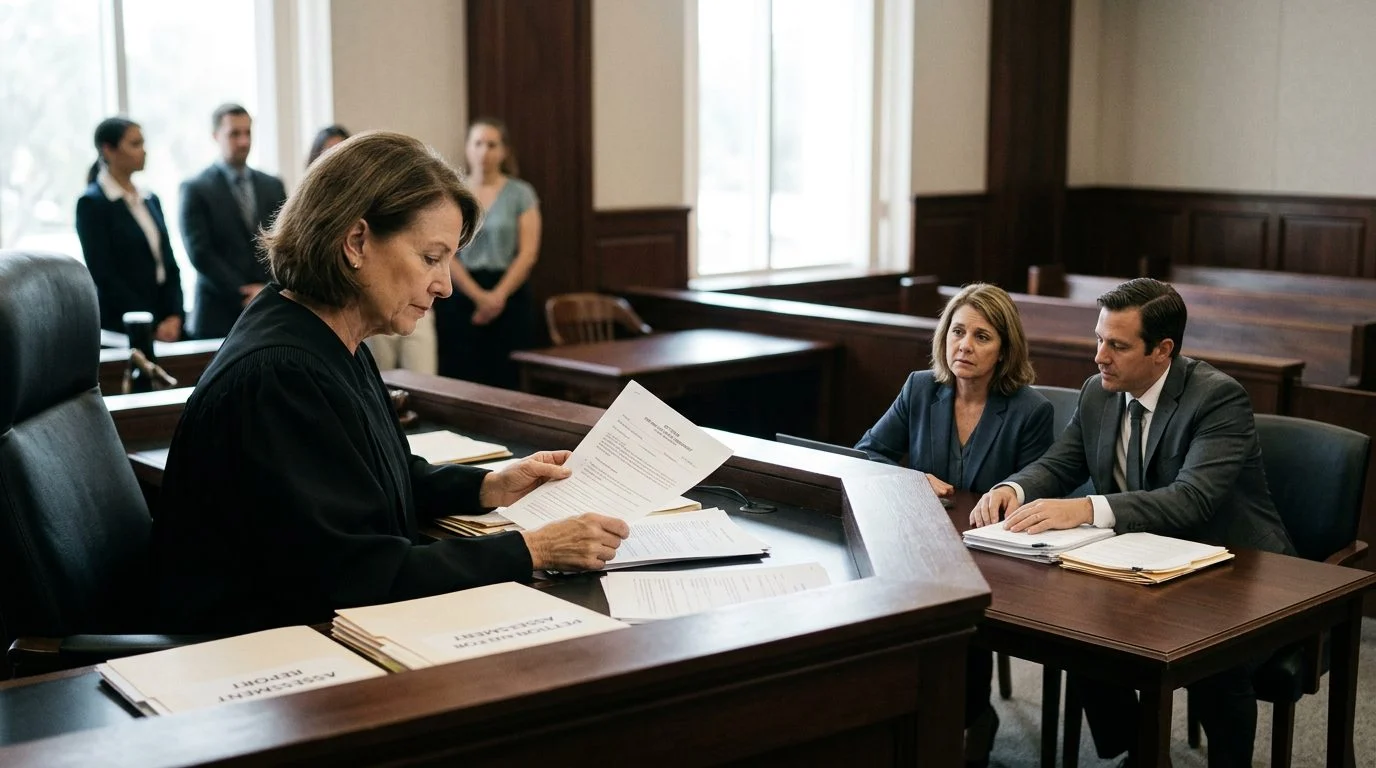
The judge weighs sworn testimony and documents against the statutory criteria. The court must schedule a hearing within 10 court working days unless a continuance is granted, under Fla. Stat. § 397.68151.
Under Fla. Stat. § 397.68151, the court must immediately determine whether your loved one has an attorney or whether appointing one is appropriate. Under Fla. Stat. § 397.681, if the court believes your loved one needs or desires counsel, the court must appoint counsel for him or her without regard to his or her wishes. Your loved one must generally be present at the hearing unless the court makes certain findings, as described in Fla. Stat. § 397.6957.
Florida’s appellate courts have split on one procedure point. In J.C. v. State, the Fifth District reversed where the trial court questioned the only witness while the petitioner was absent. The Fifth District reaffirmed that rule in C.W.R.K. v. Stewart Marchman Act Behavioral Healthcare. The Fourth District has certified conflict with it in J.J.J. v. D.G..
If the court orders involuntary treatment, it may order treatment from a publicly funded licensed provider, or from a privately funded provider if the respondent can pay. Each case turns on its own facts. The result depends on the facts presented, not on general concern.

Talking Through Your Situation With Robinson Casey
If you are gathering facts for someone you love, you are doing it in the middle of a crisis you did not choose. You are trying to protect a person while still learning what the law requires. You do not have to sort out every rule alone.
Bring your dated notes, your timeline, and your questions. Robinson Casey focuses on Marchman Act petitions and guardianship matters in Miami-Dade, South Florida, and statewide. The first consultation is free, confidential, and carries no obligation to continue. Call (561) 849-4700 or request a consultation.
Common Questions
What must a judge find?
The petitioner must prove by clear and convincing evidence that the respondent is substance abuse impaired and has a history of lack of compliance with treatment for substance abuse, and that the statutory grounds for services are met.
Who can file a Marchman Act petition for an adult?
A spouse or legal guardian, any relative, a service provider, or an adult who has direct personal knowledge of your loved one’s substance abuse impairment and prior course of assessment and treatment may file.
Does your loved one have a right to a lawyer?
Yes. The respondent has the right to counsel at every stage, unless he or she waives it while present, and the court finds the waiver is knowing, intelligent, and voluntary; if the court believes the respondent needs or desires counsel, the court must appoint one.
Where is the petition filed?
It is filed in the county where your loved one is physically located at the time of filing.
How Robinson Casey Supports Families
Organized Case Records
We help families assemble dates, incidents, and treatment history into a clear, organized record for the court.
A Focused Practice
Our work centers on Marchman Act petitions and guardianship matters, so each case receives attention from a practice built around these proceedings.
Confidential Conversations
Your first consultation is free, confidential, and carries no obligation to continue.
Direct Access
Call (561) 849-4700 to speak with our team about your family's situation.
Start Writing Things Down Now
Notes made close to the events, such as dates, specific incidents, witnesses, and any prior treatment attempts, can be valuable when you speak with an attorney. Keep them factual and private, and bring them to your consultation.
Matters We Handle
Marchman Act Petitions
Guidance for families seeking court-ordered assessment and services for a loved one struggling with substance abuse.
Guardianship Matters
Help with plenary, limited, and mental health guardianship proceedings in South Florida and statewide.
Emergency Temporary Guardianship
Support for families who need prompt court involvement to protect a person who cannot safely manage their own affairs.
Involuntary Commitment for Addiction
Representation in proceedings that seek treatment for addiction when voluntary care has not succeeded.
Talk With Robinson Casey About Your Family's Situation
Related practice areas
- Involuntary Commitment for Addiction in Florida
- Involuntary Commitment For Addiction in Miami Dade
- Involuntary Commitment For Addiction in South Florida
- Which County to File a Marchman Act Petition in Florida