
Marchman Act Petitions | South Florida
Can a Parent Testify at a Marchman Act Hearing in Florida?
Robinson Casey focuses on Marchman Act petitions and guardianship matters for families across South Florida and statewide. Call (561) 849-4700 for a free, confidential first consultation, with no obligation to continue.
Casey III, Esq. · Published November 8, 2026
Richard J. Casey III, Esq. is responsible for this page.
Short Answer: Yes, a Parent or Family Member Can Testify at a Marchman Act Hearing
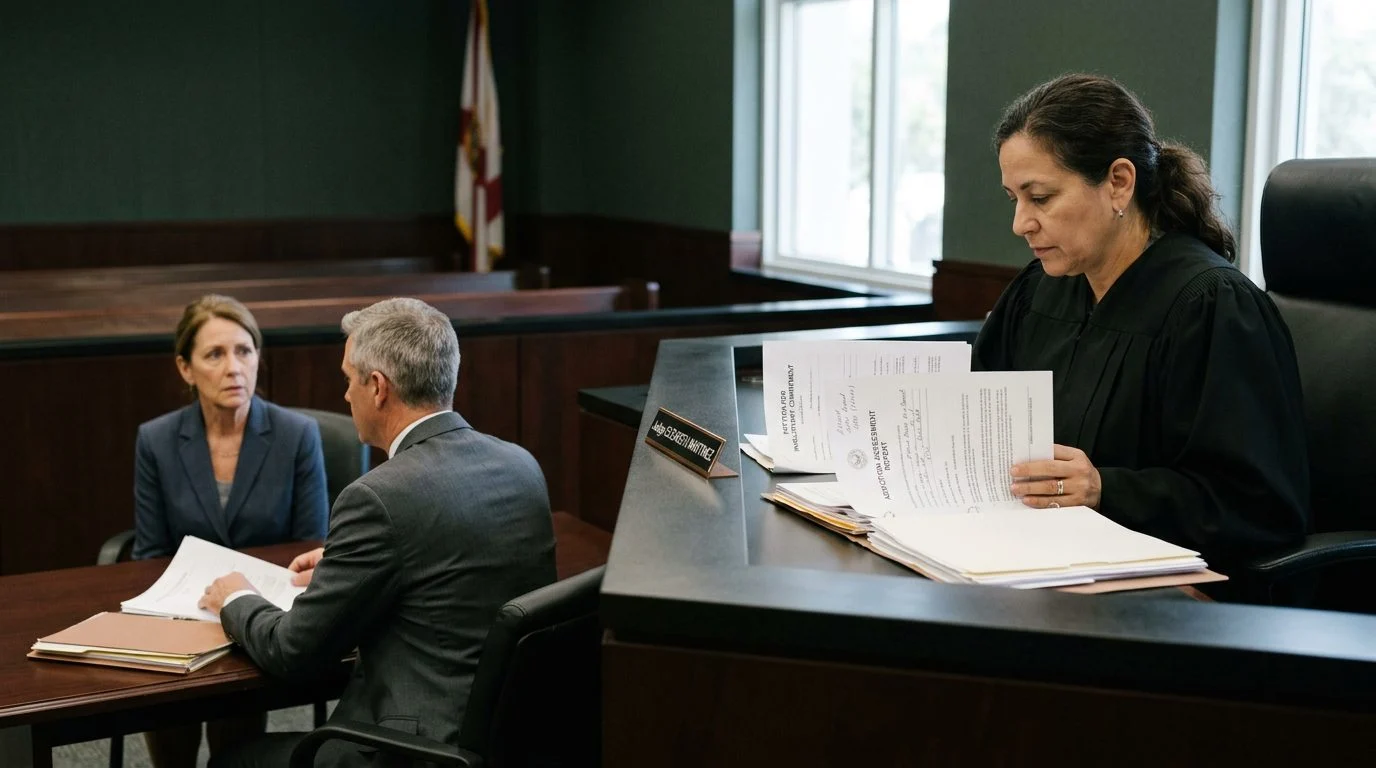
Yes. A parent or other family member can testify at a Marchman Act hearing in Florida. The court must hear and review all relevant evidence, and that includes testimony from family members who know the person’s history and how it connects to the person’s current condition (Fla. Stat. § 397.6957).
The Marchman Act is Florida’s law for court-ordered help when substance use has taken away a person’s power of self-control. At the hearing, the judge decides whether the person named meets the legal criteria for involuntary treatment. Family testimony helps the court see the full picture. How your testimony is given depends on the facts of the case and the court’s procedures. For the general rules, read our Marchman Act overview.
If your loved one's substance use has led to a Marchman Act petition, we can talk through whether and how you should speak at the hearing. Talk it through with our team — the first consultation is free, confidential, and carries no obligation.

Understanding the Marchman Act Show Cause Hearing
The show cause hearing is the court hearing on a petition for involuntary treatment services. Many families use the shorter name. The petition starts the case, and the hearing is where the court takes evidence.
A petition must name the person and the petitioner. It must also state how they are related.
The legal criteria are in Fla. Stat. § 397.675. The court looks for a good faith reason to believe the person is impaired and has lost self-control.
Under Fla. Stat. § 397.6957, the petitioner must prove by clear and convincing evidence that the respondent is substance abuse impaired and has a history of lack of compliance with treatment for substance abuse, and that because of such impairment the respondent is unlikely to voluntarily participate in the recommended services or is unable to determine for himself or herself whether services are necessary. The petitioner must also show either that without services the respondent is likely to suffer from neglect or refuse to care for himself or herself, posing a real and present threat of substantial harm to his or her well-being, with a substantial likelihood of serious bodily harm in the near future as shown by recent behavior; or that the respondent’s refusal to voluntarily receive care is based on judgment so impaired by reason of substance abuse that the respondent is incapable of appreciating his or her need for care and of making a rational decision regarding that need for care. The court must schedule the hearing within 10 court working days, unless a continuance is granted (Fla. Stat. § 397.68151).
The petition belongs in the county where the person is physically located when it is filed. Filing in the wrong county is generally a venue problem, not a loss of jurisdiction (J.P. v. J.N.). For families in Miami-Dade and across South Florida, the county where your loved one is found matters.
Who Can Give Testimony at the Hearing
Family members who know the person’s history can testify. For an adult, a petition may come from a spouse or legal guardian, any relative, a service provider, or an adult with direct personal knowledge of the substance use and prior treatment (Fla. Stat. § 397.68112).
So a parent, spouse, adult child, or sibling fits the statute’s wording.
Witnesses may attend remotely. They may testify under oath by audio-video technology, as appropriate, if they provide the parties with all relevant documents by the close of business on the day before the hearing (Fla. Stat. § 397.6957).
Appeals courts have policed how judges handle witnesses. In R.S. v. C.P.T., the court stated that the effect of the trial judge’s actions was to relieve Appellee of her burden of proof and to help her prove the essential elements of the case. In J.C. v. State, the court said that the trial court failed to follow the applicable statute by essentially functioning as the absent petitioner. In C.W.R.K., the court stated that the trial court failed to follow the governing statute when, in the absence of the petitioner, it called and questioned the health care professional who executed the involuntary services certificate.
In J.J.J. v. D.G., the Fourth District affirmed and certified conflict with R.S., J.W., and C.W.R.K. It certified conflict with the Fifth District cases. The conflict is open, and the 2024 statutory amendments may affect how it applies.
What Testimony From a Family Member Usually Covers
Good testimony ties your observations to the legal criteria. The statute asks the court to weigh the person’s prior history and how it relates to the current condition (Fla. Stat. § 397.6957). Useful points include recent substance use, changes in behavior, safety concerns, earlier treatment, and times your loved one turned down help.
Refusal alone is not enough. The statute says that “mere refusal to receive such services does not constitute evidence of lack of judgment” (Fla. Stat. § 397.675). Fla. Stat. § 397.675 reads: “(b) Without care or treatment, is likely to suffer from neglect or refuse to care for himself or herself; that such neglect or refusal poses a real and present threat of substantial harm to his or her well-being; and that it is not apparent that such harm may be avoided through the help of willing, able, and responsible family members or friends or the provision of other services, or there is substantial likelihood that the person has inflicted, or threatened to or attempted to inflict, or, unless admitted, is likely to inflict, physical harm on himself, herself, or another.” That is why details about what happened, and what it led to, carry weight.
Dated examples give the judge something concrete to weigh. General statements about character give the judge much less. Separate what you saw yourself from what someone else told you.
Court records are confidential. Petitions, orders, and related records may be disclosed only to listed people, such as the petitioner, the respondent, and the respondent’s attorney (Fla. Stat. § 397.6760). If a mental health condition is also involved, read our guide on dual diagnosis and the Marchman Act.
How the Person Named Is Represented and Their Rights
The person named has the right to a lawyer at every stage of the case, but may waive that right if present and the court finds the waiver is knowing, intelligent, and voluntary. If the court believes the person needs or wants a lawyer, the court must appoint one, whatever the person’s wishes (Fla. Stat. § 397.681).
The Second District has also held that a Marchman Act respondent has a constitutional right to counsel (Hillsborough County v. Albrechta).
The person must be present at the hearing. The court may excuse presence only if the person knowingly, intelligently, and voluntarily waives the right to be present, or, after proof of service and review of the circumstances, finds that presence is inconsistent with their best interests or is likely to be injurious to self or others (Fla. Stat. § 397.6957).
Because the person may have a lawyer, your account may be tested. Plan to answer questions calmly and stick to what you know.
Age Matters: Minors and Testimony About Your Loved One
Age changes who may file and who receives notice. For a minor, a parent, legal guardian, or service provider may file the petition (Fla. Stat. § 397.68112).
If you are a parent, legal guardian, or legal custodian who seeks involuntary admission of a minor, you are required to participate in all aspects of treatment determined appropriate by the director of the licensed service provider (Fla. Stat. § 397.6759). When the respondent is a minor, the petition and notice must be personally delivered to the minor (Fla. Stat. § 397.68151).
If an unrepresented minor is involved, the court must immediately appoint a guardian ad litem to act for the minor (Fla. Stat. § 397.681).
The rules for a minor are not the same as the rules for an adult. For an adult who lives outside Florida, read our guide on Marchman Act cases for adults living out of state.
Not sure what your next step is?
Talk it through with our team — the first consultation is free, confidential, and carries no obligation.
Preparing to Testify and Organizing Information
Start with a dated timeline. Write down each incident, what you saw or heard, and who else was present. Note the date, place, and substance involved as closely as you can.
Gather records you already have, such as discharge papers from an earlier treatment stay. A petition may include a report from a qualified professional who examined the person within 30 days before filing (Fla. Stat. § 397.68141).
If you plan to testify remotely, give the parties your relevant documents by the close of business the day before the hearing (Fla. Stat. § 397.6957). The court may also order drug tests at the hearing.
Filing a petition carries no clerk fee. The clerk of the court may not charge one for filing a petition under this section (Fla. Stat. § 397.681). If the substance involved is a prescription sedative, see our page on benzodiazepine dependence and the Marchman Act.
Frequently Asked Questions
Can a parent testify at a Marchman Act hearing in Florida?
Yes. The court shall hear and review all relevant evidence, including testimony from family members familiar with the person’s prior history and how it relates to their current condition.
Does the person named have to attend the hearing?
The person must attend unless they knowingly waive it, or the court finds that attending is inconsistent with their best interests or likely to be injurious.
Can a family member testify remotely?
Yes. Witnesses may testify under oath by audio-video technology, and they must give the parties their documents by the close of business the day before.
Does the person named have a right to a lawyer?
Yes. The respondent has the right to counsel at every stage of a judicial proceeding relating to a petition for involuntary treatment for substance abuse impairment, but may waive that right if present and the court finds the waiver is knowing, intelligent, and voluntary, and the court shall appoint counsel if it believes the respondent needs or desires counsel.
How do you Marchman Act someone in Florida?
The petition is filed with the clerk in the county where the person is located, and no clerk fee applies. The court then schedules a hearing within 10 court working days, unless a continuance is granted. For more detail, see our Marchman Act overview.

Next Steps for Families in Miami-Dade and South Florida
If your loved one faces a Marchman Act petition in Miami-Dade or South Florida, you may be deciding whether to speak at the hearing and what to say. The rules above help, but your facts shape how they apply.
Robinson Casey focuses on Marchman Act petitions and guardianship matters. To talk through your role at the hearing, call (561) 849-4700 or request a consultation online. The first consultation is free, confidential, and without obligation to continue.
Richard J. Casey III, Esq. is responsible for this page.
How Robinson Casey Supports Families
Family-Centered Focus
We understand that Marchman Act cases affect the whole household. We work to help parents understand the process and their options from the first call.
Clear Communication
We explain court procedures, hearing expectations, and the questions a parent may be asked, so you know what to expect before you step into the courtroom.
Careful Preparation
Our team helps you organize relevant history, records, and observations so your account is clear, accurate, and well prepared.
Practice Limited to Key Areas
Robinson Casey focuses on Marchman Act petitions and guardianship matters, including emergency temporary, plenary, limited, and mental health guardianship.
Important: Every Case Is Different
The information on this page is general and is not legal advice. Whether and how a parent may testify depends on the facts of your situation and the court's review. Speak with a lawyer about your specific circumstances before the hearing.
Preparing to Speak With the Court
Gather Your Observations
Write down specific, dated examples of your family member's behavior and how it has changed over time.
Stay Factual and Calm
Focus on what you saw and experienced, rather than general opinions, to help the court understand the situation clearly.
Know What May Come Up
Consider questions about treatment history, prior incidents, and daily functioning, and review them with your attorney.
Talk With Our Team
Our team can help you understand the process and plan your next steps. Your first consultation is free, confidential, and carries no obligation to continue.
Have Questions About Testifying at a Marchman Act Hearing? Talk With Robinson Casey.
Related practice areas
- Florida Marchman Act Lawyer for Adult Son Who Refuses Rehab