
Marchman Act & Guardianship | South Florida and Statewide
Marchman Act Hearings by Video in Florida: A Family Guide
Clear answers about remote hearings for families facing a Marchman Act petition or a guardianship matter. Richard J. Casey III, Esq., Robinson Casey, focuses on these cases.
By Richard J. Casey III, Esq. · Published October 25, 2026
Why Families Are Asking About a Video or Phone Marchman Act Hearing
A Marchman Act hearing can sometimes be attended by video or phone in Florida.
Families searching for a Marchman Act hearing by video Florida courts allow usually want a straight answer first. Remote attendance is possible in some situations. It isn’t automatic for everyone involved.
Maybe a family member was served, or you just learned a petition was filed. The hearing date may be close. You may be trying to work out whether you can join from work, from another county, or from home. That’s a hard place to be.
A Marchman Act hearing is a court proceeding. A judge decides whether a person should receive court-ordered treatment for substance use. Fla. Stat. § 397.6957 sets out the basic rules for these hearings.
This page covers whether a hearing can be attended remotely, what that looks like, and how to prepare. Court procedures vary. The presiding judge and the clerk set how a given hearing is held.
If a notice about a loved one's Marchman Act hearing has your family unsure what to do next, our team is ready to talk it through with you. Talk it through with our team — the first consultation is free, confidential, and carries no obligation.

What the Marchman Act Is and How It Differs From the Baker Act
The Marchman Act is the Florida process for asking a court to order treatment for a person impaired by substance abuse. It is found in Chapter 397 of the Florida Statutes.
The Baker Act is a different law. It deals with mental health crises. People mix the two up often, so check which statute a notice cites.
Every case starts with a petition, which is the written request filed with the court. Under Fla. Stat. § 397.68112, an adult’s petition may be filed by a spouse or legal guardian, any relative, a service provider, or an adult with direct personal knowledge of the person’s impairment and treatment history.
If you’re a relative or close friend, you may fall into one of those groups. Knowing that helps you understand your role in the case.
For the full overview, read our guide to involuntary commitment for addiction.
Before the Hearing: Petition, Notice, and Scheduling
The court must schedule the hearing within 10 court working days unless it grants a continuance. Fla. Stat. § 397.68151 sets this timeline.
Copies of the petition and the notice go to the respondent; the respondent’s parent, guardian, or legal custodian, in the case of a minor; the respondent’s attorney, if known; the petitioner; the respondent’s spouse or guardian, if applicable; and such other persons as the court may direct.
Where the petition is filed matters. In J.P. v. J.N., however, the filing of the petition in the wrong county did not divest the circuit court in Putnam County of jurisdiction. Under J.P. v. J.N., the wrong-county filing did not strip the Putnam County circuit court of jurisdiction. It does not take away the court’s power to hear the case.
Read the notice closely. Note the date, the time, the courtroom or division, and any video or phone instructions. Follow the court’s remote-access steps exactly.
Confirm that the court has your current phone number and email. That way, instructions reach you in time. Miami-Dade County sits in the Eleventh Judicial Circuit. Ask the court which remote-hearing steps apply to your case.
How Video and Phone Appearances Work in a Marchman Act Hearing
The court decides whether remote participation is used in a given hearing. A witness may attend remotely and, as appropriate, testify under oath by audio-video technology, but must provide the parties with all relevant documents by the close of business on the day before the hearing.
Florida’s general court rule, Fla. R. Gen. Prac. & Jud. Admin. 2.530, lets courts use communication technology for many proceedings. Audio-video technology lets every participant hear, see, and speak with the others in real time. Unless another rule of procedure or general law governs, the rule allows communication technology for all proceedings before a court official, except civil involuntary commitment proceedings under section 394.467 (the Baker Act); Marchman petitions are not named in that exception.
If a motion or notice proposes remote technology, a party may object in writing within 10 days after service. The court may set a different period. Missing that window can waive the objection.
The Polk County Clerk virtual court page says virtual appearances require preparation. Test your device, internet connection, and audio before the hearing day. Pick a quiet, private room.
A video appearance usually needs a steady camera and a neat setting. A phone line needs a clear connection and a quiet space.
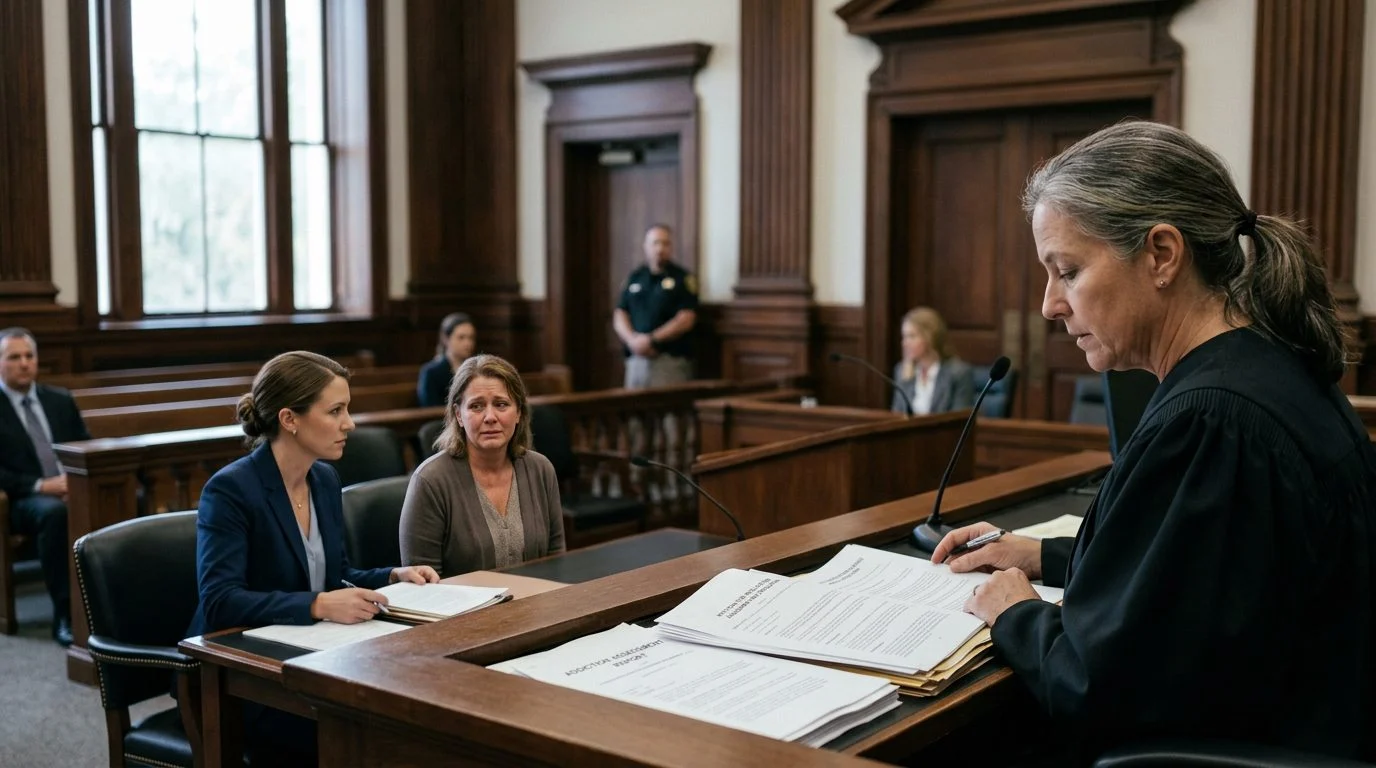
What Happens During a Marchman Act Hearing
The judge hears all relevant evidence. That includes testimony from family members who know the person’s history and how it relates to the current condition. Fla. Stat. § 397.6957 provides that the court shall hear and review the results of the assessment completed by the qualified professional, and that the court may also order drug tests.
Testimony must be taken under oath, and the proceedings must be recorded. The person named in the petition may refuse to testify.
Under Fla. Stat. § 397.681, a respondent may waive the right to counsel if the respondent is present and the court finds that the waiver is made knowingly, intelligently, and voluntarily.
Section 397.681 gives the courts jurisdiction over involuntary treatment petitions for substance abuse impaired persons and gives the respondent the right to counsel; it does not address clinical assessment.
On a phone or video line, mute when you aren’t speaking. Wait until the judge calls on you. If you want to record anything, ask the clerk first.
For guidance on contact with a loved one during the process, see visiting someone under the Marchman Act.
Court Review, Orders, and Possible Outcomes
If the court finds the conditions proved by clear and convincing evidence, it may order involuntary treatment for up to 90 days. If the court finds the conditions proved by clear and convincing evidence, it may order involuntary treatment from a publicly funded provider for up to 90 days. Fla. Stat. § 397.697 sets that limit for publicly funded treatment.
No one can predict a result from a hearing’s format. Each case turns on its own record and evidence.
A case can also end without treatment. If the person is not assessed within 90 days, the court must dismiss the case, under Fla. Stat. § 397.6818.
Whether a filed petition can be dropped depends on the facts and the court’s procedures. Questions about that are best raised with a lawyer who can review the case file.
Families dealing with a discharge that is refused treatment can read about hospital discharge refusing treatment. For relapse, see relapse after rehab.
Not sure what your next step is?
Talk it through with our team — the first consultation is free, confidential, and carries no obligation.
Tips for Family Members Attending a Remote Marchman Act Hearing
Gather the case number, the notice, and any remote-access instructions before the hearing. Keep them within reach on the day.
Family testimony can matter. If you plan to testify remotely, you must give the parties all relevant documents by the close of business the day before the hearing, under Fla. Stat. § 397.6957.
Write your questions down before the hearing. Keep a notepad ready for names, dates, and the judge’s instructions.
Have a backup phone number ready in case the video connection fails. If there’s a technical problem, tell the court using the method it directs.
Log in or call in early, following the court’s entry steps. Speak calmly. Strong emotion is hard to manage on a screen, so pause before you answer.
Frequently Asked Questions About Remote Marchman Act Hearings
Can you video call into a court hearing in Florida?
Sometimes. Florida’s general rule lets courts use communication technology, including audio or audio-video technology, for proceedings before a court official, and the court official sets the details for each hearing.
Can someone video record you without your permission in Florida?
Marchman Act proceedings must be recorded, but that doesn’t answer whether a family member may record. Ask the clerk before you record anything.
What happens at a Marchman Act hearing?
The judge hears evidence, including testimony from family members and the assessment results. Testimony is under oath, and the person may refuse to testify.
Can a Marchman Act be dropped?
Questions about withdrawing a petition are best raised with a lawyer who can review the case file.

Talk With Robinson Casey About Your Family’s Marchman Act Hearing
If a notice about a loved one’s hearing leaves you unsure whether to join by video or phone, you don’t have to sort it out alone. The person named in the petition has a right to counsel, and you can get help with the next steps too.
Richard J. Casey III, Esq. is the responsible lawyer for this page. Robinson Casey focuses on Marchman Act petitions and guardianship matters across South Florida and statewide.
Our first consultation is free, confidential, and comes with no obligation to continue.
To talk through your family’s hearing, call (561) 849-4149 or schedule a consultation.
How Robinson Casey Can Help
Focused Practice
Robinson Casey focuses on Marchman Act petitions and guardianship matters, so the questions families bring us are the ones we handle every day.
Free First Consultation
Your first consultation is free, confidential, and carries no obligation to continue.
South Florida and Statewide
We serve families in Miami-Dade and across South Florida, and we assist clients in other parts of Florida.
Support for the Whole Family
Our team, including our attorneys and support staff, works to keep you informed at each step of the process.
Free, Confidential First Consultation
Hearings move quickly, and families often have questions before they know what to expect. Your first consultation with Robinson Casey is free, confidential, and carries no obligation to continue.
Services Robinson Casey Handles
Marchman Act Attorney
Representation for families involved in Marchman Act petitions and the related court process.
Guardianship Attorney
Guidance on guardianship petitions for adults who need help managing personal or financial decisions.
Emergency Temporary Guardianship
Assistance with urgent petitions when a loved one needs immediate court protection.
Involuntary Commitment for Addiction
Help navigating involuntary commitment proceedings for substance use disorder.