
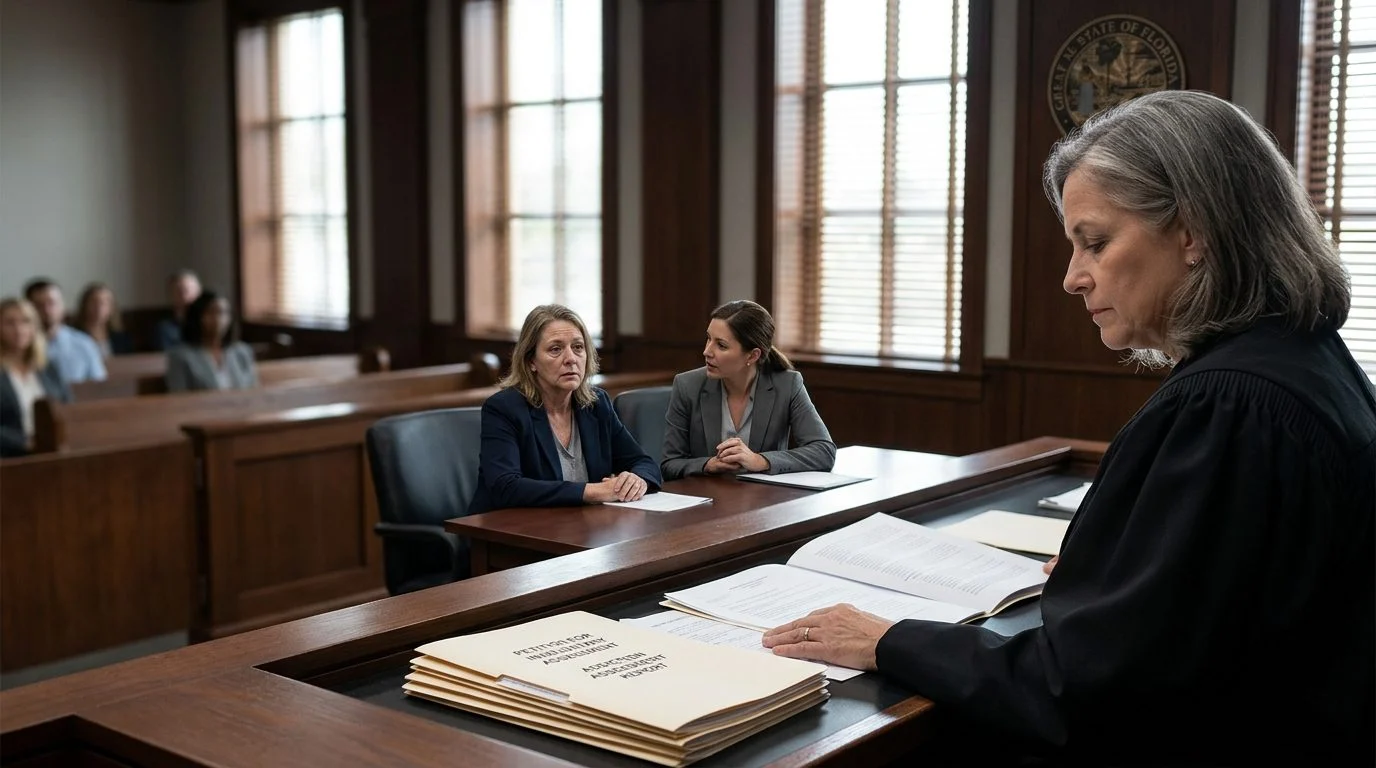
Marchman Act Guidance for Miami-Dade and South Florida Families
When Your Adult Child Is Homeless and Struggling with Addiction, Help Is Available Through the Courts
Robinson Casey focuses on Marchman Act petitions and guardianship matters for families across South Florida and statewide. Richard J. Casey III, Esq., is responsible for this page.
By Richard J. Casey III, Esq. · Published October 31, 2026
If your adult child is homeless and struggling with substance use, Florida law may offer a court path to treatment. The Marchman Act lets certain family members ask a judge to order involuntary assessment and treatment for substance use impairment. Many parents searching for how to get homeless adult child into rehab Florida are doing it in a crisis, often on someone else’s behalf. This page explains the process in plain terms. It is general information, not advice on your child’s case.
Where you are right now: a child on the street and a parent out of options
You may have just gotten the call. Maybe your child overdosed, was taken to the hospital, was arrested, or disappeared for days. You have likely spent years paying for treatment, trying interventions, and holding firm boundaries. Each new crisis seems worse than the last.
The fears are specific. You may be afraid your child will overdose and die. You may fear jail, or a winter spent sleeping outside. You may be losing hope that anything will work.
You do not have to manage this alone. Florida has a court process built for families facing a loved one’s substance use impairment. It does not replace medical care. It can put a judge’s order behind treatment when the legal criteria are met.
If your child is living on the street and you feel you have run out of options, you don't have to face it alone. Reach out to talk through what Florida law may allow. Talk it through with our team — the first consultation is free, confidential, and carries no obligation.

What the Marchman Act is and who it covers
The Marchman Act is Florida’s law for involuntary assessment and treatment of people impaired by substance use. The Florida Department of Children and Families publishes general information about the Marchman Act. The criteria appear in § 397.675, in Chapter 397 of the Florida Statutes.
Don’t confuse it with the Baker Act. The Baker Act covers mental health, and the Florida State Courts System bench guide treats it as a separate statute.
For an adult, a petition may be filed by a spouse or legal guardian, any relative, a service provider, or an adult with direct personal knowledge of the impairment and prior treatment. See § 397.68112.
The court looks for a good-faith reason to believe the adult is substance abuse impaired and has lost the power of self-control about substance use. The adult must also need services and be unable to appreciate that need, or be likely to neglect himself or herself in a way that poses a real and present threat of substantial harm. Physical harm to self or others is another route: there must be a substantial likelihood that the respondent has caused, attempted, or threatened physical harm to himself, herself, or another person, or that, without admission, the respondent is likely to cause such harm. Under the statute, mere refusal of services is not by itself evidence of lack of judgment.
The petition must describe the impairment in facts. The judge decides, not the family.
How homelessness and repeated crises fit into a petition
The facts behind it often bear on the statute’s harm standards. Whether your child can get food, medicine, or safe shelter may fit the neglect standard in § 397.675, depending on the facts, but only if it is not apparent that the harm could be avoided with help from willing, able, and responsible family members or friends or through other services.
Useful facts include prior overdoses, emergency room or hospital records, police contacts, missed care, and relapse after treatment. A petition may include a report from a qualified professional who examined the adult within 30 days before filing. If there was no assessment, the petition must say so (§ 397.68141). An adult may also be the subject of a petition after protective custody or an emergency admission within the previous 10 days (§ 397.68111).
Start now. Write down dates, places, and the names of people who saw each event. Gather records you already have. Bring that timeline to your first conversation with a lawyer. At the hearing, the court must hear and review all relevant evidence, including testimony from family members who know the adult’s history, and may order drug tests (§ 397.6957). No outcome can be promised. The court decides on the evidence presented.
How the process works, step by step
The process runs from a consultation to a filed petition, a hearing, and a court order. Notice is given at each stage.
- Consultation. We review the facts and whether the Marchman Act fits. Your first consultation is free, confidential, and carries no obligation to continue.
- Filing. The petition goes to the clerk of the court in the county where the adult is located. The clerk may not charge a filing fee for it (§ 397.681).
- Upon the filing of a petition, the court must immediately determine whether the respondent has an attorney or whether appointing counsel is appropriate (§ 397.68151).
- Emergency path. If an emergency exists, the court may enter an ex parte assessment and stabilization order without appointing an attorney. A provider may not hold the person for more than 72 hours of observation unless a listed exception applies (§ 397.6818).
- Treatment may be ordered only on clear and convincing evidence, for up to 90 days, with renewal possible (§ 397.697).
Appeals courts have split on how far a judge may question witnesses when the petitioner is absent. In J.C. v. State, the court stated: ‘In doing so, the court failed to follow the applicable statute by essentially functioning as the absent petitioner.’ The Fourth District, in J.J.J. v. D.G., certified conflict with Fifth District decisions. Treat this as an open question, not a settled statewide rule. Timing depends on the court calendar and the facts of each case.
Other legal paths when the adult child cannot make decisions
Guardianship is a separate court path. It applies when an adult’s capacity to make decisions is in question. Emergency temporary guardianship is the most urgent option.
A court may appoint an emergency temporary guardian after a petition to determine incapacity is filed. The court must specifically find that there appears to be imminent danger that the person’s physical or mental health or safety will be seriously impaired, or that the person’s property is in danger of being wasted, misappropriated, or lost, unless immediate action is taken (§ 744.3031). The court must appoint counsel for the alleged incapacitated person. Notice must be served on the alleged incapacitated person and their attorney at least 24 hours before the hearing, unless the petitioner demonstrates that substantial harm would occur if the 24-hour notice is given (§ 744.3031).
The emergency authority expires after 90 days or when a guardian is appointed, whichever comes first. It may be extended for another 90 days if the emergency still exists.
Limited, plenary, and mental health guardianship are other types. Which path fits depends on your child’s condition and the facts. A consultation can help sort that out.
Why families bring this to Robinson Casey, and where filings happen in South Florida
Robinson & Casey is a Florida law firm that focuses exclusively on Marchman Act petitions and guardianship matters. The firm serves families across South Florida and statewide. Richard J. Casey III, Esq. is the responsible lawyer for this page. The firm’s lawyers and support staff handle petitions, hearing preparation, and the paperwork that comes with them.
For families in Miami-Dade, the petition is filed with the clerk in the county where the adult is located. Local filing questions are covered during the consultation.
The firm limits its practice to these two areas. That keeps each consultation focused on your child’s situation, your records, and the steps that follow.
Not sure what your next step is?
Talk it through with our team — the first consultation is free, confidential, and carries no obligation.

Common questions parents ask, and the next step
Most parents ask whether they can force an adult child into treatment. Under the Marchman Act, a court can order involuntary treatment when the legal criteria are proved.
Can you make a family member go to rehab in Florida?
Yes, a court can order involuntary treatment under the Marchman Act if the criteria are proved by clear and convincing evidence.
Does my adult child have to agree?
No. The process runs through notice and a court hearing, not the adult’s consent.
What if I don’t know where my child is living?
The petition is filed where the adult is located, so write down the last known places and dates.
What should I bring to the first consultation?
Bring a dated timeline, names of witnesses, any hospital or police records you have, and your child’s contact information.
If you are researching this for a child who is still on the street, you may not be ready to hire anyone yet. When you want to talk through the facts, request a consultation or call (561) 849-4149.
How Robinson Casey Supports Families
Marchman Act Petitions
We help families prepare and file petitions under Florida's Marchman Act, the state law that governs court-ordered treatment for substance use disorders.
Guardianship Matters
Our practice covers emergency temporary, plenary, limited, and mental health guardianship, so each filing fits the adult's specific circumstances.
Urgent Situations
When a loved one's safety is at risk, we focus on moving quickly and explaining each step of the court process in plain language.
Clear Communication
We keep families informed about what happens next, what documents are needed, and what to expect at each stage.
If Someone Is in Immediate Danger
Call 911 first. Once your loved one is safe, call Robinson Casey at (561) 849-4149 to talk through your legal options.
Matters We Handle
Marchman Act Attorney
Petitions for court-ordered assessment and treatment for adults with substance use disorders.
Involuntary Commitment for Addiction
Guidance on the court process for involuntary treatment under Florida law.
Guardianship Attorney
Guardianship filings for adults who need a court-appointed decision-maker.
Emergency Temporary Guardianship
Urgent petitions when an adult faces immediate risk and needs prompt court protection.
Plenary and Limited Guardianship
Full and partial guardianship options, tailored to the level of support the adult requires.
Mental Health Guardianship
Court-supervised guardianship for adults whose mental health affects their ability to make safe decisions.