
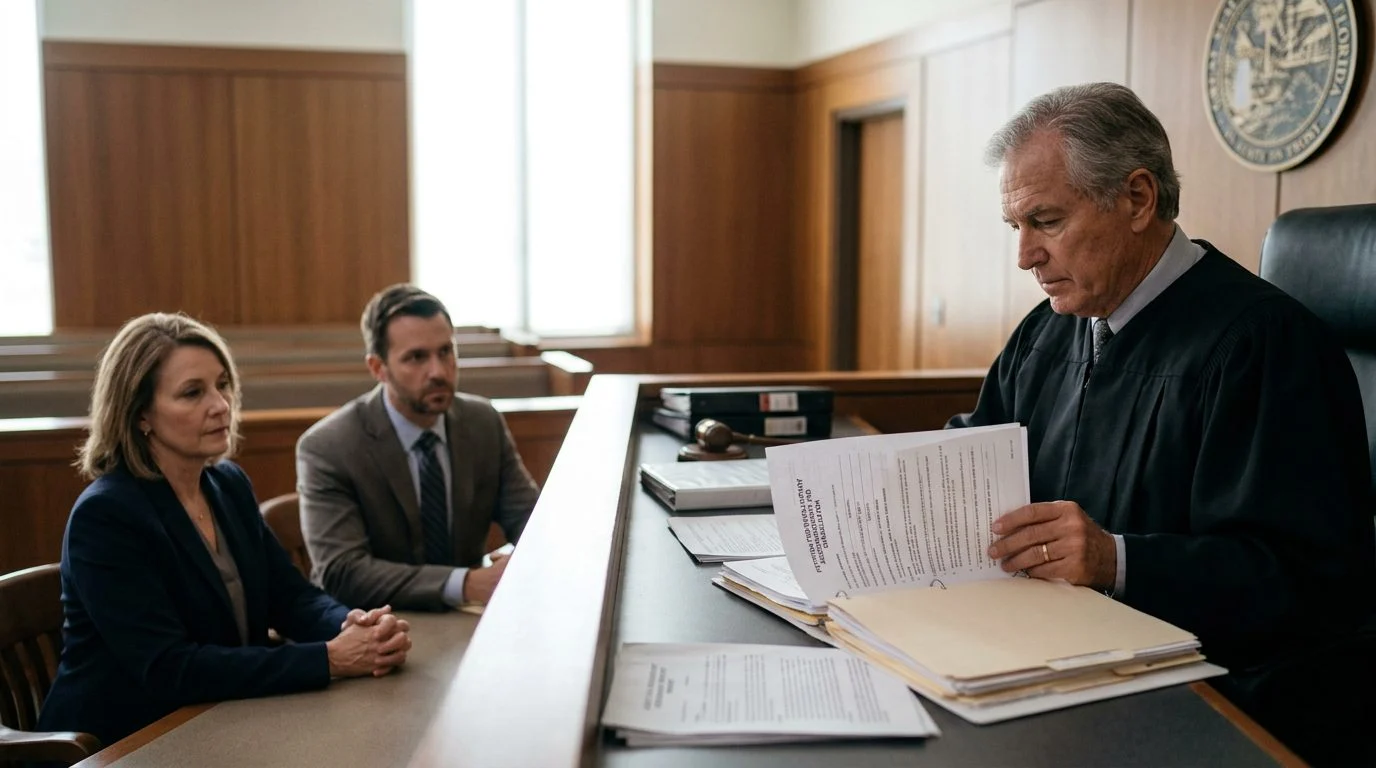
Marchman Act Attorney | South Florida and Statewide
A Clear Path Forward When Your Adult Child Needs Help
Robinson Casey focuses on Marchman Act petitions and guardianship matters for families in Miami-Dade, South Florida and across Florida. Richard J. Casey III, Esq. is responsible for this page.
Why Families Turn to Robinson Casey
A Focused Practice
Our practice is limited to Marchman Act petitions and guardianship matters, so your case is handled by attorneys who work in these areas every day.
A Free, Confidential First Consultation
Talk with us about your family's situation at no cost. The consultation is confidential and comes with no obligation to continue.
Miami-Dade, South Florida and Statewide
We serve families throughout South Florida and across the state, bringing the same careful attention to every matter.
Compassion for Hard Decisions
Families facing a loved one's addiction or mental health crisis need clear answers. We explain the process in plain language so you can make informed decisions.
By Richard J. Casey III, Esq. · Published October 27, 2026
A Marchman Act lawyer for parents in Florida helps a family ask a court to order assessment and, if the legal criteria are met, treatment for an adult with a substance use disorder. Relatives can file this petition, and it goes to the court in the county where the adult is physically located. This page explains who can file, what the petition must say, and what a petitioner’s lawyer handles. Robinson Casey focuses on Marchman Act petitions and guardianship matters for families in South Florida and statewide.
What the Marchman Act Is and Who It Helps
The Marchman Act is Florida’s civil law for court-ordered help with substance abuse.
A petition asks a judge to order an assessment first. If the court finds the criteria met, it can order treatment. Under Fla. Stat. § 397.697, the court must find the conditions proved by clear and convincing evidence, and an order may last up to 90 days.
Who can file? Under Fla. Stat. § 397.68112, for an adult the petition may come from a spouse or legal guardian, any relative, a service provider, or an adult with direct personal knowledge of the impairment and prior treatment.
If you’re a parent watching an adult child’s use get worse, you may feel you have no safe option left. Your questions are reasonable. You don’t need every answer before you start.
If an adult in your life is struggling with substance use, our team can talk through what a Marchman Act petition would involve for your family. Talk it through with our team — the first consultation is free, confidential, and carries no obligation.

Marchman Act vs. Baker Act: Which Law Applies
The Marchman Act deals with substance use. A separate Florida law, the Baker Act, deals with mental health crises. Many families face both problems at once.
The Marchman Act criteria focus on substance use. They can also apply when a co-occurring mental health disorder is present, under Fla. Stat. § 397.675.
The difference matters because it shapes which petition is filed and which court process follows. The facts of the adult’s history decide that question. A lawyer can review those facts with you before anything is filed.
What the Court Looks For in a Marchman Act Petition
A petition must state facts, not only worry. Under Fla. Stat. § 397.68141, a petition for involuntary services must contain the name of the respondent, the name of the petitioner, the relationship between the respondent and the petitioner, the name of the respondent’s attorney if known, and the factual allegations establishing the need for involuntary services. It must also give the factual reasons for the petitioner’s belief.
The court looks for a reason to believe the adult has lost power of self-control over substance use. It also looks for either impaired judgment about the need for care or a real risk of harm. Refusing treatment alone is not evidence of impaired judgment, under § 397.675.
Useful evidence often includes:
- Dates and examples of substance-related incidents
- Past treatment attempts and what happened
- Medical or police records, where they exist
- Names of family members who know the adult’s history
The court’s decision depends on the facts of each family’s record.
A petition that lacks a good-faith basis can fail. In D.H. v. K.J.R., the Second District held that an ex parte order was error where the petition did not show a good-faith reason to believe the criteria were met.
How the Marchman Act Process Unfolds Step by Step
The process begins with a petition filed with the clerk, and the respondent must be present at the hearing on that petition unless the court finds a knowing, intelligent, and voluntary waiver or that presence is inconsistent with the respondent’s best interests or likely to be injurious to self or others. Here is the usual path.
- Fact review. You describe the adult’s history, your goals, and what has already been tried.
- Filing in the right county. A petition belongs where the adult is physically located. However, in J.P. v. J.N., the filing of the petition in the wrong county did not divest the circuit court in Putnam County of jurisdiction. Under § 397.681, the clerk may not charge a fee for filing the petition.
- Emergency orders, if needed. When an emergency exists, the court may enter an ex parte assessment and stabilization order under § 397.6818. A provider generally may not hold the person for more than 72 hours of observation, with listed exceptions.
- Hearing. The court schedules the hearing under § 397.68151.
- Order and follow-through. If the criteria are proved, the court may order treatment and keeps jurisdiction to monitor compliance.
What Representation Covers for the Petitioning Parent
A petitioner’s lawyer prepares the petition, organizes the evidence, and presents the family’s case at hearing. The petitioner keeps the burden of proof.
Representation for a petitioning parent typically includes:
- Preparing and filing the petition and supporting papers
- Advising you on what to say to the adult, the court, and treatment providers
- Appearing for the petitioner and presenting witnesses and records
- Explaining each order and what it requires of your family
The Fifth District has ruled that when the petitioner is absent, a trial court may not call and question the professional to supply the petitioner’s case. See C.W.R.K. and J.C. v. State. A Fourth District decision reached a different result and certified conflict, so the issue is not fully settled.
The adult named in the petition has the right to counsel at every stage, unless the adult waives that right while present and the court finds the waiver is made knowingly, intelligently, and voluntarily. A respondent who desires counsel and cannot afford private counsel has the right to court-appointed counsel, under § 397.681. Learn more about respondent counsel in Florida. If you’re still deciding how to raise this with your loved one, read about talking to an adult about a court petition.
Why Families Work With Robinson Casey
Robinson Casey limits its practice to Marchman Act petitions and guardianship matters. You can read more on our Miami-Dade Marchman Act page.
Richard J. Casey III, Esq. is the responsible lawyer for this page. Our support staff, including assistants and office staff, help families organize documents, deadlines, and schedules. We focus on helping you present a clear, fact-based petition.
Not sure what your next step is?
Talk it through with our team — the first consultation is free, confidential, and carries no obligation.

Marchman Act Questions Parents Ask Most
Can a parent file a Marchman Act petition for an adult child?
Yes.
Does a Marchman Act case mean jail?
The law centers on assessment, stabilization and treatment, as the Florida Department of Children and Families describes it.
Where is the petition filed?
It is filed with the clerk in the county where the adult is physically located, under § 397.681.
How soon is the hearing?
The court must schedule it within 10 court working days unless a continuance is granted, under § 397.68151.
Is the first consultation free?
Yes. The first consultation is free, confidential, and carries no obligation to continue.
If an adult you love is struggling with substance use, you don’t have to work through the court process alone. Our team can talk through your situation. Call (561) 849-4149 or visit our contact page.
Matters We Handle
Marchman Act Petitions
We help parents and family members prepare and file petitions under the Florida Marchman Act for loved ones struggling with substance abuse.
Involuntary Commitment for Addiction
We guide families through the assessment, stabilization and treatment process that the Marchman Act provides.
Guardianship Matters
We represent families in plenary, limited and mental health guardianship proceedings, and in emergency temporary guardianship when urgent protection is needed.
Emergency Temporary Guardianship
When a loved one faces an immediate risk, we act quickly to ask the court for temporary protection while the case moves forward.
Don't Face the Court Process Alone
Family cases involving addiction, mental health or incapacity can move quickly and carry serious consequences. Speaking with an attorney early helps you understand your options and prepare.