
Marchman Act Attorney · Miami-Dade & South Florida
Marchman Act Hearing: What If Your Loved One Won't Show Up?
Robinson Casey focuses on Marchman Act petitions and guardianship matters for families across South Florida. Learn what a missed hearing can mean and how to protect your loved one and your family.
Casey III, Esq. · Published November 4, 2026
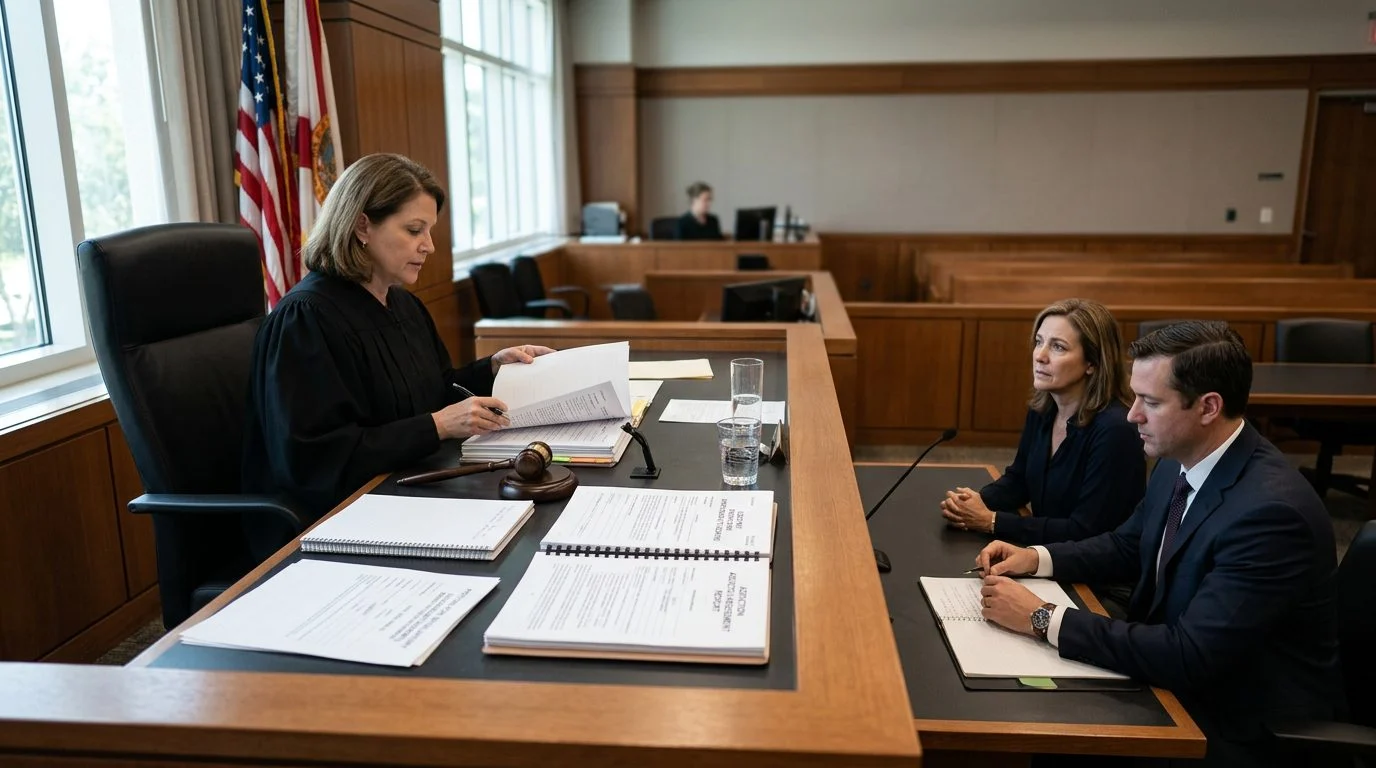
If the person named in a Marchman Act petition will not show up to a Marchman Act hearing, the case does not simply stop. A missed hearing changes the timeline and the options. Florida law still sets clear steps for what happens next. This page explains those steps in plain language for any family member facing this situation.
Why a Missed Marchman Act Hearing Feels So Urgent for Families
A missed hearing matters because the court uses that hearing to decide what happens next.
Many families reach this point after weeks of worry. Your loved one may have said they will not go. Or they may have stopped answering calls, texts and mail. The date keeps getting closer, and the fear grows.
The hearing is where the court reviews the petition and the evidence. The statute says the court must hear and review all relevant evidence, including testimony from family members who know the respondent’s history (Fla. Stat. § 397.6957). When a date is missed, the route changes. The case does not automatically end.
Guilt, exhaustion and fear are common at this stage. Many relatives feel they must have done something wrong. A missed hearing is a legal step in the case, not a verdict on your family. For the full picture, read our involuntary commitment guide.
If your loved one has said they won't go to the hearing, you don't have to work out the next step alone. Our team can talk through your situation with you. Talk it through with our team — the first consultation is free, confidential, and carries no obligation.

What the Respondent Must Receive Before the Hearing
The person named in the petition, called the respondent, must receive the petition and a notice of the hearing. Service is the step that ties that person to the hearing date.
The clerk issues a summons. The court must provide copies of the petition and notice to the respondent, the respondent’s parent or guardian if the respondent is a minor, the respondent’s attorney if known, the petitioner, the respondent’s spouse or guardian if applicable, and such other persons as the court may direct (Fla. Stat. § 397.68151). Unless a chief judge allows private process servers, the clerk sends the summons to a law enforcement agency within 6 hours after it is issued.
Having notice and attending are two different things. A person can get the papers and still not come. The statute says a copy of the petition and notice of the hearing must be provided to the respondent (Fla. Stat. § 397.68151). Under Fla. Stat. § 397.6957, the respondent must be present at a hearing on a petition for involuntary treatment services unless the court finds that he or she knowingly, intelligently, and voluntarily waives the right to be present or, upon receiving proof of service and evaluating the circumstances of the case, that presence is inconsistent with his or her best interests or is likely to be injurious to self or others (statute text).
Keep your records in one place. Save the petition, the notice, and any proof of service. You, or a lawyer you speak with, will need them quickly.
What the Court Can Do When the Respondent Does Not Appear
When the respondent does not appear, the court can act on the record it has. If the court reasonably believes the respondent meets the commitment criteria and that a substance abuse emergency exists, and the respondent’s location is known at the time of the hearing, it can also order law enforcement to bring the respondent in for evaluation.
The same order can direct service of the notice and petition (Fla. Stat. § 397.6818).
An ex parte order is one the court may enter based on the petition alone, without an attorney, before the hearing, when the petitioner asserts that emergency circumstances exist or the court determines upon review of the petition that an emergency exists. If it is not carried out by the first hearing date, it is void. But if the respondent does not appear for any reason, the court may reissue an ex parte order valid for 90 days. That applies when the court reasonably believes the criteria are met and a substance abuse emergency exists (same statute).
The court’s options depend on the facts of the case. Those facts include how service was made, what evidence is available, and what the petitioner presents at the hearing.
A missed hearing does not automatically end the petition. The respondent must be present at a hearing on a petition for involuntary treatment services unless the court finds that he or she knowingly, intelligently, and voluntarily waives the right to be present or, upon receiving proof of service and evaluating the circumstances of the case, that his or her presence is inconsistent with his or her best interests or is likely to be injurious to self or others (Fla. Stat. § 397.6957). If the respondent stays unassessed after 90 days, the court must dismiss the case.
What Happens When the Petitioner Cannot Attend
That burden stays with the petitioner.
The trial court had called and examined the only witness while the petitioner was absent. The Fourth District took a different view in J.J.J. v. D.G.. The trial court failed to follow the governing statute when, in the absence of the petitioner, it called and questioned the health care professional who executed the involuntary services certificate (C.W.R.K. v. Stewart Marchman Act Behavioral Healthcare).
Fla. Stat. § 397.6957 requires the respondent to attend the hearing on a petition for involuntary treatment services. The court can excuse that only if it finds the respondent knowingly, intelligently, and voluntarily waived the right to be present, or if, after receiving proof of service and evaluating the circumstances of the case, it finds that the respondent’s presence would be inconsistent with his or her best interests or likely to be injurious to self or others. Fla. Stat. § 397.6957 reads: “(1)(a) The respondent must be present at a hearing on a petition for involuntary treatment services unless the court finds that he or she knowingly, intelligently, and voluntarily waives his or her right to be present or, upon receiving proof of service and evaluating the circumstances of the case, that his or her presence is inconsistent with his or her best interests or is likely to be injurious to self or others.”
Practical Steps Families Can Take Before the Hearing
Start a written timeline, keep every record, and be ready to describe your loved one’s history clearly.
Write down the dates of service, messages sent to your loved one, anything they said about attending, and any contact with the clerk. Witnesses may testify at the hearing under oath, and may attend and testify remotely by audio-video telecommunications technology.
Family members play a real role. The court must hear and review all relevant evidence, including testimony from individuals such as family members familiar with the respondent’s prior history. A witness may testify remotely by audio-video, but must give the parties all relevant documents by close of business the day before the hearing.
A petition may include a professional’s report from an exam within 30 days before filing. If the respondent refused assessment, the petition must say so (Fla. Stat. § 397.68141).
Substance use and mental health symptoms can affect whether a person understands a notice or can plan to attend. Describe those symptoms clearly to your lawyer and to the court. For guidance on the conversation with your loved one, read how to tell a family member about a petition.
If your loved one has threatened anyone or acts unpredictably, say so to the court and to any lawyer you consult.
How a Missed Hearing Can Change the Timeline
The hearing must be scheduled within 10 court working days unless a continuance is granted. If the respondent does not appear at the hearing and the court reasonably believes the respondent meets the commitment criteria and that a substance abuse emergency exists, and the respondent’s location is known at the time of the hearing, the court must continue the case for no more than 10 court working days (Fla. Stat. § 397.6818).
If the conditions justifying involuntary treatment are expected to exist after 90 days of treatment, a renewal can be requested before that period ends (Fla. Stat. § 397.697). A person may also be discharged early when the person no longer meets the criteria for involuntary admission and has given informed consent to be transferred to voluntary treatment status, among other listed conditions (Fla. Stat. § 397.6971).
Filing location matters too. However, in J.P. v. J.N., the filing of the petition in the wrong county did not divest the circuit court in Putnam County of jurisdiction.
Frequently Asked Questions
It can also reissue an ex parte order valid for 90 days if the court reasonably believes the respondent meets the commitment criteria and that a substance abuse emergency exists (Fla. Stat. § 397.6818).
Can the hearing go forward without the respondent?
The statute requires the respondent to be present, unless a waiver or a presence finding applies (Fla. Stat. § 397.6957).
Does a missed hearing end the petition?
Not automatically. The court must dismiss the case if the respondent remains unassessed after 90 days.
Does my loved one have a right to a lawyer?
Yes. A respondent has the right to counsel at every stage of a judicial proceeding, though the respondent may waive that right if present and the court finds the waiver is knowing, intelligent, and voluntary (Fla. Stat. § 397.681).
Not sure what your next step is?
Talk it through with our team — the first consultation is free, confidential, and carries no obligation.

Talk With Robinson Casey About Your Loved One’s Hearing
Robinson Casey limits its practice to Marchman Act petitions and guardianship matters. It serves families across South Florida and statewide.
Richard J. Casey III, Esq. is the lawyer responsible for this page. Our team supports families through these petitions and the questions that come with them. A lawyer can review your petition, your notice and your timeline, and explain how these steps apply to your facts.
Your first consultation is free, confidential, and comes with no obligation to continue. To talk through your loved one’s hearing, reach out to Robinson Casey or call (561) 849-4149.
How Robinson Casey Helps Families
Marchman Act Petitions
We focus on preparing and presenting Marchman Act petitions for families seeking help for a loved one struggling with substance use.
Guardianship Matters
Our practice covers guardianship attorney services, including emergency temporary, plenary, limited, and mental health guardianship.
Involuntary Commitment for Addiction
We help families understand the involuntary commitment process and what each step may mean for their loved one.
Clear Communication
Our team keeps you informed about your case and answers your questions in plain language.
Don't Wait to Ask Questions
If your loved one has not appeared, or you are unsure what happens next, speak with a lawyer as early as possible rather than waiting for the hearing date.
Common Questions Families Bring to Us
Can the hearing move forward?
Hearing procedures depend on the facts of each case. Our attorneys review the petition, notice, and court record with you to explain the options.
Does a missed hearing end the case?
Every case is different. We can help you understand where your matter stands and what questions to raise with the court.
What about urgent safety concerns?
When a loved one's health or safety is at risk, we discuss emergency options such as emergency temporary guardianship.
Where do I start?
Begin with a confidential conversation about your family's situation and the steps that may follow.