
Marchman Act | Florida
Loved One Out of State? Get Answers About Marchman Act Options
Robinson & Casey focuses exclusively on Marchman Act petitions and guardianship matters for Florida families, including families whose loved one is located outside their home area.
By Richard J. Casey III, Esq. · Published October 13, 2026
Does Florida’s Marchman Act Still Apply When Your Loved One Lives Out of State?
It might, but the answer depends on where your loved one is located, what the statute says, and what the court decides. The Marchman Act is Florida’s law for court-ordered assessment and treatment of people with substance use problems. Under section 397.681, Florida Statutes, involuntary treatment petitions for substance abuse impaired persons must be filed with the clerk of the court in the county where the person is located. The chapter’s stated purpose is a range of substance abuse services in the least restrictive setting that supports long-term recovery, while protecting people’s rights (§ 397.305).
Your question has two parts. The first is where your loved one is physically located. The second is where your loved one lives. The statute’s main venue rule speaks to location, not residence. Keep both questions in mind as you read.
If your son, daughter, or spouse is struggling with substance use from another state, and you can't tell whether Florida's process can reach them, we're glad to talk it through with you. Talk it through with our team — the first consultation is free, confidential, and carries no obligation.

How Location and Residence Are Addressed in the Statute
The venue rule is short. A petition “must be filed with the clerk of the court in the county where the person is located” (§ 397.681). The clerk may not charge a fee for filing it.
Other requirements may apply. The court decides how the statute fits the facts of each case.
If your loved one is outside Florida, that raises separate questions about whether and where a Florida petition may be filed. The answer turns on the facts and the court’s ruling.
Filing a Petition From Another State: Who May File and What It Must Contain
For an adult, § 397.68112 lists who may file. The list includes a spouse or legal guardian, any relative, a service provider, and an adult with direct personal knowledge of the person’s impairment and prior treatment. The quoted text does not tie these categories to where the petitioner lives. Other requirements may apply, and the court decides.
The petition itself has content rules. Under § 397.68141, it must name the respondent and the petitioner, state their relationship, and list the respondent’s attorney if known. It must also include facts showing why the petitioner believes the person is impaired and has lost self-control. The statute lists more required facts, so check the full text.
A petition may include a report from a qualified professional who examined the person within 30 days before filing. If the person was never assessed, or refused one, the petition must say so.
Family members outside Florida often find these steps easier with a plan. Consider gathering:
- A dated list of incidents, and what you saw or heard directly
- Names and phone numbers of people with direct knowledge
- Any prior treatment records you can lawfully get
- Documents that show your relationship to the person
- Notes on any past assessment or refusal
A complete file does not mean the court will accept the petition. The court evaluates the filing under the statute.
What Happens in Court When the Respondent Is Not in Florida
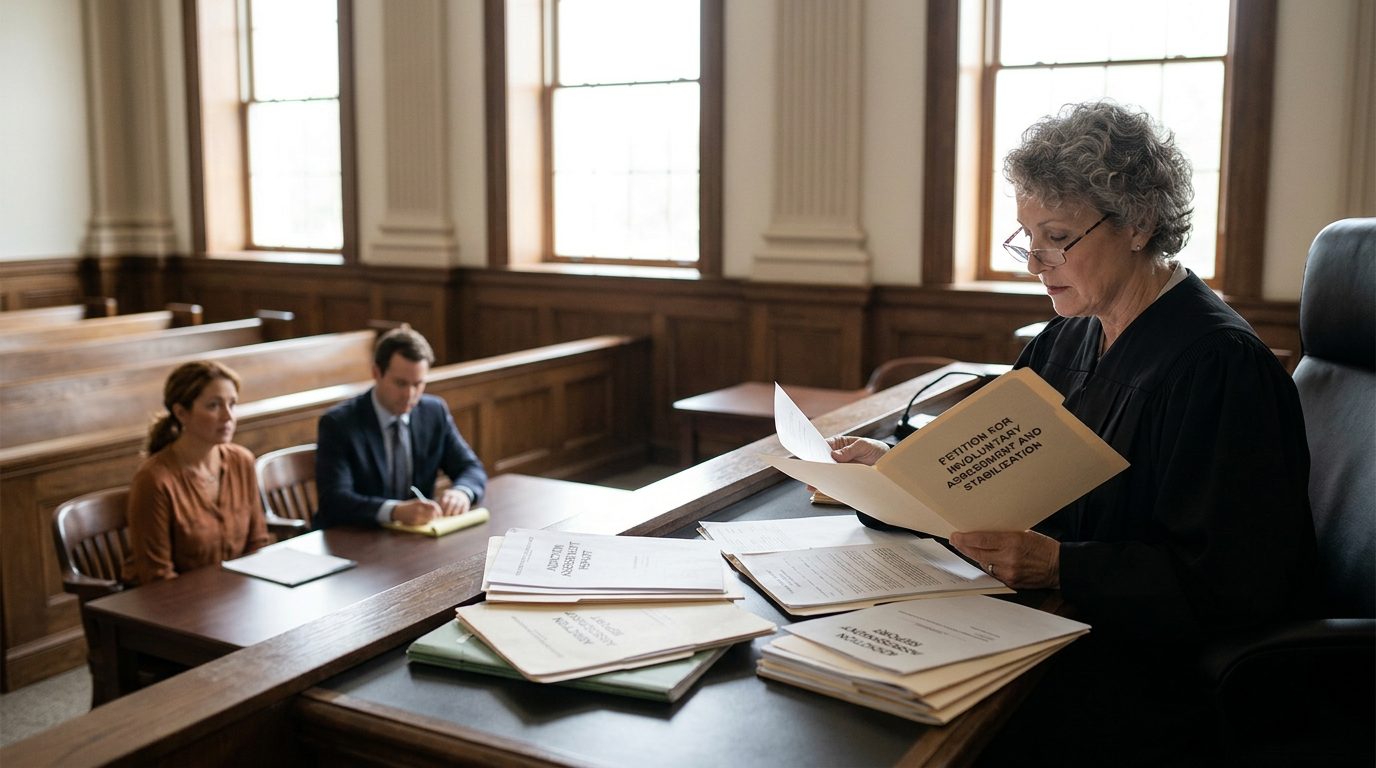
The court moves in stages, and timing depends on the court’s schedule and discretion. When a petition describes an emergency, § 397.6818 says the court may rely on the petition alone. The court may then enter an ex parte order for assessment and stabilization without appointing an attorney. The statute also limits observation by a service provider to 72 hours, subject to listed exceptions and court action.
The statute says the court “shall schedule a hearing” within 10 court working days unless a continuance is granted (§ 397.68151). The actual date depends on the court’s calendar and rulings.
Notice and service also matter. The respondent must receive a copy of the petition and the hearing notice. The clerk may send the summons to law enforcement for service, unless the chief judge authorizes private process servers.
Remote attendance is possible but not automatic. Under § 397.6957, witnesses may attend remotely and testify under oath by audio-video technology. A witness who will testify remotely must give the parties documents by the close of business the day before. Florida’s court rules on the use of communication technology may also apply to remote testimony, and they may call for a written request or notice to the court; the current text of those rules governs. Whether remote testimony is allowed is up to the court.
Any outcome is a possibility the court may order, not a certainty. Under § 397.697, the court may order involuntary treatment if the conditions are proved by clear and convincing evidence. Any such order is limited to a period not to exceed 90 days.
Coordinating With Out-of-State Family, Providers, and Records
Your role from another state is shaped by the statute and by any court orders. Coordination mostly means preparing evidence and keeping clear records.
The court must hear relevant evidence. That can include testimony from family members who know the person’s history (§ 397.6957). Whether that testimony happens in person or by remote technology depends on the court’s order.
The statute also says the qualified professional’s clinical assessment goes to the clerk, and it must be filed by the close of business the day before the hearing. It must follow any applicable confidentiality rules. Your access to those records may be limited, so check what the court permits.
If your loved one is in Florida, the court may name a licensed service provider for the assessment or treatment (§ 397.6818). Ask how the provider was chosen. Do not assume a particular facility will accept a court-ordered case.
Keep a dated timeline, saved messages, and a list of witnesses. These notes can help you answer the court’s questions. Gathering them does not mean the process will move faster or reach a particular result.
When a Florida Order May Not Resolve the Situation
A Florida order may not settle things if your loved one moves, refuses cooperation, or stays out of state. Whether the order reaches beyond Florida depends on its terms and on other law. The court decides those questions.
Under § 397.697, the court keeps jurisdiction after an order. It may enter further orders as circumstances require, including monitoring compliance and addressing violations. That question needs its own review.
Before any petition, some families benefit from planning their first steps. Our guide on what to do when a family member is using drugs covers early steps. For the full overview, see our involuntary commitment guide.
A matter like this may be referred to another lawyer or firm where appropriate.
Not sure what your next step is?
Talk it through with our team — the first consultation is free, confidential, and carries no obligation.
Common Misconceptions About Using the Marchman Act From a Distance
Misconception: A Florida petition works the same everywhere. The venue rule ties filing to the county where the person is located (§ 397.681).
Misconception: Living out of state means no Florida process is possible. The statute doesn’t say that. The court decides the question based on the facts.
Misconception: A family member’s report decides the case. The court must find the conditions proved by clear and convincing evidence before it may order treatment (§ 397.697). Criteria for involuntary admission also include several listed requirements, and other requirements may apply (§ 397.675).
Quick answers to common questions
Can a Marchman Act petition be filed if my loved one is out of state? The statute ties filing to the county where the person is located, and it doesn’t say how that applies outside Florida. The court decides.
Can I attend the hearing from another state? Witnesses may be allowed to testify remotely under the statute and court rules. Whether that happens depends on the court’s order.
Who can file for an adult? The statute lists categories such as a spouse, legal guardian, relative, service provider, or an adult with direct personal knowledge. Other requirements may apply.

Talk Through Your Loved One’s Situation With Robinson Casey
If your loved one is struggling with substance use from another state, you may be unsure whether Florida’s Marchman Act can reach them. That uncertainty is hard, and you don’t have to sort it out alone. Robinson Casey is a law firm that limits its practice to Marchman Act and guardianship matters. To schedule a consultation, or to talk by phone at (561) 849-4149, reach out with the facts you have.
This page is general information, not legal advice. Results depend on the facts of each case and on the court’s decision. A matter may be referred to another lawyer or firm where appropriate.
What Robinson Casey Focuses On
Marchman Act Petitions
Help with petitions for court-ordered assessment and treatment of persons with substance use problems under Florida's Marchman Act.
Guardianship Matters
Guidance on emergency temporary, plenary, limited, and mental health guardianship proceedings in Florida courts.
Involuntary Commitment for Addiction
Representation in matters involving involuntary commitment for addiction under Florida law.
Consultation Focused on Your Situation
A conversation about where your loved one is located, the filing questions that apply, and the steps that may follow.
Important: Location and Court Decisions Matter
Where a petition is filed depends on the statute and the facts of each case. Other requirements may also apply, and the court decides each matter based on the evidence and its own discretion. No outcome can be promised.
Questions to Bring to a Consultation
Where is your loved one located?
The county where the person is located is part of the filing analysis under Florida law, so share the exact location.
What has already happened?
Bring any prior court papers, assessments, or correspondence so the discussion reflects your actual circumstances.
What protective options are being considered?
Ask how a Marchman Act petition differs from a guardianship filing and which may fit your situation.
What happens next?
Ask what the court process may involve, recognizing that timing and results depend on the court's schedule and discretion.