
Marchman Act Petitions | South Florida
Marchman Act Treatment, Explained Step by Step
Robinson Casey focuses on Marchman Act petitions and guardianship matters for families across South Florida and statewide. Here is what the process looks like, from petition to treatment.
By Richard J. Casey III, Esq. · Published October 26, 2026
What Is Treatment Like Under a Marchman Act Order in Florida?
Treatment under a Marchman Act order starts with a clinical assessment. If a judge finds the legal criteria met, the court can order involuntary treatment for up to 90 days at a licensed provider. The Marchman Act is Florida’s court process for involuntary assessment, stabilization, and treatment of adults and youth who are severely impaired, according to the Florida Department of Children and Families.
This guide is written for families. It follows the process in the order it runs, from petition through assessment, hearing, treatment, review, and discharge. Robinson Casey focuses on Marchman Act petitions and guardianship matters for families in Miami-Dade, across South Florida, and statewide. Richard J. Casey III, Esq. is the responsible lawyer for this page.
If your loved one is under a Marchman Act order and you're unsure what comes next, our team can talk it through with you. Talk it through with our team — the first consultation is free, confidential, and carries no obligation.

What the Marchman Act Provides for Addiction Treatment
The Marchman Act lets a court order assessment and treatment when a person has lost self-control over substance use and has inflicted or is likely to inflict physical harm on himself or herself or others, or when substance-impaired judgment leaves the person unable to appreciate the need for care and make a rational decision about it. The law is part of Florida Statutes Chapter 397.
A case starts with a petition. For an adult, a spouse or legal guardian, any relative, a service provider, or an adult who has direct personal knowledge of the person’s substance use impairment and his or her prior course of assessment and treatment may file it (Fla. Stat. § 397.68112).
The petition must state the facts behind the request. It names the respondent and the petitioner and explains their relationship. It also explains why the petitioner believes the person is impaired and has lost self-control (Fla. Stat. § 397.68141).
Once an order is entered, it controls what happens to the person named in it. It can set where the person goes and how long they stay. Families should read it closely.
This page explains the process. It cannot promise how any case will end. What happens depends on the assessment, the provider, and the court’s rulings.
Assessment Comes Before Treatment
A clinical assessment generally comes before any treatment order. The court must hear and review the results of the assessment completed by the qualified professional, and the respondent must be present at the hearing unless the court finds that he or she knowingly, intelligently, and voluntarily waives the right to be present or, upon receiving proof of service and evaluating the circumstances of the case, that his or her presence is inconsistent with his or her best interests or is likely to be injurious to self or others (Fla. Stat. § 397.6957).
Emergencies move faster. The court may rely on the petition alone and enter an ex parte assessment and stabilization order, without first appointing an attorney. That order must be carried out while the treatment hearing is pending (Fla. Stat. § 397.6818). The petition facts must give a good-faith reason to believe the criteria are met, or the order fails (D.H. v. K.J.R.).
Holds at the start are short. A provider may not hold the person for longer than 72 hours of observation. Longer holds are allowed only in listed cases, such as a court-granted extension, withdrawal or medical needs, or a weekend or holiday (Fla. Stat. § 397.6818).
The assessment has its own deadline.
The assessor writes a report for the court. It must reach the clerk by the close of business the day before the hearing. It must include a treatment recommendation and note any co-occurring mental health needs. A report with no treatment recommendation leads to dismissal, so the report matters as much as the hearing.
What Happens at the Court Hearing and Order
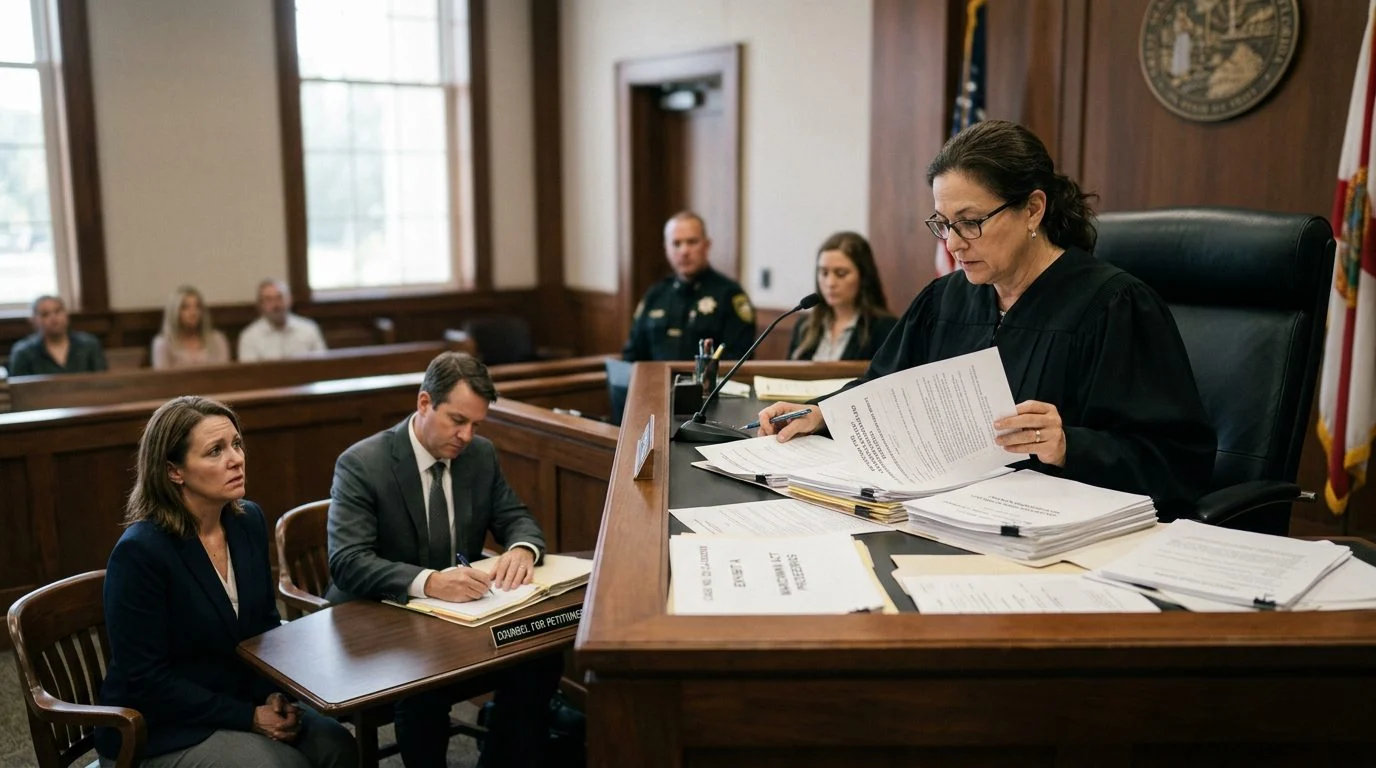
A judge decides at a hearing whether the criteria are proved and whether to order treatment. The court must find the conditions proved by clear and convincing evidence before it orders treatment (Fla. Stat. § 397.697).
The judge looks for a good-faith reason to believe the person is substance abuse impaired and has lost the power of self-control. The person must also need services they cannot see the need for, or be likely to neglect themselves or refuse care in a way that poses a real and present threat of substantial harm to their well-being, where it is not apparent that such harm may be avoided through the help of willing, able, and responsible family members or friends or other services, or there is a substantial likelihood they have inflicted or threatened harm on themselves or another (Fla. Stat. § 397.675). Fla. Stat. § 397.675 reads: “(b) Without care or treatment, is likely to suffer from neglect or refuse to care for himself or herself; that such neglect or refusal poses a real and present threat of substantial harm to his or her well-being; and that it is not apparent that such harm may be avoided through the help of willing, able, and responsible family members or friends or the provision of other services, or there is substantial likelihood that the person has inflicted, or threatened to or attempted to inflict, or, unless admitted, is likely to inflict, physical harm on himself, herself, or another.”
The petition goes to the clerk in the county where the person is located. The clerk may not charge a filing fee (Fla. Stat. § 397.681). The court must set the hearing within 10 court working days unless a continuance is granted (Fla. Stat. § 397.68151).
Testimony is taken under oath and recorded. The court may also order drug tests.
What happens when someone is placed under a Marchman Act petition?
A petition is filed, the person gets notice, and a hearing is set. The respondent has a right to counsel at every stage. A respondent who cannot afford a private lawyer may receive court-appointed counsel.
One Fifth District rule is worth knowing. In J.C. v. State, the court reversed where the judge called and questioned the only witness after the petitioner was absent. The petitioner carries the burden of proof (J.C. v. State). Treat this as Fifth District law, not a statewide rule.
If the judge grants the petition, the order can require up to 90 days of treatment from a licensed provider. The court can direct a sheriff to take the person into custody and deliver them to the provider if needed (Fla. Stat. § 397.697).
What Involuntary Treatment Looks Like Day to Day
Day to day, involuntary treatment happens at a licensed service provider, under the terms of the court order. The assessment shapes the plan. The report must contain a recommendation on the level of substance abuse treatment the person requires, if any (Fla. Stat. § 397.6957).
The person’s dignity must be respected at all times. An individual may not be deprived of any constitutional right while receiving services (Fla. Stat. § 397.501).
Contact is controlled. Providers set rules for telephone, mail, and visits. The statute says close supervision of communications is necessary, especially early in treatment. Providers must tell the individual, and the family if involved at admission, about those rules (Fla. Stat. § 397.501). Ask the provider to explain its rules early.
Before release, discharge planning must cover follow-up behavioral health appointments, how to get prescribed medications, living arrangements and transportation, and referral to recovery support (Fla. Stat. § 397.6977).
The first weeks can be hard for the family. A person may resist rules or push back. That reaction does not decide the case. Steady information from the provider helps families plan the next steps.
How Long Treatment Can Last and How Reviews Work
An initial court-ordered treatment period can last up to 90 days. Reviews happen through a renewal process before that period ends.
How long can you be held on the Marchman Act in Florida?
The first order runs up to 90 days. Observation holds are capped at 72 hours unless a listed exception applies.
If a service provider believes that a person nearing the scheduled date of release from involuntary treatment services continues to meet the criteria, a petition for renewal of the involuntary treatment services order must be filed with the court before the expiration of the court-ordered services period (Fla. Stat. § 397.6975). The service provider may file it, or the original petitioner may file it with the provider’s supporting documentation. The court must schedule the hearing within 10 court working days, to be held no more than 15 days after filing. Fla. Stat. § 397.6975 reads: “The hearing is conducted pursuant to ss. 397.6957 and 397.697 and must be held before the circuit court unless referred to a magistrate.” If the court grants renewal, it may order up to 90 more days (Fla. Stat. § 397.6975).
If no renewal is filed, the person is discharged automatically at the end of the 90 days (Fla. Stat. § 397.6977).
The court keeps jurisdiction over the case. It can monitor compliance, change the treatment approach, or start contempt proceedings for violating a valid order (Fla. Stat. § 397.697).
The court-ordered period is different from voluntary care. A person who no longer meets the criteria and gives informed consent can move to voluntary treatment status (Fla. Stat. § 397.6971).
Not sure what your next step is?
Talk it through with our team — the first consultation is free, confidential, and carries no obligation.
Can a Marchman Act Case Be Dropped or Ended Early?
A Marchman Act case can end early when a statutory ground applies. Grounds include discharge, dismissal, or the end of the ordered period.
Can a Marchman Act be dropped?
A petition can be dismissed, and an order can end early, only on the grounds the statute sets. A person may be discharged early when they no longer meet the criteria and give informed consent to voluntary status. If the individual was admitted on the grounds of likelihood of infliction of physical harm upon himself or herself or others, an individual may be determined eligible for discharge once such likelihood no longer exists (Fla. Stat. § 397.6971).
Once a qualified professional finds the person qualifies for early release, the provider must discharge them right away. The provider must also notify everyone the court named in the original order (Fla. Stat. § 397.6971).
No one can say in advance how a judge will rule on an early release request. Each request turns on the assessment and the facts at that time.
Who Pays for Services Under a Marchman Act Order
Under Florida law, the court can order publicly funded or privately funded treatment. Payment depends on who can pay.
Who pays for the Marchman Act in Florida?
The court can order treatment through a privately funded provider if the respondent can pay. It can also do so if someone acting for the respondent voluntarily shows both willingness and ability to pay (Fla. Stat. § 397.697). The court may also order the respondent to receive involuntary treatment services from a publicly funded provider for a period not to exceed 90 days (Fla. Stat. § 397.697).
Filing the petition carries no clerk fee (Fla. Stat. § 397.681). The court may prohibit, or a law enforcement agency may waive, any service of process fees if a petitioner is determined to be indigent.
Who pays depends on the facts of each case, including the person’s ability to pay and the provider named in the order.

Where to Go From Here If a Loved One Is Under an Order
If a loved one is in a facility under a court order, the next steps are learning the order’s terms, the review dates, and the choices in front of you. You did not choose this situation. You may be tracking several dates, a provider’s rules, and questions you did not expect.
Families in this position often need to decide whether to prepare for a renewal hearing, whether to contest a petition or renewal, and what the order means for contact and planning after release.
Robinson Casey focuses on Marchman Act petitions and guardianship matters for families in Miami-Dade, across South Florida, and statewide. Richard J. Casey III, Esq. is the responsible lawyer for this page.
Our first consultation is free, confidential, and carries no obligation to continue. Call (561) 849-4149 or use our contact page to talk through your loved one’s order and the dates ahead.
The Marchman Act Process at a Glance
1. The Petition
The process begins when a petition is filed with the court asking for an assessment of a family member who may be severely impaired by substance use.
2. Clinical Assessment
A licensed provider evaluates the person's condition and treatment needs, and the results are shared with the court.
3. The Court Hearing
A judge reviews the evidence and decides whether the legal criteria for involuntary treatment have been met.
4. Treatment and Stabilization
If the court orders treatment, the person receives care at a licensed provider, with the focus on stabilization and recovery.
How Robinson Casey Supports Families
Focused Practice
Robinson Casey limits its practice to Marchman Act petitions and guardianship matters, so the work stays centered on these proceedings.
Plain-Language Guidance
Our team explains each step of the process in clear terms, so families know what to expect at every stage.
Organized Preparation
We help families gather the information the court and the attorney need to understand the situation.
Confidential Conversations
Your first consultation is confidential, and it comes with no obligation to continue.
Families Across South Florida
We serve families in Miami-Dade and throughout South Florida, and we handle matters statewide.
Prepare Before You Meet With an Attorney
Write down recent incidents, gather medical and treatment history, and note any prior court filings. Clear details help your attorney understand the situation from the start.