
Marchman Act & Guardianship · South Florida
Baker Act or Marchman Act? Know the Difference Before You Act
Robinson Casey focuses on Marchman Act petitions and guardianship matters for families across South Florida and statewide.
By Richard J. Casey III, Esq. · Published October 20, 2026
The difference between a Baker Act and a Marchman Act comes down to the condition involved. The Baker Act deals with mental illness. The Marchman Act deals with substance abuse impairment. Both are Florida involuntary-treatment laws, but they sit in different chapters and follow different steps. This guide explains each one for families in South Florida and across the state.
The Short Answer: Mental Illness Versus Substance Impairment
The Baker Act covers mental illness, and the Marchman Act covers substance abuse impairment. That one difference often decides which law fits a family’s situation.
Under that statute, mental illness is an impairment of the mental or emotional processes. It affects a person’s conscious control of actions or ability to perceive reality. It also substantially interferes with ordinary daily life. For Baker Act purposes, the term does not include intoxication or conditions manifested only by substance abuse.
Substance abuse impairment works differently. It means using alcohol or another mood-altering substance so that a person has lost self-control. The use has also caused harm, or is likely to cause harm, to the person or to someone else.
The Marchman Act is a Florida law that covers substance abuse impairment. The sections below compare them side by side, starting with the Baker Act.
If your family is working out which Florida law applies to a loved one's crisis, you don't have to face it alone. Robinson Casey can talk it through with you. Talk it through with our team — the first consultation is free, confidential, and carries no obligation.

The Baker Act: Involuntary Examination for Mental Illness
Under Fla. Stat. § 394.463, a person may be taken to a receiving facility when there is reason to believe they have a mental illness. The person must also have refused a voluntary examination after a clear explanation of its purpose. Or the person must be unable to decide for himself or herself whether an examination is needed.
A court can start the process. A circuit or county court may enter an ex parte order, which is issued without the other side present. The order must rest on sworn testimony with specific facts. If less restrictive options are not available, a law enforcement officer or other agent of the court takes the person into custody and delivers them to a facility.
The facility is often a designated receiving facility. Florida law defines it as an approved public or private hospital, crisis stabilization unit, or addictions receiving facility. It provides emergency screening, evaluation, and short-term stabilization. The Florida Agency for Health Care Administration describes these units as providers of emergency psychiatric evaluation and short-term treatment.
The examination has a clear purpose. Under the statute, an involuntary examination determines whether a person qualifies for involuntary services. That finding guides what happens next.
The Marchman Act: Court Petition for Substance Abuse Impairment
The Marchman Act starts with a petition filed in court. For an adult, the petition goes to the clerk of the court in the county where the person is located. The clerk cannot charge a fee for filing it, under Fla. Stat. § 397.681.
Under Fla. Stat. § 397.68112, a petition for an adult may be filed by a spouse or legal guardian, any relative, a service provider, or an adult who has direct personal knowledge of the respondent’s substance abuse impairment and his or her prior course of assessment and treatment. The person must also meet the criteria. Under Fla. Stat. § 397.68111, a petition can follow protective custody or an emergency admission within the past 10 days. It can also follow an assessment by a qualified professional within 30 days.
Venue matters. In J.P. v. J.N., a Fifth District decision, the court held that filing in the wrong county was a venue defect, not a loss of jurisdiction.
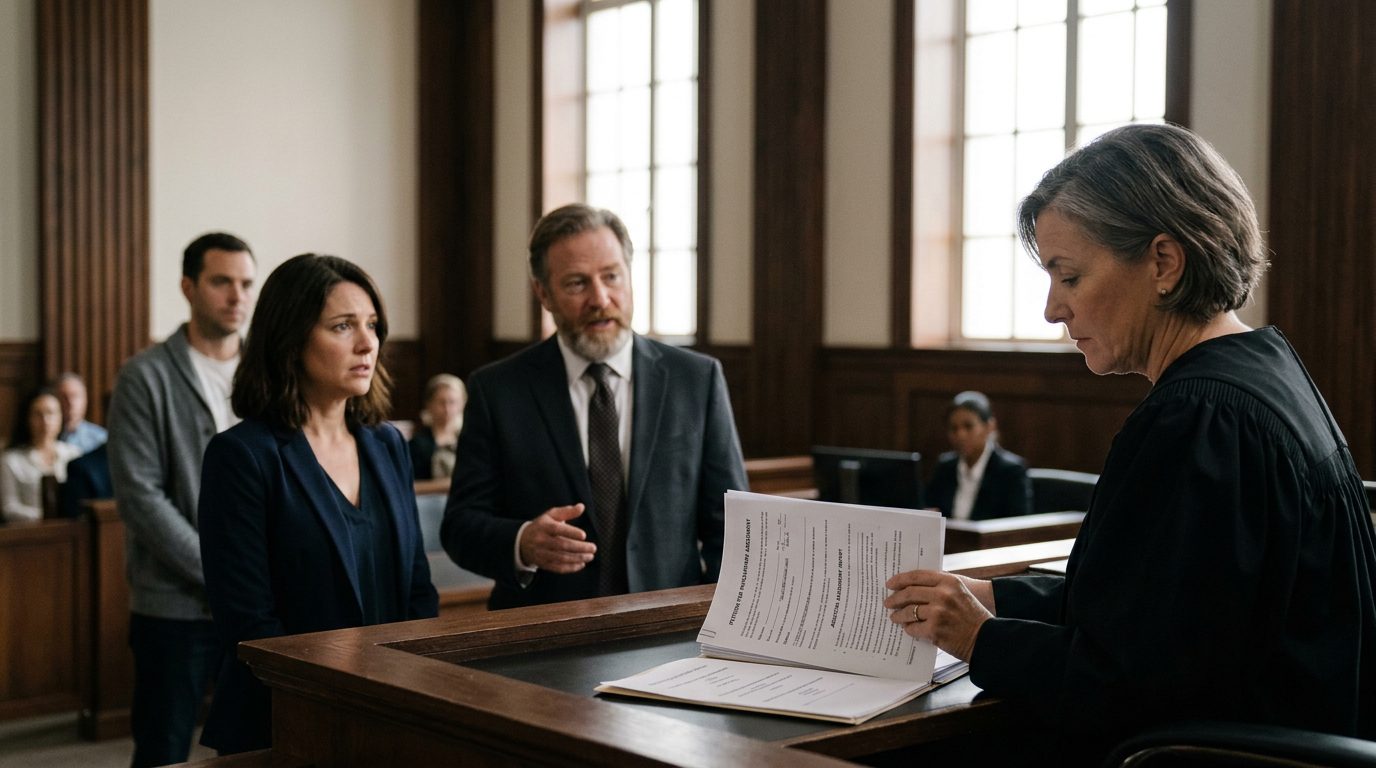
The process has several steps. First, the court may enter an ex parte assessment and stabilization order based on the petition. Under Fla. Stat. § 397.6818, when the petitioner asserts that emergency circumstances exist, or the court determines upon review of the petition that an emergency exists, the court may rely solely on the contents of the petition and, without appointing an attorney, enter an ex parte order for the respondent’s involuntary assessment and stabilization. A service provider may hold the person for no more than 72 hours of observation, subject to listed exceptions.
A judge then holds a hearing. Testimony at the hearing is taken under oath, and family members familiar with the person’s history may testify. The respondent must be present at the hearing on a petition for involuntary treatment unless the court finds that he or she knowingly, intelligently, and voluntarily waives the right to be present or, upon receiving proof of service and evaluating the circumstances of the case, that his or her presence is inconsistent with his or her best interests or is likely to be injurious to self or others; the court also reviews the qualified professional’s clinical assessment.
The court decides under Fla. Stat. § 397.697. The conditions must be proved by clear and convincing evidence. If they are, the court may order involuntary treatment services for up to 90 days. The petition itself must give a good faith reason to believe the criteria are met. In D.H. v. K.J.R., the Second District held that an ex parte order was error where the petition did not show that reason.
Key Differences at a Glance
The main difference is the condition. The Baker Act addresses mental illness, and the Marchman Act addresses substance abuse impairment.
- Condition: Mental illness under the Baker Act. Substance abuse impairment under the Marchman Act.
- Who starts it: The Baker Act can start with a court order, carried out by law enforcement. For an adult under the Marchman Act, a spouse or legal guardian, any relative, a service provider, or an adult who has direct personal knowledge of the respondent’s substance abuse impairment and prior course of assessment and treatment can file a petition.
- Court role: The Baker Act can begin with an ex parte court order. The Marchman Act is a court petition that ends in a hearing. The court keeps jurisdiction for later orders under § 397.697.
- Setting: The Baker Act uses designated receiving facilities. The Marchman Act uses licensed service providers.
- Time limits: Under the Marchman Act, observation is capped at 72 hours, subject to exceptions. A treatment order can run up to 90 days.
When Mental Illness and Substance Use Overlap
Many people have both a mental illness and a substance use problem. When both are present, the right law can be less clear.
Florida law addresses this overlap. The Marchman Act covers a substance use disorder with a co-occurring mental health disorder, under § 397.675. During a Marchman hearing, the court may start involuntary examination under Chapter 394 if it believes mental illness is also present. That step is set out in § 397.6957.
A family may meet both laws at different points. Labels don’t settle the question. A PMC article on treatment terminology notes that terms like involuntary treatment lack a shared meaning across U.S. behavioral health services. Which act applies depends on the facts, the assessments, and the court involved.
Do I Need a Marchman Act Attorney?
A person facing a Marchman petition has the right to a lawyer. Families can also seek legal help early, before a petition is filed.
Under § 397.681, the respondent has the right to counsel at every stage of the proceeding, which the respondent may waive if present and the court finds the waiver is knowing, intelligent, and voluntary. A respondent who cannot afford private counsel may receive court-appointed counsel. The Second District also held in Hillsborough County v. Albrechta that due process gives a respondent a constitutional right to counsel in these proceedings.
Robinson Casey focuses on Marchman Act petitions and guardianship matters. The firm serves families across South Florida and statewide. Richard J. Casey III, Esq. is the responsible lawyer for this page. Our attorneys focus on these matters for families facing a petition.
Who can file a Marchman Act petition?
For an adult, a spouse or legal guardian, any relative, a service provider, or an adult with direct personal knowledge of the substance abuse and of the person’s prior course of assessment and treatment can file. The petition must state the facts that support the need for services.
Where is a Marchman Act petition filed?
It is filed with the clerk of the court in the county where the person is located. The clerk cannot charge a fee for filing it.
Does the person have a right to a lawyer?
Yes. The respondent has the right to counsel at every stage, unless the respondent waives it while present and the court finds the waiver is made knowingly, intelligently, and voluntarily; a respondent who wants counsel and cannot afford it has the right to court-appointed counsel.
Not sure what your next step is?
Talk it through with our team — the first consultation is free, confidential, and carries no obligation.

Talk With Robinson Casey About Your Family’s Situation
Watching a loved one’s drinking or drug use turn dangerous is hard. Many families face the choice in the middle of a crisis they did not choose. You may be asking whether to file a petition now, or wait and see.
You don’t have to sort out these statutes alone. The first consultation is free, confidential, and carries no obligation to continue. Call (561) 849-4149 or request a consultation online.
Why Families Start with Robinson Casey
Focused practice
The firm focuses on Marchman Act petitions and guardianship matters, so its work centers on these proceedings.
Confidential first consultation
Your first consultation is free, confidential, and carries no obligation to continue.
South Florida and statewide
The firm serves families in Miami-Dade and across South Florida, and represents clients statewide.
Support for the whole family
Our team helps families understand the process, the paperwork, and the options available to them.
Don't Assume the Two Laws Work the Same Way
The Baker Act and the Marchman Act address different situations and follow different procedures. Choosing the wrong path can cost valuable time.
Key Questions to Think Through
What is the underlying concern?
The Marchman Act focuses on substance abuse, while the Baker Act focuses on mental health crises. Identifying the primary concern is the first step.
What kind of petition is needed?
Each statute uses its own petition process, filing requirements, and hearing procedures. The forms and facts that matter differ from one law to the other.
Who is involved in the process?
Families, service providers, and the courts each play a role. Understanding who participates in each process helps you prepare.