
Miami-Dade & South Florida
Marchman Act Petitions in Miami-Dade, Explained
Robinson Casey focuses on Marchman Act petitions and guardianship matters for families across South Florida and statewide. Call (561) 849-4149 to talk through your situation.
By Richard J. Casey III, Esq. · Published October 21, 2026
The Short Answer: Florida Circuit Court
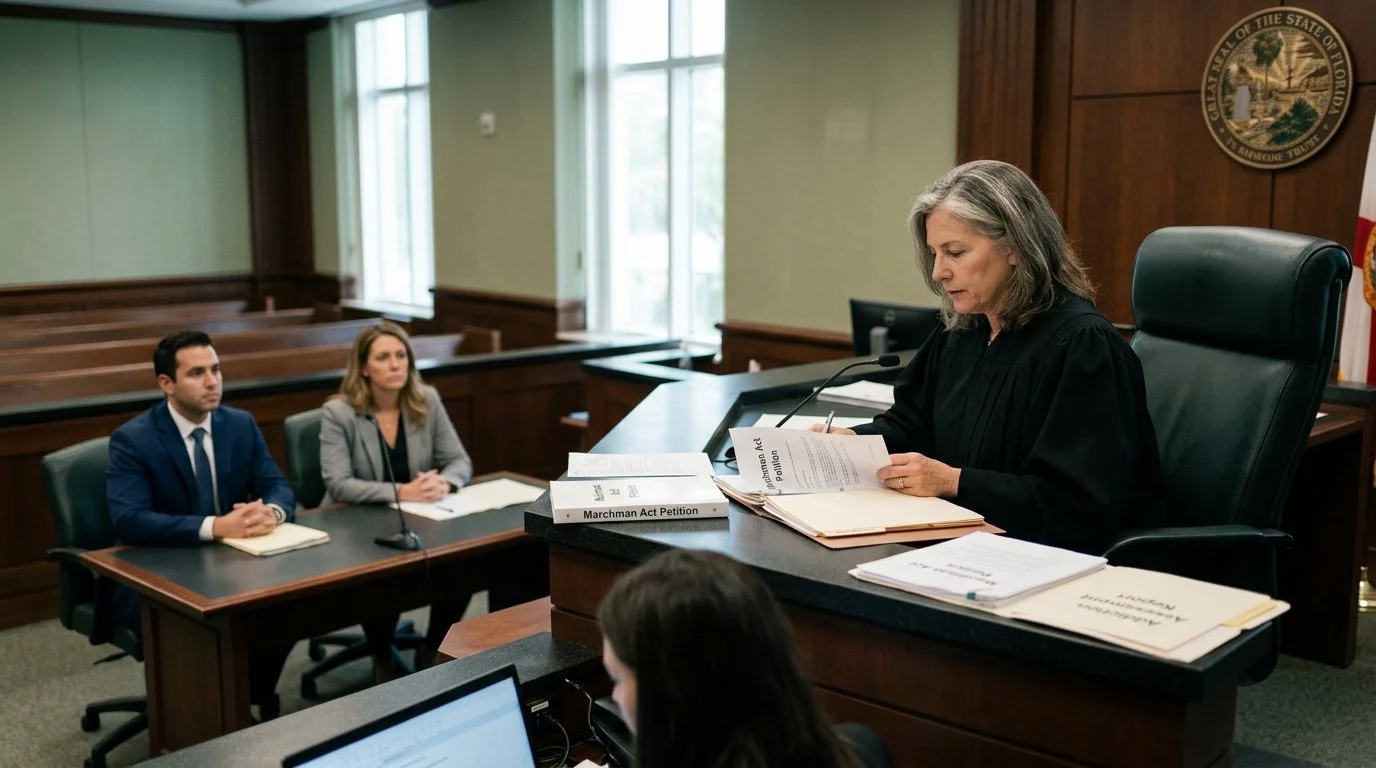
A Marchman Act petition goes to a Florida circuit court, filed with the clerk in the county where the person is located. It does not go to a drug court or a separate addiction court. The statute says the courts have jurisdiction over these petitions, and the petition must be filed where the person is.
The Marchman Act is Florida’s civil process for court-ordered assessment and treatment of a person with a substance use problem. It can apply when a person has lost the power of self-control about substance use. It can also apply when a person cannot make a rational choice about care, or may harm self or others. The rules sit in Florida Statutes Chapter 397. The criteria for involuntary admission spell out what the court looks for.
If a loved one’s drinking or drug use has become dangerous, you are asking the right first question. For the full overview, see our Marchman Act guide.
If you are weighing whether to file for someone you love who cannot make safe choices right now, we are glad to talk it through with you. Talk it through with our team — the first consultation is free, confidential, and carries no obligation.

Why the Circuit Court Hears These Petitions
Circuit courts hear Marchman Act petitions because the statute gives the courts authority over involuntary treatment petitions. A judge can order an assessment and stabilization. When the legal standard is met, the judge can order treatment. A police agency or a treatment provider cannot make that order on its own. The court’s role is what gives the order its force.
This page answers one narrow question: which court receives the petition. It does not try to describe the authority of every Florida court. Robinson & Casey focuses on Marchman Act petitions and guardianship matters, so this is the court question we work on most directly.
The judge does not act as a lawyer for either side. In R.S. v. C.P.T., the appellate court explained that the effect of the trial judge’s actions was to relieve the appellee of her burden of proof and to help her prove the essential elements of the case. Families should know that the petitioner, not the judge, carries the job of presenting the case.
Which County’s Circuit Court Receives the Petition
The petition goes to the county where the person is physically located when it is filed. That may not be the county where the family lives. The filing rule comes from the statute on involuntary petitions.
In J.P. v. J.N., the respondent was at a detox facility in one county while his home was in another. The Fifth District held that filing in the wrong county did not take away the circuit court’s jurisdiction. The appellate court in J.P. v. J.N. explained that filing the petition in the wrong county did not divest the circuit court in Putnam County of jurisdiction.
Our Miami-Dade filing guide covers local steps. Families in neighboring counties can read the South Florida overview.
One easy mistake is assuming the family’s home county controls. If a loved one is in Broward and the family lives in Miami-Dade, the loved one’s location matters most. Confirm that before filing, and raise it in a consultation.
What Happens Once the Petition Reaches the Circuit Court
The court must schedule a hearing within 10 court working days, unless a continuance is granted. The respondent must receive a copy of the petition and the notice of the hearing. The hearing and notice rules set out who must be notified.
Under § 397.68151, the court must schedule a hearing within 10 court working days unless a continuance is granted. Testimony is taken under oath, and the respondent may refuse to testify. See the hearing rules.
The respondent has a right to counsel at every stage. Florida’s Second District found that due process is involved, so a respondent has a constitutional right to counsel in these cases.
In an emergency, the court may enter an ex parte order based on the petition alone. The provider may hold the person for no more than 72 hours of observation, with listed exceptions. Fla. Stat. § 397.6957 reads: “The respondent’s assessment by a qualified professional must occur within 72 hours after his or her arrival at a licensed service provider unless the respondent shows signs of withdrawal or a need to be either detoxified or treated for a medical condition, which shall extend the amount of time the respondent may be held for observation until such issue is resolved but no later than the scheduled hearing date, absent a court-approved extension.” This is described in the court determination statute. A weak petition carries real risk. In D.H. v. K.J.R., the court held that an ex parte order was wrong where the petition did not give a good faith reason to believe the statutory criteria were met.
See the treatment order statute.
How a Marchman Act Case Differs from Drug Court and Guardianship
Drug court is a different kind of court program. This page covers only the Marchman Act petition, which asks the circuit court to order assessment and, when the law is met, treatment.
Guardianship asks a different question. Robinson & Casey focuses on guardianship matters too, including emergency temporary, plenary, limited, and mental health guardianships.
A Marchman Act petition and a guardianship can overlap in one family’s situation. The right route depends on the facts. A consultation can help sort that out.

Preparing for the Filing Decision
Before filing, know the county where the person is located. Also gather the facts that show why you believe the person meets the criteria, and any recent assessment. The petition contents statute requires the respondent’s name, the petitioner’s name, the relationship between them, the name of the respondent’s attorney if known, and the factual allegations showing the need for involuntary services. A report from a qualified professional who examined the person within 30 days can be attached.
For an adult, the petition may be filed by a spouse or legal guardian, any relative, a service provider, or an adult with direct personal knowledge of the impairment and treatment history. The who may petition statute sets this out. The clerk may not charge a fee for filing the petition (§ 397.681), and if a petitioner is found to be indigent, the court may prohibit, or a law enforcement agency may waive, service of process fees. Court records under this part are confidential and exempt from public records disclosure, but the clerk may disclose them upon request to listed persons, including the petitioner and the respondent.
If you are deciding this for someone you love who cannot make safe choices right now, the weight of that decision is real. You do not need every answer before you call. Robinson & Casey can talk through which county and court fit your family’s situation. The first consultation is free, confidential, and carries no obligation to continue. Call (561) 849-4149 or reach out through our contact page.
Responsible lawyer for this page: Richard J. Casey III, Esq.
Why Families Call Robinson Casey
A Focused Practice
Robinson Casey focuses on Marchman Act petitions and guardianship matters, so our attention stays on the court processes families in these situations face.
Careful Preparation
Our team helps organize the facts, records, and details that a Florida circuit court will need to review.
Miami-Dade and South Florida
We serve families in Miami-Dade and South Florida, and we represent clients statewide in these matters.
Free First Consultation
Your first consultation is free, confidential, and carries no obligation to continue.
Do Not Wait to Ask Questions
If you are worried about a loved one's substance use or safety, start writing down specific events, dates, and any statements or threats that concern you. Clear, dated facts help the court understand the situation. Contact Robinson Casey early so you can discuss your options before the situation escalates.
Matters Robinson Casey Handles
Marchman Act Petitions
Petitions filed in a Florida circuit court for court-ordered assessment and treatment of a person with a substance use problem.
Guardianship
Guardianship matters in Florida, including plenary and limited guardianship, handled with attention to the person's needs and the court's requirements.
Mental Health Guardianship
Guardianship matters involving a person's mental health condition and the decisions that condition affects.
Involuntary Commitment for Addiction
Court processes for involuntary commitment for addiction, tied to the Marchman Act framework.