
Marchman Act & Guardianship | Miami-Dade and South Florida
Florida Statute 397 Involuntary Treatment: A Family Guide
Clear answers for families facing a Marchman Act petition, involuntary commitment for addiction, or a guardianship matter. Robinson Casey focuses on these cases across South Florida and statewide.
By Richard J. Casey III, Esq. · Published October 30, 2026
When Your Loved One Can No Longer Make Safe Decisions
Under Fla. Stat. § 397.6818, when emergency circumstances exist, the court may rely solely on the contents of the petition and, without appointing an attorney, enter an ex parte order for the respondent’s involuntary assessment and stabilization, which must be executed while the hearing on the petition for treatment is pending. This page explains how that law works in plain terms, for families already in the middle of a crisis.
You may know this pattern well. There’s another hospital stay, a refusal of care, bills going unpaid, or a dangerous choice about where your loved one sleeps or drives. You may fear irreversible harm, financial exploitation, or the next psychiatric crisis.
Those fears make sense. You want a proper legal way to protect your family member and make necessary decisions for them. It is not a substitute for advice on your own facts, and the details of your situation decide what applies.
If your loved one keeps refusing care while money, housing, or safety are at risk, you don't have to sort out the court process alone. Talk it through with our team — the first consultation is free, confidential, and carries no obligation.

What Florida Statute Chapter 397 Covers
Chapter 397 covers Florida’s substance abuse and mental health services.
Each section covers one piece of the process: who qualifies, what a petition says, and how the court proceeds.
Search results also show older statute versions, some dated 2000, 2006, or 2022. The Legislature has amended Part V in recent sessions. In 2025, for example, both § 397.68141 (ch. 2025-143) and § 397.68151 (ch. 2025-10) were amended.
Who May File and What a Petition Must Address
For an adult, a spouse or legal guardian, any relative, a service provider, or an adult who has direct personal knowledge of the person’s impairment and prior course of assessment and treatment may file. For a minor, a parent, legal guardian, or service provider may file.
A petition must name the respondent (the person in crisis) and the petitioner (the person filing). It must also state their relationship and the facts behind the request. Under Fla. Stat. § 397.68141, the factual allegations in a petition for involuntary services must demonstrate the following:
- Why you believe the person is substance abuse impaired.
- Why you believe that impairment has caused a loss of self-control.
- Why you believe the person may harm themselves or others, or refuses care because impaired judgment blocks their decision.
Specific events carry more weight than general worry. Examples include a refusal of treatment after an overdose, repeated detox admissions, or spending that threatens housing. Mere refusal of services does not by itself show lack of judgment, according to Fla. Stat. § 397.675. Fla. Stat. § 397.675 reads: “(b) Without care or treatment, is likely to suffer from neglect or refuse to care for himself or herself; that such neglect or refusal poses a real and present threat of substantial harm to his or her well-being; and that it is not apparent that such harm may be avoided through the help of willing, able, and responsible family members or friends or the provision of other services, or there is substantial likelihood that the person has inflicted, or threatened to or attempted to inflict, or, unless admitted, is likely to inflict, physical harm on himself, herself, or another.” A facially insufficient petition can fail, as the court in D.H. v. K.J.R. held.
The Court Process: Assessment, Stabilization and Hearing
The court first decides whether the person needs an attorney and schedules a hearing within 10 court working days, unless a continuance is granted. See Fla. Stat. § 397.68151. The petition goes to the clerk in the county where the person is located, and the clerk may not charge a filing fee. See Fla. Stat. § 397.681. The Miami-Dade Clerk directs adult matters to Probate Court and minor matters to Juvenile Court.
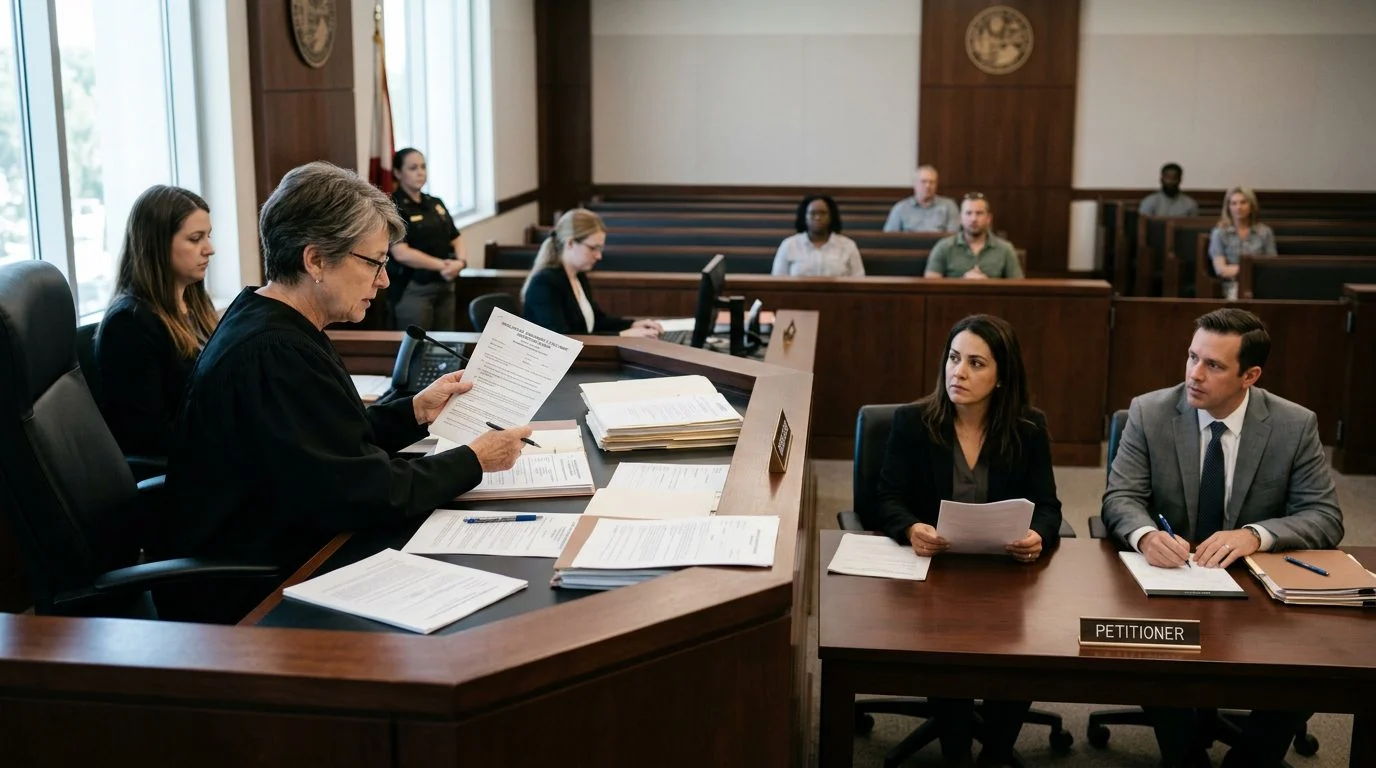
In an emergency, the court may rely on the petition alone and enter an ex parte order for assessment and stabilization without appointing an attorney. A service provider may hold the person for up to 72 hours of observation, subject to listed exceptions. See Fla. Stat. § 397.6818.
See Fla. Stat. § 397.6957. See Fla. Stat. § 397.6957. See Fla. Stat. § 397.697. See Fla. Stat. § 397.6975.
Involuntary Services Compared With Assisted Outpatient Treatment
Involuntary outpatient treatment lets a person receive court-ordered services while living outside a facility. It has specific conditions. Under § 397.697, the person must be supported by a social worker or case manager of a licensed service provider, or by a willing, able, and responsible individual the court appoints who must tell the court and parties if the person fails to comply with the outpatient program.
The services must also be available in the county where the person is located. The person must be likely to follow a prescribed outpatient care plan. An assessment expressly recommending outpatient services is also required.
Inpatient-style orders and outpatient orders use the same statute, so the facts of each case determine which fits.
Where Guardianship Fits When Addiction and Mental Health Overlap
Part V and guardianship address different needs, though they can overlap in the same family.
An involuntary admission may rest on a substance use disorder with a co-occurring mental health disorder. See Fla. Stat. § 397.675. When both conditions are present, a family may need decisions about medical care, money, and housing that a treatment order does not address.
Robinson Casey handles emergency temporary, limited, plenary, and mental health guardianship matters. Each is a separate court tool with its own scope. The right tool depends on the facts, the decisions that need to be made, and the court’s view of the person’s needs. For an overview of the Marchman Act practice, see the Marchman Act attorney overview.
Not sure what your next step is?
Talk it through with our team — the first consultation is free, confidential, and carries no obligation.
When a Spouse or Partner Is Hiding Substance Use
A spouse can file a Part V petition for an adult respondent. An adult with direct personal knowledge of the impairment and prior treatment can also file. See Fla. Stat. § 397.68112.
Concealment makes this harder. The petition must still state facts showing why you believe impairment exists. Missing money, hidden pills, or unexplained absences can be the details a petition describes. If the person was never assessed, or refused an assessment, the petition must say so. See Fla. Stat. § 397.68141.
See Fla. Stat. § 397.681.

Talk With Robinson Casey About Your Family’s Situation
Robinson Casey limits its practice to Marchman Act petitions and guardianship matters. Richard J. Casey III, Esq. is the responsible lawyer for this page.
Quick Answers
A parent, legal guardian, or service provider may file for a minor.
Which county handles the petition?
The petition goes to the clerk in the county where the person is located.
Is there a filing fee?
The clerk may not charge a fee to file the petition under this section.
Does the person have a right to a lawyer?
Yes. The respondent has the right to counsel at every stage of the proceeding, however, the respondent may waive that right if the respondent is present and the court finds that such waiver is made knowingly, intelligently, and voluntarily.
If your loved one keeps refusing care while money, housing, or safety are at risk, you don’t have to sort out the court process alone. Call (561) 849-4700 or request a consultation. The first consultation is free, confidential, and carries no obligation to continue.
How Robinson Casey Can Help Your Family
Guardianship Matters
Our attorneys guide families through guardianship proceedings, including emergency temporary, plenary, and limited guardianship.
Mental Health Guardianship
We assist families seeking protective arrangements for an adult who cannot safely manage personal or financial decisions.
Support for Families
Our team keeps families informed at each step, with plain-language explanations of what to expect.
If Someone Is in Immediate Danger
Call 911 first. Then contact our office so we can discuss the petition or guardianship options that may apply to your family's situation.
Key Terms Families Often Hear
Petition
The written request filed with the clerk asking the court to order an evaluation or treatment for a person under Chapter 397.
Respondent
The person named in the petition, whose rights and wellbeing the court considers throughout the proceedings.