
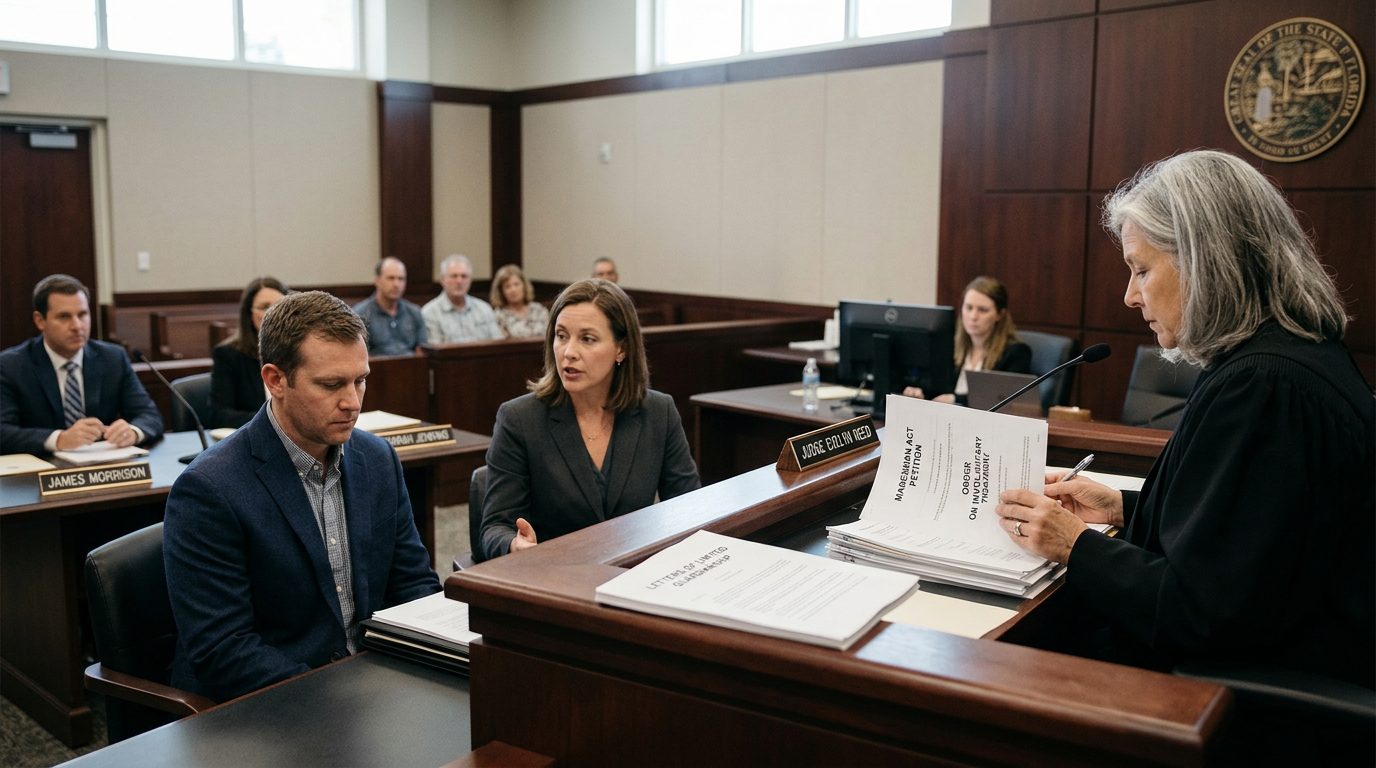
Marchman Act & Guardianship
Can You Force an Adult Into Rehab in Florida? Legal Options Explained
Florida law provides pathways to seek involuntary treatment for substance abuse. Learn how the Marchman Act works and when it applies.
By Richard J. Casey III, Esq. · Published September 28, 2026
Can You Force an Adult Into Rehab in Florida? Legal Requirements
No—you cannot force an adult into rehab in Florida without legal authority. Attempting to do so could expose you to civil or criminal liability. However, Florida law does provide a specific statutory mechanism: the Marchman Act allows families, healthcare providers, and others to petition a court for an involuntary commitment order when a person’s substance abuse poses imminent danger to themselves or others.
This page explains what the law actually permits, what “imminent danger” means, and how the process works.
If you're watching a family member's substance abuse create an immediate crisis and you're unsure whether legal intervention is possible, families in your situation reach out to discuss the Marchman Act pathway and what it could mean for your loved one. Talk it through with our team — the first consultation is free, confidential, and carries no obligation.

The Short Answer: Ordinary Force Is Not Legal
Adults in Florida have the right to refuse substance abuse treatment, even when family members believe treatment is necessary. You cannot physically compel an adult into a rehab facility without court authority.
Attempting to force someone into treatment without legal process can result in:
- Civil liability (a lawsuit for false imprisonment or intentional infliction of emotional distress)
- Criminal charges (kidnapping, unlawful restraint, or battery)
- Damage to your relationship with the person and their trust in you
The key point: the person’s legal right to refuse treatment is real and enforceable. Your belief that treatment is necessary does not override that right—but Florida law does recognize situations where a court can override it.
The Marchman Act: Florida’s Legal Path to Involuntary Treatment
The Marchman Act (Fla. Stat. § 397.675) is the statute that permits involuntary commitment for substance abuse in Florida. It allows family members, healthcare providers, law enforcement, and others to petition a court for an order requiring treatment.
The Marchman Act does not give families the power to force treatment directly. Instead, it gives a court the power to order it, after a legal hearing and a finding that the legal threshold has been met.
The petition must demonstrate that the person poses an imminent danger to themselves or others due to substance abuse. The court, not the family, makes the final decision about whether to grant the petition and order treatment.
What “Imminent Danger” Means Under Florida Law
Imminent danger is not merely the possibility of future harm or chronic substance abuse. It must be immediate and substantial—a real, present threat.
Examples that may meet this threshold include:
- Active overdose risk or recent overdose
- Severe withdrawal symptoms requiring medical intervention
- Behavior that directly endangers the person (driving while intoxicated, self-harm)
- Behavior that directly endangers others (violence, reckless endangerment)
- Inability to care for basic needs due to acute intoxication or withdrawal
Chronic substance abuse alone—even serious addiction—typically does not meet the legal threshold unless there is an acute crisis or imminent risk of harm. The court evaluates the specific facts and circumstances of each case.
Who Can File a Marchman Act Petition
The following people can file a petition under the Marchman Act:
- A spouse, parent, adult child, or sibling of the person
- A healthcare provider or addiction treatment professional
- A law enforcement officer
- Any other person who has knowledge of the person’s substance abuse and its effects
You do not need to be a family member to file, but you must have personal knowledge of the substance abuse and its impact.
The Marchman Act Process: From Petition to Court Order
The process typically unfolds as follows:
1. Filing the petition
A petition is filed with the court in the county where the person resides or is found. The petition describes the person’s substance abuse, the imminent danger, and the facts supporting the petition.
2. Ex parte emergency order (if applicable)
The court may issue an ex parte order (without the person present) if the evidence supports imminent danger. This allows for emergency temporary commitment without waiting for a full hearing. The person may be transported to a treatment facility or held for evaluation.
3. Notice and hearing
The person has the right to a hearing, typically within a few days, to contest the petition. They have the right to legal counsel and the right to cross-examine witnesses.
4. Court decision
If the court finds imminent danger based on clear and convincing evidence, it can order the person into treatment for up to 5 days of evaluation and stabilization.
5. Continued treatment (if warranted)
After evaluation, the court may order continued treatment if the person still meets the legal criteria.
Not sure what your next step is?
Talk it through with our team — the first consultation is free, confidential, and carries no obligation.
Emergency Temporary Involuntary Commitment
Florida law allows for emergency temporary commitment when imminent danger is present and immediate action is necessary. This can happen without a full court hearing if the evidence is compelling—for example, if the person is actively overdosing or in acute withdrawal.
The person must be brought before a judge within a specified timeframe (typically 24 hours) for a hearing. This is a short-term measure designed to stabilize the person and allow for medical evaluation and assessment.
Emergency temporary commitment is not the same as long-term involuntary treatment; it is a bridge to evaluation and decision-making.
What Happens After a Court Order for Treatment
Once a court orders involuntary treatment, the following typically occurs:
- The person is admitted to a treatment facility designated by the court or agreed upon by the parties
- Treatment begins with medical evaluation and stabilization
- The facility develops a treatment plan based on the person’s medical and psychological needs
- The person retains certain legal rights during treatment, including the right to legal counsel and the right to contest continued commitment
- The court may order continued treatment if the person still meets the legal criteria after the initial period
The goal is stabilization and evaluation, not long-term sobriety. Involuntary treatment is most effective when combined with the person’s own willingness to engage in recovery.
Limitations and Important Considerations
The Marchman Act is not a tool for general life management or to force someone into treatment simply because they have a substance abuse problem. It requires a specific legal finding of imminent danger, which is a high threshold.
Key limitations:
- Imminent danger is required. Chronic addiction alone, without acute crisis, typically does not meet the legal standard.
- The person retains rights. They can contest the petition, have legal representation, and challenge continued commitment.
- Repeated petitions are possible. If the person continues to pose imminent danger after release, another petition may be filed.
- Involuntary treatment has limits. Forcing someone into treatment does not ensure engagement or recovery. The person’s own motivation and willingness to participate are critical factors.
The Marchman Act is designed to intervene in crisis and create an opportunity for evaluation and treatment—not to solve addiction through force alone.
Frequently Asked Questions
Can I file a Marchman Act petition if the person is not in Florida?
No. The petition must be filed in the county where the person resides or is found. If the person is out of state, Florida courts do not have jurisdiction.
What evidence do I need to file a Marchman Act petition?
You need specific facts about the person’s substance abuse, the imminent danger it poses, and your personal knowledge of the situation. Vague concerns or general statements are not sufficient.
What happens if someone refuses treatment after a Marchman Act order?
If the person refuses treatment after a court order, they may face contempt of court charges. The court can also modify the order or extend the commitment period.
How long does involuntary commitment typically last?
The initial commitment is usually 5 days for evaluation and stabilization. After that, the court may order continued treatment if the person still meets the legal criteria, or the person may be released.
Can I file multiple Marchman Act petitions for the same person?
Yes, if the person continues to pose imminent danger after release, you can file another petition. Each petition is evaluated on its own facts.

When to Contact a Marchman Act Attorney
If you’re facing a situation where a family member’s substance abuse has created an immediate crisis—active overdose risk, severe withdrawal, or behavior that endangers them or others—understanding your legal options matters.
A Marchman Act attorney can help you:
- Assess whether your situation meets the legal threshold of imminent danger
- Understand the petition process and what to expect in court
- Prepare the petition and supporting evidence
- Represent your interests at the hearing
- Explore other legal options if the Marchman Act does not fit your circumstances
If you believe a family member’s substance abuse poses imminent danger to themselves or others and you’re unsure whether legal intervention is possible, families in your situation reach out to discuss the Marchman Act pathway and what it could mean for your loved one. Contact Robinson & Casey to schedule a consultation and learn how the law may apply to your family’s circumstances.
Call (561) 849-4149 or reach out online to speak with a Marchman Act attorney.
Jurisdiction Matters
A Marchman Act petition must be filed in the Florida county where the person resides or is found. If the individual is out of state, Florida courts do not have jurisdiction to order treatment.
What You Need to Know About Involuntary Commitment in Florida
The Marchman Act Process
Florida's Marchman Act allows family members, healthcare providers, or law enforcement to petition a court for involuntary assessment and treatment of substance abuse. The petition must show that the person's substance abuse poses an imminent danger to themselves or others.
Evidence Required
You will need specific facts documenting the person's substance abuse and the imminent danger it creates. This may include medical records, witness statements, or documentation of harmful behavior related to drug or alcohol use.
Types of Court Orders
A judge may issue an emergency ex parte order for immediate assessment, or schedule a full hearing. Orders can authorize involuntary assessment, stabilization, or long-term treatment depending on the circumstances and evidence presented.
Who Can File
Parents, guardians, adult children, spouses, physicians, mental health professionals, and law enforcement may petition the court. The petitioner must have direct knowledge of the person's substance abuse and the danger it poses.
Robinson & Casey Handles Marchman Act & Guardianship Matters
Marchman Act Petitions
We prepare and file petitions for involuntary assessment and treatment of substance abuse under Florida law.
Guardianship Representation
We handle emergency temporary guardianship, plenary guardianship, limited guardianship, and mental health guardianship matters for families across Florida.
Urgent Situations
When immediate action is needed, we work quickly to file emergency petitions and seek temporary orders to protect your loved one.
Statewide Service
We serve families throughout South Florida and statewide, handling Marchman Act and guardianship cases across Florida counties.