
Marchman Act & Guardianship | South Florida & Statewide
Worried About a Grandchild? Get Answers From a Marchman Act Attorney
Robinson Casey focuses on Marchman Act petitions and guardianship matters for families in Miami-Dade, South Florida and across Florida. Find out where your family stands.
By Richard J. Casey III, Esq. · Published October 29, 2026
Can a Grandparent File a Marchman Act Petition for an Adult Grandchild?
Yes. A grandparent is a relative, and Florida law lets any relative file a petition for involuntary treatment services for an adult with a substance abuse impairment. Fla. Stat. § 397.68112 sets out who may file.
Watching a grandchild spiral is hard. You may be the one answering late-night calls, noticing unsafe choices, and wondering what comes next. Many grandparents feel they have no legal option. The Marchman Act is one option, and it starts with a petition filed in court.
A petition doesn’t give you automatic power over your grandchild’s decisions. It asks a judge to review specific facts and decide whether the legal standard is met. This page covers who can file, how the process works, how guardianship differs, what it costs to start, and what to expect next.
If your grandchild is cycling through crises and you feel you have no legal path, you don't have to take the next step alone. Talk with us about the facts. Talk it through with our team — the first consultation is free, confidential, and carries no obligation.

The Marchman Act Explained: Purpose, Who It Covers, and Who Can Petition
Florida’s Marchman Act is the state law for adults and youth severely impaired by substance abuse. It allows court-ordered assessment, stabilization, and treatment. It also allows voluntary admission. The DCF Marchman Act overview describes the law’s purpose.
A judge can order involuntary services only when the facts meet the statute. Florida law sets out the criteria for involuntary admission for substance abuse impairment:
- A good faith reason to believe the person is substance abuse impaired.
- Loss of self-control over substance use because of that impairment.
- The person must be substance abuse impaired and have a history of not complying with substance abuse treatment; because of that impairment, the person must be unlikely to voluntarily participate in the recommended services or unable to decide for himself or herself whether services are necessary, and either judgment so impaired by substance abuse that the person is incapable of appreciating the need for care and of making a rational decision about it, or neglect or refusal that poses a real and present threat of substantial harm to the person’s well-being, together with a substantial likelihood of serious bodily harm to self or others in the near future, as evidenced by recent behavior.
A petition must name you and the person. It must state how you are related and lay out the factual reasons behind your belief. Fla. Stat. § 397.68141 requires those facts. If the person was never assessed, or refused an evaluation, the petition must say so. Dated, specific incidents give a judge something concrete to review. General worry does not.
Guardianship Options When a Marchman Petition Is Not the Right Tool
Guardianship addresses an adult who cannot make safe decisions about medical care, money, housing, or daily life. A Marchman petition addresses a substance use crisis. Which tool fits depends on the facts.
- Emergency temporary guardianship. After a petition to determine incapacity has been filed, and before a guardian is appointed, the court may appoint an emergency temporary guardian if it finds imminent danger that the person’s physical or mental health or safety will be seriously impaired, or that the person’s property is in danger of being wasted, misappropriated, or lost, unless immediate action is taken. Fla. Stat. § 744.3031 limits this authority to 90 days after appointment or until a guardian is appointed, whichever occurs first, with one possible 90-day extension if the emergency conditions still exist.
- Plenary guardianship. Broad authority over personal and property decisions, used when an adult needs help across most areas of life.
- Limited guardianship. Authority only over the specific decisions the adult cannot make.
- Mental health guardianship. Authority tied to psychiatric conditions and treatment decisions.
- Involuntary commitment for addiction. The Marchman process itself, for concerns centered on substance use.
Incapacity findings are narrow. A court must find incapacity on clear and convincing evidence. It can remove only the rights the person cannot exercise.
How the Process Works, Step by Step
A Marchman case moves through five stages, from consultation and records to filing, hearing, and court follow-up.
- Consultation. Review recent incidents, hospital stays, refused care, and any existing court orders.
- Records. Collect hospital and crisis records, a medication history, and a dated log of incidents written as plain facts.
- Filing. The petition goes to the clerk of the court in the county where the person is physically located. In J.P. v. J.N., a filing in the wrong county did not take away the circuit court’s jurisdiction.
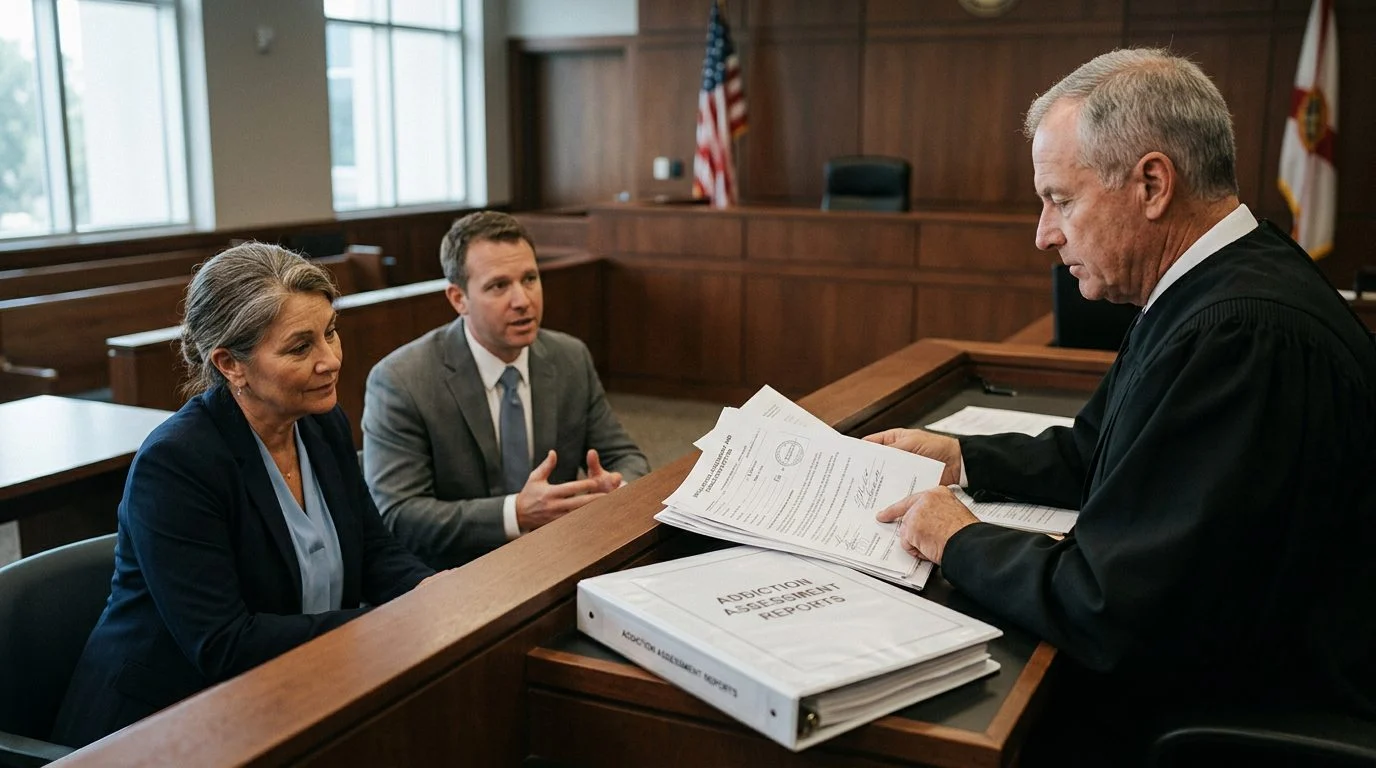
- Hearing. The court must schedule a hearing within 10 court working days unless it grants a continuance. Fla. Stat. § 397.68151 sets that deadline. The court hears relevant evidence, including testimony from family members who know the person’s history. Fla. Stat. § 397.6957 covers that testimony.
- Order and follow-up. If the court finds the conditions proved by clear and convincing evidence, it may order involuntary treatment for up to 90 days. Fla. Stat. § 397.697 lets the court keep jurisdiction for further orders.
Plan to attend the hearing yourself. In J.C. v. State, the petitioner carried the burden of proof, and the Fifth District reversed an order where the petitioner was absent. The Fourth District has certified conflict with that line of cases. The time between stages varies with the court’s calendar.
Costs and the Free First Consultation
The first consultation is free, confidential, and comes with no obligation to continue. Several costs can still arise, so know them early.
- Service fees. The court may prohibit service of process fees for a petitioner found indigent.
- Treatment costs. Before admission, a provider must disclose the full charge and the fee owed under its payment policy. Individuals contribute based on ability to pay. Fla. Stat. § 397.431 requires that, before a provider accepts an individual for admission, both the full charge for services and the fee charged to that individual under the provider’s fee system or payment policy be disclosed.
Bring your incident log, records, medication list, and any court papers to the first meeting. Gathering records early keeps the process moving.
Why Families Work With Robinson Casey
Robinson Casey limits its practice to Marchman Act petitions and guardianship matters. The firm serves families across South Florida and statewide.
- The practice covers Marchman Act petitions, guardianship, emergency temporary guardianship, plenary and limited guardianship, mental health guardianship, and involuntary commitment for addiction.
- Richard J. Casey III, Esq. is the responsible lawyer for this page.
- Support staff, including assistants and office staff, handle document organization and scheduling. Families get a clear point of contact.
- Our team helps families keep records organized and track court dates.
Not sure what your next step is?
Talk it through with our team — the first consultation is free, confidential, and carries no obligation.
Frequently Asked Questions
What states have the Marchman Act?
It is Florida’s law. This page covers Florida only.
Can a grandparent file if the parents disagree?
Florida law lets any relative file for an adult. Family members who know the history can testify at the hearing.
Does the clerk charge a fee to file?
Is refusing help enough for a petition?
No. Refusing help alone does not show impaired judgment, so the petition needs facts that show more.
Does a grandparent need a lawyer?
Under Fla. Stat. § 397.68151(1), the court determines whether the respondent is represented by an attorney or whether appointment of counsel for the respondent is appropriate. Whether you are a petitioner or the person named in a petition, you can speak with a lawyer about your situation. Contact Robinson Casey for a free, confidential initial consultation with no obligation to continue.
This section does not set how long treatment may last. It says appointed regional counsel represents the person until the petition is dismissed, the court order expires, the person is discharged from involuntary treatment services, or the office is otherwise discharged by the court.

Next Step: Talk Through Your Grandchild’s Situation
If your grandchild is stuck in repeated hospital stays, refused care, and unsafe choices, you don’t have to map out the legal path alone. A consultation can review your facts and show which option may fit.
Call (561) 849-4149 or request a consultation to talk through what you’re seeing. For more on family options, read the Marchman Act attorney for relatives guide.
Matters We Handle
Marchman Act Petitions
Guidance on petitions under Florida's Marchman Act for a family member struggling with substance use.
Involuntary Commitment for Addiction
Help understanding the process and what to expect when a loved one needs court-ordered treatment.
Emergency Temporary Guardianship
Support when a person needs immediate protection and a court-appointed guardian is necessary without delay.
Plenary and Limited Guardianship
Guidance on guardianship options, from broad authority to narrower arrangements tailored to the person's needs.
Mental Health Guardianship
Assistance for families seeking court oversight of decisions for a relative with a mental health condition.
Why Families Start With Robinson Casey
Free First Consultation
Your first consultation is free, confidential and comes with no obligation to continue.
Direct Access
Call (561) 849-4149 to speak with our team about your family's situation.
Focused Practice
Robinson Casey focuses on Marchman Act and guardianship matters, the areas where our lawyers concentrate their work.
South Florida and Statewide
We serve families in Miami-Dade and South Florida, and across the state.
Don't Wait Until the Crisis Peaks
Family members often reach out when a situation is already urgent. Getting clear information early can help you understand your options and prepare for what comes next.