
Marchman Act Attorney | South Florida and Statewide
Getting Help for Cocaine Use Starts With a Clear Plan
Robinson Casey focuses on Marchman Act petitions and guardianship matters for families across South Florida and statewide. Talk with us about your situation.
By Richard J. Casey III, Esq. · Published October 29, 2026
A Marchman Act petition asks a Florida court to order assessment and treatment for an adult whose substance use has taken over daily life. This guide explains how a Marchman Act cocaine Florida case works, from the first petition to the hearing. If your spouse’s use has made home feel unsafe, you need a clear picture of your options. Robinson & Casey limits its practice to Marchman Act petitions and guardianship matters, serving families in Miami-Dade, South Florida and statewide.
What the Marchman Act Covers for Cocaine and Stimulant Use
A Marchman Act cocaine case in Florida runs through the same statute as cases involving alcohol or other drugs. The law sits in Chapter 397 of the Florida Statutes and focuses on assessment, stabilization and treatment. Families often turn to this process when a spouse refuses voluntary care, after a serious incident, or when use keeps getting worse. The court asks whether the statutory criteria are met and whether the person needs court-ordered help.
If cocaine use has turned your home upside down, you don't have to face the next step alone. Talk with Robinson & Casey about what the Marchman Act offers your family. Talk it through with our team — the first consultation is free, confidential, and carries no obligation.

Who Can File and Who Qualifies Under Florida Law
A spouse can file a Marchman Act petition for an adult. A legal guardian, any relative, a service provider, or an adult with direct personal knowledge of the person’s impairment and prior course of assessment and treatment can file too. Fla. Stat. § 397.68112 sets out who may file.
To qualify, the person must be substance abuse impaired and have lost the power of self-control about substance use. The person must also need services. Fla. Stat. § 397.675 lists these criteria.
A refusal alone does not prove lack of judgment, the statute says. In a household, the facts that matter often include missed work, unsafe driving, threats, neglect of the children and money losses. Record each incident with dates, places and who saw it.
How the Process Works: From Petition to Hearing
The process starts when a petition is filed with the clerk of the court in the county where the person is physically located. In J.P. v. J.N. (Fla. Dist. Ct. App. 2017), the court stated: “However, the filing of the petition in the wrong county did not divest the circuit court in Putnam County of jurisdiction.”
- Petition. It names the person, the petitioner, their relationship, the person’s attorney if known, and the factual allegations supporting the need for services. It may include an assessment report from a qualified professional who examined the person within 30 days before filing. The clerk may not charge a filing fee. See Fla. Stat. § 397.68141 and Fla. Stat. § 397.681.
- Hearing. If the respondent does not appear, the court must reasonably believe the respondent meets the commitment criteria and that a substance abuse emergency exists before it may issue or reissue an ex parte order. If the respondent’s location is known, the court must continue the case for no more than 10 court working days; otherwise, the petitioner must inform the court that the respondent has been assessed so the court can schedule a hearing as soon as practicable. If the respondent has not been assessed within 90 days, the court must dismiss the case.
- Treatment order. If the conditions are proved by clear and convincing evidence, the court may order treatment for up to 90 days. Fla. Stat. § 397.697
Before the first meeting with a lawyer, gather dates, texts, bank statements and any prior assessments.
What to Expect on Timing and at the Hearing
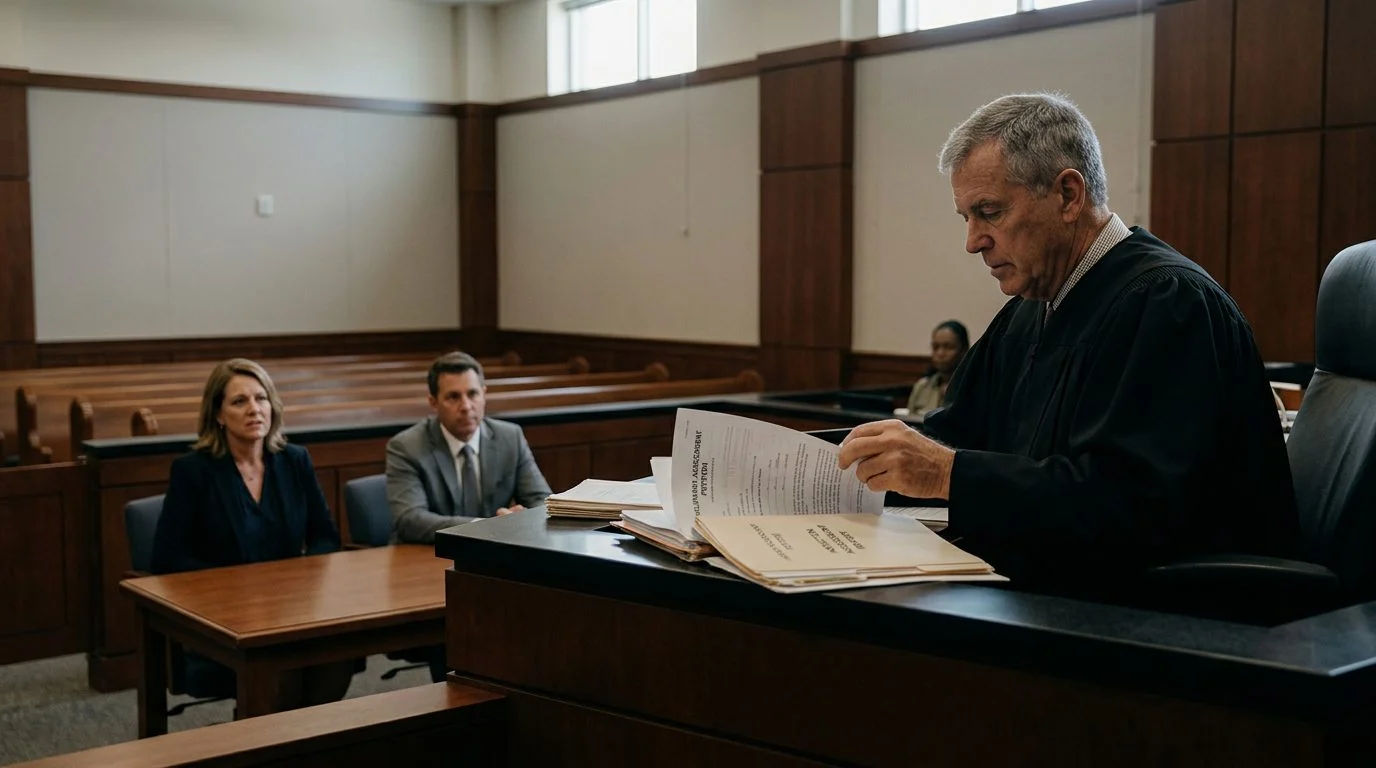
Timing depends on the facts, the county and the court’s calendar. The hearing is the central event, and the respondent must be present unless the right to be present is properly waived or the court finds, after receiving proof of service and evaluating the circumstances, that presence is inconsistent with the respondent’s best interests or is likely to be injurious to self or others. The court hears all relevant evidence, including testimony from family members who know the person’s history. Testimony is under oath, and witnesses may testify remotely as appropriate if they provide the parties with all relevant documents by the close of business on the day before the hearing, and the court may order drug tests. The respondent may refuse to testify. Fla. Stat. § 397.6957 sets these rules.
Your role is to stay reachable, answer the court’s questions truthfully and keep accurate records. Florida’s appeals courts have not spoken with one voice on how far a judge may question witnesses when the petitioner is absent. The Fifth District has held that a court failed to follow the statute when it questioned the only witness in that situation. In J.J.J. v. D.G., the court stated: “we certify conflict with R.S., J.W., and C.W.R.K., for the reasons stated above. Affirmed; conflict certified.” No outcome can be predicted in advance.
When Cocaine Use Comes With Mental Illness
When substance use and a mental health condition overlap, the statute’s criteria address both. Fla. Stat. § 397.675 covers a person with a substance use disorder and a co-occurring mental health disorder. Describe any psychiatric hospitalization, emergency room visit or serious incident with dates and details. Describe what you saw and heard, such as agitation, paranoia or sleeplessness, rather than guessing at a diagnosis. Examination proceedings for other mental illness are provided in Fla. Stat. § 397.6957(4). Fla. Stat. § 397.6957 reads: “If at any point during the hearing the court has reason to believe that the respondent, due to mental illness other than or in addition to substance abuse impairment, meets the involuntary commitment provisions of part I of chapter 394.” Fla. Stat. § 397.6957 provides that the respondent must be present at a hearing on a petition for involuntary treatment services unless the court finds that he or she knowingly, intelligently, and voluntarily waives his or her right to be present or, upon receiving proof of service and evaluating the circumstances of the case, that his or her presence is inconsistent with his or her best interests or is likely to be injurious to self or others.
Protecting the Children and the Household While the Case Moves
Protect the children first, and call 911 whenever someone is in immediate danger. A Marchman Act case moves on the court’s timetable, so the household needs a plan while it does. Start with these steps:
- Keep a dated log of incidents, including what happened, who saw it and whether children were present.
- Save texts, voicemails and photos that show threats or unsafe conduct.
- Gather bank statements and bills that show money problems.
- Agree on a safety plan with the other parent or a trusted adult, including where the children will stay.
- Do not minimize or leave out incidents. The court relies on accurate facts, and a petition that omits a dangerous event leaves the court with an incomplete picture.
Not sure what your next step is?
Talk it through with our team — the first consultation is free, confidential, and carries no obligation.
Why Families Bring These Cases to Robinson & Casey
Robinson & Casey is a Florida law firm that limits its practice to Marchman Act petitions and guardianship matters. Richard J. Casey III, Esq. is the responsible attorney for this page. The firm serves families in Miami-Dade, South Florida and statewide. The firm’s support staff helps organize records and documents, so families can focus on the facts. No outcome can be promised, because each case turns on its own facts and on the court’s decision.
Frequently Asked Questions
Can my spouse refuse treatment and still be assessed?
Yes. In a nonemergency case, the court can order an assessment even if the person previously refused one. Fla. Stat. § 397.6957 requires the court to hear and review all relevant evidence, including the results of the assessment completed by the qualified professional.
Marchman Act involuntary admission criteria
Does my spouse have to use cocaine every day to qualify?
No. The criteria focus on impairment and lost self-control, not a set number of days of use.
Do I need a lawyer to file a petition?
A lawyer can review your facts and help you meet the petition’s content rules. The respondent also has a right to counsel at every stage of the court case, which the respondent may waive if present and the court finds the waiver is knowing, intelligent, and voluntary.

Talk With Robinson & Casey About Your Family’s Situation
If cocaine use is wearing down your marriage, your money and your children’s sense of safety, you are carrying a heavy load alone. Talk with Robinson & Casey about your family’s facts and the options the Marchman Act offers. Call (561) 849-4149 or request a consultation. The free first consultation is confidential and carries no obligation to continue.
Why Families Contact Robinson Casey
Free First Consultation
Your first consultation is free, confidential, and carries no obligation to continue.
A Focused Practice
Our practice focuses on Marchman Act petitions and guardianship matters, so your case is handled by attorneys who work in these areas every day.
Clear Explanations
We walk you through the petition process, the court's role, and the documents involved in plain language.
Support for Your Family
Our team supports you through each step, from your first call to the court process.
Don't Wait to Ask Questions
Cocaine use can change quickly, and so can the options available to your family. If you are worried about a loved one, reach out early so you can understand the process before decisions are made.
How We Work With Your Family
1. Talk With Us
Start with a free, confidential consultation to share what is happening and ask your questions.
2. Review Your Options
We explain the Marchman Act petition process and how it may apply to your loved one's situation.
3. Prepare for Court
We help you gather information and understand what to expect at each stage of the court process.