
Marchman Act Attorney | Miami-Dade and South Florida
When Your Family Needs Help Getting a Loved One Into Treatment
Robinson Casey focuses on Marchman Act petitions and guardianship matters for families across South Florida and statewide. Learn how a petition works and how to take the first step.
By Richard J. Casey III, Esq. · Published November 1, 2026
When Heroin Use Has Reached a Breaking Point
If your adult child keeps using heroin and voluntary care has not held, Florida’s Marchman Act may give your family a court route to ask for help.
You may be living through a call from a hospital, a reversed overdose, or a night when your child did not come home. You may have paid for treatment, set boundaries, and tried every plan you could find. The crisis keeps coming back.
Most parents in this spot fear the same things. They fear an overdose that ends in death, arrest and jail, homelessness, and losing hope that anything will work. This page explains how the Marchman Act process works in Florida. No one can promise how a particular case will end.
Not sure what your next step is?
Talk it through with our team — the first consultation is free, confidential, and carries no obligation.

What the Marchman Act Is and Who Can File in Florida
The Marchman Act is Florida’s court process for ordering assessment and treatment of adults with substance abuse impairment. Heroin is an illegal drug.
For an adult, a petition may be filed by a spouse or legal guardian, any relative, a service provider, or an adult with direct personal knowledge of the substance use and prior treatment (Fla. Stat. § 397.68112). That means a parent who is a relative can file.
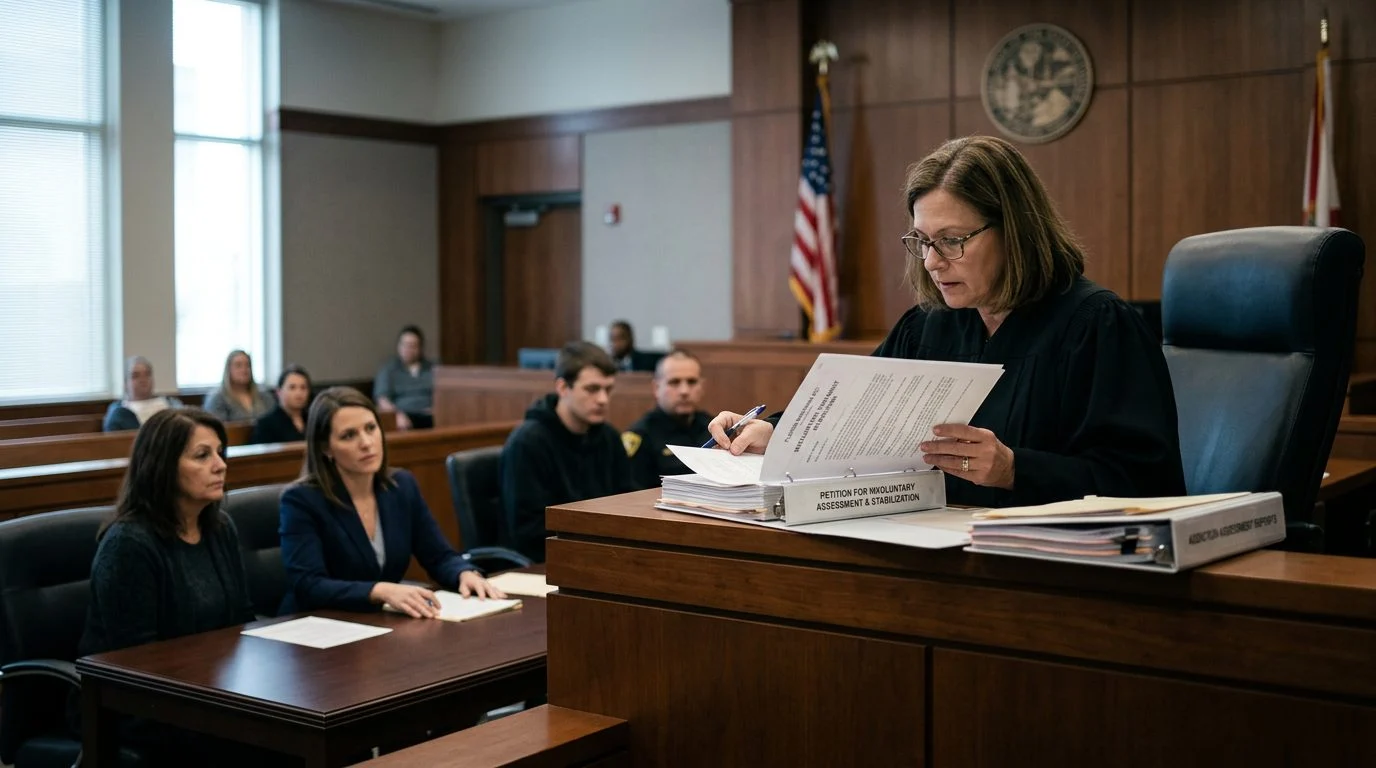
The process starts with a petition. It asks a judge to order an assessment and, if the legal standard is met, a treatment order.
What a Court Looks at in a Heroin Case
A court looks for a good-faith reason to believe your child is substance abuse impaired. It also looks for a loss of self-control over substance use (Fla. Stat. § 397.675).
The statute also asks about harm or judgment. The person must be in need of services and unable to see that need. Or the person must be likely to neglect himself or herself, or likely to harm himself, herself or others. Fla. Stat. § 397.675 reads: “(b) Without care or treatment, is likely to suffer from neglect or refuse to care for himself or herself; that such neglect or refusal poses a real and present threat of substantial harm to his or her well-being; and that it is not apparent that such harm may be avoided through the help of willing, able, and responsible family members or friends or the provision of other services, or there is substantial likelihood that the person has inflicted, or threatened to or attempted to inflict, or, unless admitted, is likely to inflict, physical harm on himself, herself, or another.”
The petition must give the reasons behind your belief. It must name both people, their relationship, and the factual basis for the request (Fla. Stat. § 397.68141). A professional’s report from the 30 days before filing may be attached. If there was no assessment, the petition must say so.
Dates, specific overdoses, emergency room visits and treatment history make a petition concrete. Vague statements are easy to challenge.
How the Petition and Emergency Admission Process Works
The petition is filed with the clerk in the county where your adult child is physically located. The clerk may not charge a filing fee (Fla. Stat. § 397.681).
Here is the general path:
- Gather facts. Collect dates, incidents, and treatment history.
- File the petition. File with the clerk in the correct county.
- Ask for emergency help if needed. When an emergency exists, the court may enter an ex parte order for assessment and stabilization without first appointing an attorney (Fla. Stat. § 397.6818).
- Observation period. A service provider may not hold the person for more than 72 hours of observation, unless a listed exception applies.
- Hearing. The court sets the hearing as described below.
Some checkpoints are firm. An ex parte order not carried out by the first hearing date is void. If the respondent does not appear at the hearing for any reason, including lack of service, and the court reasonably believes the respondent meets this chapter’s commitment criteria and that a substance abuse emergency exists, the court may reissue an ex parte assessment and stabilization order valid for 90 days; and if the respondent has not been assessed within 90 days, the court must dismiss the case.
The Court Hearing, Testimony, and What Happens Next
The court must schedule the hearing within 10 court working days, unless a continuance is granted (Fla. Stat. § 397.68151). Your child must be given a copy of the petition and notice of the hearing (Fla. Stat. § 397.68151). The court may excuse attendance only under the statute’s limited grounds (Fla. Stat. § 397.6957).
The court hears relevant evidence. That can include testimony from family members who know your child’s history. The court may also order drug tests. Testimony is taken under oath, and the person may refuse to testify.
Your child, as the respondent, has the right to a lawyer at every stage; if your child wants a lawyer and cannot afford one, your child has the right to court-appointed counsel, and the court must appoint counsel if it believes your child needs or wants one (Fla. Stat. § 397.681).
Your evidence matters most.
How Long Treatment Lasts and What Comes After
If the court finds the conditions proved by clear and convincing evidence, it may order treatment for up to 90 days (Fla. Stat. § 397.697). A renewal may be requested before that period ends if the conditions are expected to exist after 90 days of treatment services (Fla. Stat. § 397.697).
The provider may be publicly funded. The court may order private treatment if the person can pay, or if someone acting for the person voluntarily shows the willingness and ability to pay.
The court keeps jurisdiction after the order. It can monitor compliance, change the treatment approach, and start contempt proceedings for violating a valid order.
Treatment is one part of recovery. Families often need a plan for housing, follow-up care, and daily support in the months after treatment ends.
Not sure what your next step is?
Talk it through with our team — the first consultation is free, confidential, and carries no obligation.
Costs, Timeline, and What Is Not Included
The first consultation is free, confidential, and comes with no obligation to continue (Spanish: consulta inicial gratuita, confidencial y sin compromiso).
The clerk may not charge a filing fee for a petition (Fla. Stat. § 397.681). The court may prohibit, or a law enforcement agency may waive, service-of-process fees for an indigent petitioner (Fla. Stat. § 397.68112). Other costs may apply, such as copies and professional reports.
If the court appoints counsel for your child, the Office of Criminal Conflict and Civil Regional Counsel represents that person (Fla. Stat. § 397.68151). Separate criminal matters are not part of the petition.
The timeline depends on the court calendar, continuances, and whether your child can be located.
Common Objections and How the Marchman Act Differs From Guardianship
“My child is an adult, so I have no say.” An adult relative may file a petition when the statutory criteria are met (Fla. Stat. § 397.68112).
“Will this put my child in jail?” The Marchman Act is a court process for assessment and treatment. Criminal matters are separate.
“Isn’t guardianship the same thing?” No. Guardianship is a different court process. It focuses on a person’s ability to make decisions and manage affairs. The Marchman Act focuses on substance abuse impairment and court-ordered treatment.
Robinson Casey focuses exclusively on Marchman Act petitions and guardianship matters, serving families across South Florida and statewide. Richard J. Casey III, Esq. is the responsible lawyer for this page. Our team helps families organize documents and scheduling. A matter may be referred to another lawyer or firm, and we will tell you if that happens.
Frequently Asked Questions
How do you file a Marchman Act petition in Florida?
The petition goes to the clerk of court in the county where your adult child is located. It must name the people involved and state the facts behind the request.
Can a court order treatment for a homeless or missing adult child?
A court may act when the statutory criteria are met, including a real threat of harm from neglect. Whether that applies depends on the facts.
Is the Marchman Act the same as involuntary commitment for addiction?
People often use that phrase for the Marchman Act’s court-ordered treatment process. The statute calls it involuntary treatment.
Who can file a Marchman Act petition?
For an adult, a spouse or legal guardian, any relative, a service provider, or an adult with direct personal knowledge may file.
Does a Marchman Act case create a criminal record?
The Marchman Act is a treatment process, not a criminal charge.
How long does a Marchman Act case take?
The hearing is set within 10 court working days unless continued. Treatment orders can last up to 90 days, and overall timing varies.

Talk With Robinson Casey About Your Child’s Situation
If your adult child has overdosed, relapsed, been hospitalized, been arrested, or gone missing, you may be wondering whether a court can help. You do not have to work out the legal path alone. Call Robinson Casey at (561) 849-4700, or reach our team at robinsoncasey.com/contact.
How Robinson Casey Approaches Marchman Act Matters
Support for the Whole Family
Our team works with parents, spouses, and adult children to understand the situation, gather the facts, and organize the petition.
Clear, Honest Guidance
We explain each step in plain language, including what the court will need from you and what to expect along the way.
Confidential Conversations
Your first consultation is confidential, and you are free to ask questions before deciding whether to move forward.
Do Not Wait for a Crisis to Ask Questions
Families often reach out only after a serious overdose or emergency. Speaking with an attorney early helps you understand your options before the situation becomes urgent.
Services Robinson Casey Provides
Marchman Act Petitions
Guidance on preparing and filing a petition with the clerk of court for assessment and treatment of an adult with substance use problems, including heroin and other opioids.
Involuntary Commitment for Addiction
Help understanding the court process for involuntary commitment and what it may involve for your loved one and your family.
Guardianship Matters
Representation in emergency temporary, plenary, limited, and mental health guardianship proceedings in Florida courts.
Free First Consultation
Our first consultation is free, confidential, and carries no obligation to continue. Call (561) 849-4700 or request a meeting to discuss your family's situation.