
Marchman Act & Guardianship | South Florida
Help for Families Facing Prescription Pill Misuse
Robinson Casey focuses on Marchman Act petitions and guardianship matters, helping families across South Florida and statewide decide what protective steps may be available.
Casey III, Esq. · Published November 8, 2026
If your loved one is misusing a prescription, you’re probably asking whether Florida’s Marchman Act can help. In short, yes. Florida’s definitions cover misuse of prescription medications, not only illegal drugs.
This page explains how the Act treats prescription pill misuse, who can file, and what the process generally looks like. It’s written for family members who are still gathering facts.
Yes, the Marchman Act covers prescription pill misuse
The Act can apply when the substance is a prescription medicine, including gabapentin, Adderall, or opioids. Florida law defines “substance abuse” to include the misuse of, or dependence on, prescription medications.
The same section defines “impaired” to include prescription drugs used in a way that causes mental, emotional, or physical problems, or socially dysfunctional behavior. The focus is on how the medicine is used and what it is doing to your loved one’s health, judgment, and daily life.
If you're worried about how a loved one is using a prescription, you don't have to sort out the law alone. Call (561) 849-4700 or request a consultation today. Talk it through with our team — the first consultation is free, confidential, and carries no obligation.

Florida law looks for impairment and loss of self-control
Florida law sets out specific criteria for involuntary admission for substance abuse impairment. The statute asks whether there is good faith reason to believe your loved one is substance abuse impaired. It also asks whether, because of that impairment, the person has lost the power of self-control with respect to substance use.
The statute describes two main paths. One covers a person who needs services but cannot appreciate that need or make a rational decision about it. The statute adds that simply refusing services is not, by itself, evidence of lack of judgment.
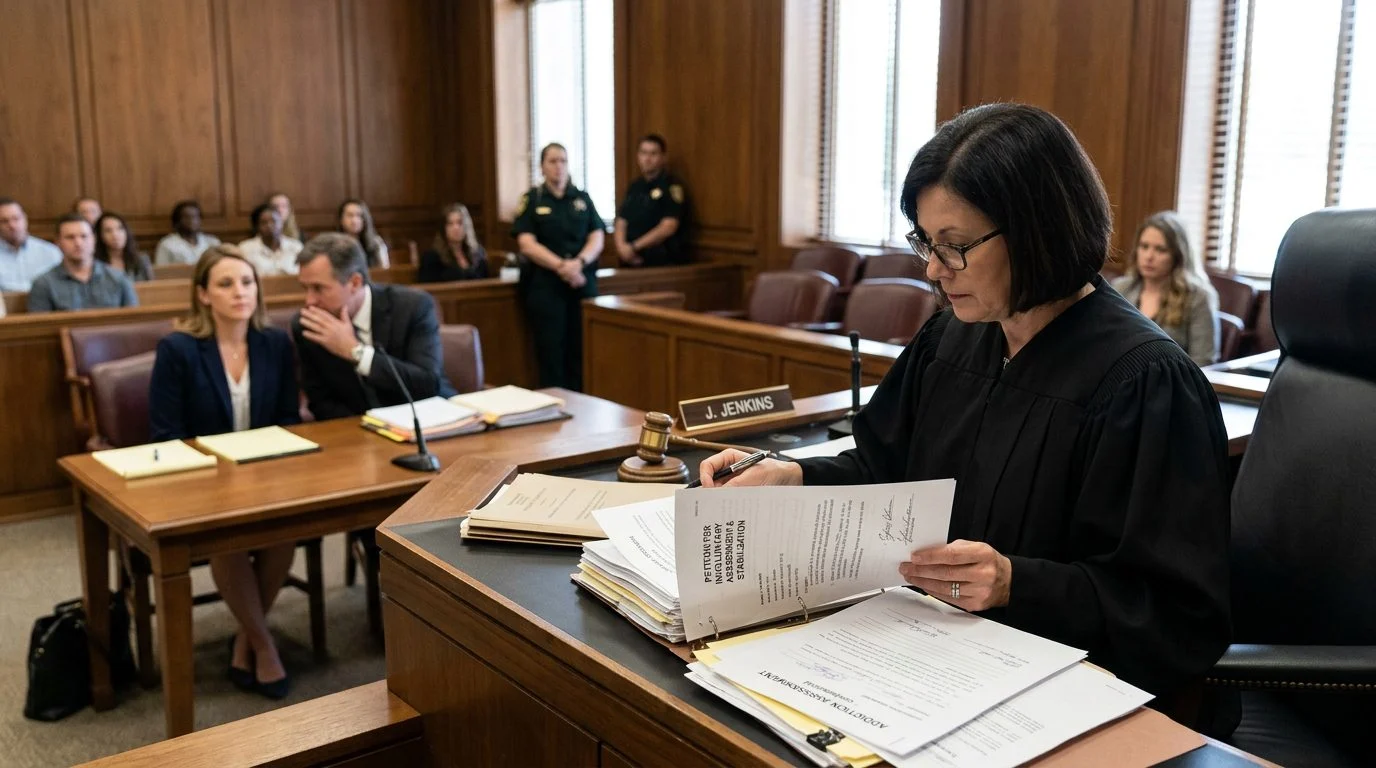
Two stages matter. The court must hear and review all relevant evidence, including the results of the assessment completed by the qualified professional, and the report must contain a recommendation on the level of substance abuse treatment the respondent requires, if any; the qualified professional’s failure to include a treatment recommendation, much like a recommendation of no treatment, shall result in the petition’s dismissal, as described in Fla. Stat. § 397.6957. Under Fla. Stat. § 397.697, a court that finds the conditions proved by clear and convincing evidence may order treatment for up to 90 days. The court makes that finding, not a family member or a lawyer.
Gabapentin, Adderall, and opioid misuse can look different
The Act focuses on impairment, not the name on the bottle. The definition of “impaired” covers any psychoactive or mood-altering substance, so gabapentin, Adderall, and opioids all fit within its language.
Families often describe a loved one taking more of a medication than prescribed, mixing it with alcohol or other substances, or running out early. Changes in work, money, family life, and judgment also tend to stand out. The statute cares about effects on daily functioning, so these patterns matter.
Each medication affects people differently, so the same pattern can look different from one prescription to the next. Questions about a specific dose or diagnosis belong with the prescribing clinician.
Who can file a Marchman Act petition, and what it must include
For an adult, a petition can be filed by a spouse or legal guardian, any relative, a service provider, or an adult with direct personal knowledge of the impairment and prior treatment.
The petition must name the respondent and the petitioner and state their relationship. It must also give the facts behind the belief that your loved one is impaired, the reason to believe that because of that impairment your loved one has lost the power of self-control with respect to substance abuse, and either the reason to believe your loved one has inflicted or is likely to inflict physical harm on himself, herself, or others unless the court orders services, or the reason to believe your loved one’s refusal of care is based on judgment so impaired by substance abuse that he or she cannot appreciate the need for care and make a rational decision about it. The petition may include an assessment by a qualified professional done within 30 days before filing. See Fla. Stat. § 397.68141.
In J.P. v. J.N., the Fifth District held that filing in the wrong county is a venue defect, not a loss of jurisdiction.
Your loved one may have an attorney. Upon the filing of a petition for involuntary services, the court must immediately determine whether the respondent is represented by an attorney or whether appointing counsel for the respondent is appropriate, and an attorney representing the person has access to the person, witnesses, and records relevant to the presentation of the person’s case. The court must schedule a hearing within 10 court working days unless it grants a continuance. See Fla. Stat. § 397.68151.
Emergencies can move faster. When the petitioner asserts that emergency circumstances exist, or the court determines upon review of the petition that an emergency exists, the court may rely solely on the contents of the petition, without appointing an attorney, and enter an ex parte order for your loved one’s involuntary assessment and stabilization under Fla. Stat. § 397.6818. A 2024 Second District decision reversed such an order because the petition did not show a good faith reason to believe the criteria were met, in D.H. v. K.J.R..
A Marchman Act case is separate from criminal charges
A Marchman Act petition is a separate court matter from any criminal case. If prescription misuse has led to an arrest, a charge, or a diversion program, the two tracks can overlap. Each matter has its own filings and hearings.
The court handling one matter may not be the court handling the other. Don’t assume a petition will settle an open charge. Share any charges early, so your plan covers both tracks.
Common misconceptions about prescriptions and the Act
A valid prescription does not, by itself, take a case outside the Act. Under Fla. Stat. § 397.6818, an ex parte order is for your loved one’s involuntary assessment and stabilization; the impairment and loss of self-control criteria are set out elsewhere in the chapter.
Three other myths come up often. The first is that only illegal drugs are covered. Florida’s definitions say otherwise, as explained above.
The second is that an arrest must come first. Fla. Stat. § 397.68111 lists other grounds, including a qualified professional’s assessment within 30 days. Arrest is not on that list.
The third is that families must wait for a crisis. The statute asks whether a person reasonably appears to meet the criteria. It does not require a crisis before a petition can be filed.
Not sure what your next step is?
Talk it through with our team — the first consultation is free, confidential, and carries no obligation.

Talking with Robinson & Casey about your loved one’s situation
Robinson & Casey limits its practice to Marchman Act petitions and guardianship matters. Richard J. Casey III, Esq. is the responsible lawyer for this page. Our team includes assistants and office staff.
It’s normal to feel worried and responsible while you’re still gathering facts. The decision about what to do next is yours. For a fuller overview, read our Marchman Act attorney guide.
Can the Marchman Act apply to prescription pills in Florida?
Yes. Florida’s definitions of substance abuse and impairment include prescription medications used in harmful ways.
Who can file a Marchman Act petition for an adult?
A spouse or legal guardian, any relative, a service provider, or an adult with direct personal knowledge of the impairment can file.
Does a valid prescription stop a petition?
The statute looks at impairment and loss of self-control, not only whether a prescription exists.
If you’re worried about how your loved one is using a prescription, you don’t have to sort out the law alone. Call (561) 849-4700 or request a consultation. Your first consultation is free, confidential, and without obligation.
How Robinson Casey Supports Your Family
Marchman Act Petitions
We prepare and file petitions under Florida's Marchman Act for loved ones whose substance use, including prescription medications, is causing serious harm.
Guardianship Matters
Our attorneys handle emergency temporary, plenary, limited, and mental health guardianship cases to protect people who can no longer make safe decisions.
Involuntary Commitment for Addiction
We guide families through involuntary commitment proceedings when treatment is needed and voluntary care is not possible.
Clear Communication
We explain each step in plain language so you know what to expect and can make informed decisions for your family.
If someone is in immediate danger
Misusing prescription medication can cause overdose, injury, or death. If a person is in immediate danger, call 911 or go to the nearest emergency room first, then contact our office.
Matters We Handle
Marchman Act Attorney
Petitions for court-ordered assessment and treatment when substance use, including misused prescription pills, threatens a loved one's health or safety.
Guardianship Attorney
Guidance through guardianship proceedings for adults who need a court-appointed decision-maker.
Emergency Temporary Guardianship
Immediate court protection for an incapacitated person facing urgent risk while the case moves forward.
Plenary and Limited Guardianship
Full or narrower guardianship arrangements tailored to the level of support a person needs.
Your first consultation is free, confidential, and comes with no obligation to continue. Talk with Robinson Casey about your family's situation.
Related practice areas
- Florida Marchman Act Attorney: Elderly Parent Rehab
- Marchman Act Options for a Homeless Adult Son in Florida