
Florida Guardianship and Marchman Act | Miami-Dade and South Florida
A Doctor's Opinion Matters, but a Florida Court Makes the Decision
Medical findings often start the conversation. Here is how they fit into the legal process, and how Robinson Casey helps families take the next step with confidence.
Casey III, Esq. · Published November 9, 2026
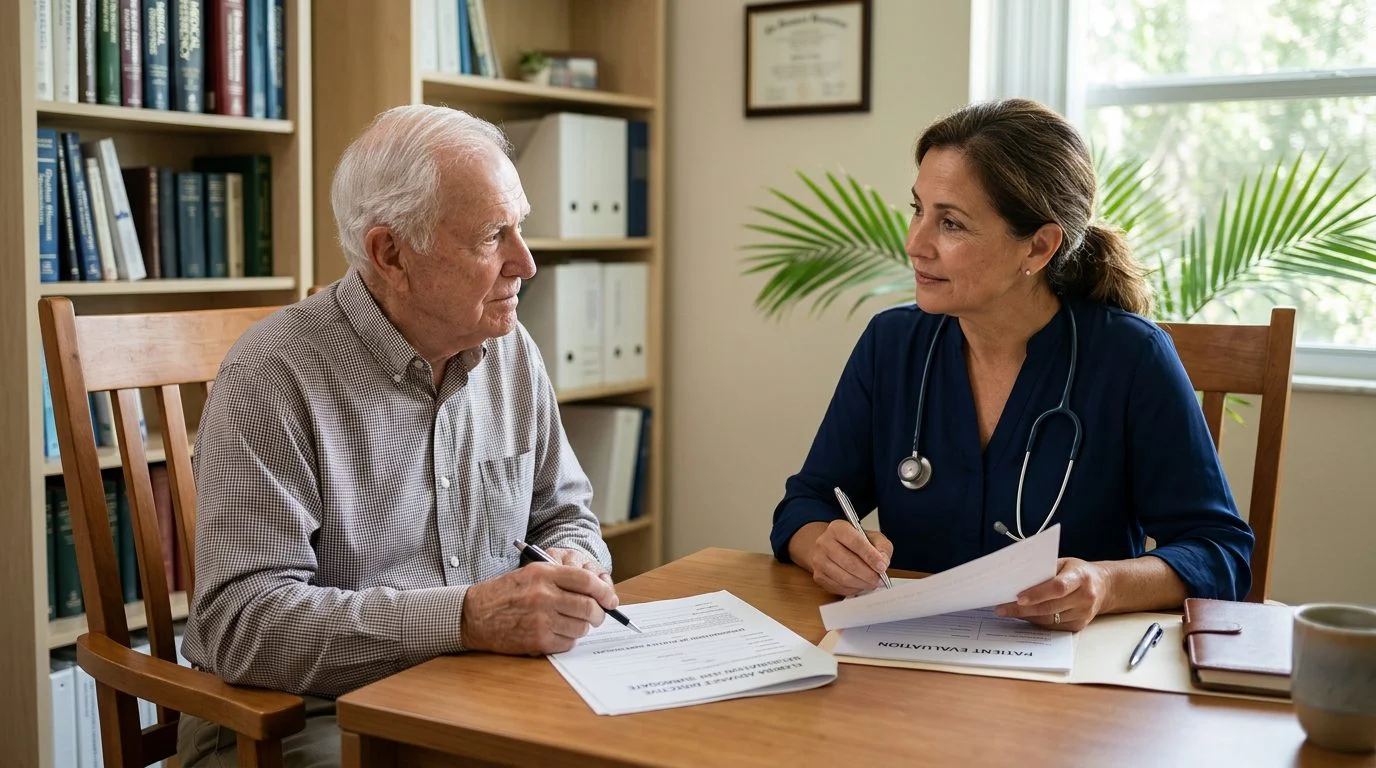
If a doctor has raised concerns about a loved one’s memory, judgment, or drinking, you may be asking whether a doctor can declare someone incompetent. The short answer is that a doctor can give a medical opinion, but in Florida a judge makes the legal finding of incapacity.
That gap between a doctor’s word and a court’s order is where many families get stuck. This page offers general information about Marchman Act and guardianship matters in Florida.
The Short Answer: A Doctor’s Opinion Is Not the Court’s Ruling
No, a doctor cannot legally declare someone incompetent on their own in Florida. A doctor’s findings are evidence, but a court decides incapacity in a guardianship case under Chapter 744.
The process starts with a petition. An adult may sign a petition to determine incapacity. It must be verified and must state the facts behind the belief that the person is incapacitated (§ 744.3201).
Once that petition is filed, the case moves to an examining committee and a hearing. A chart note or a letter from a physician does not replace that process. It is one piece of information the judge weighs.
The petition is also more than a label. It must name the rights the person cannot exercise, to the best of the petitioner’s knowledge, or state that the petitioner has insufficient experience to make that judgment. That gives the judge specific points to test.
If a doctor has raised concerns about someone you love, you don't have to sort out the court process alone. Our team is ready to talk, free and with no obligation. Talk it through with our team — the first consultation is free, confidential, and carries no obligation.

Incapacity vs. Incompetence, and What “Deemed Incapacitated” Means
In Florida, the legal term is incapacity, and only a court can find it. People often say “incompetent” in everyday speech. The statutes, however, ask whether a person is incapacitated.
The Florida statute is titled “Petition to determine incapacity” (§ 744.3201). The phrase “deemed incapacitated” shows up often online.
Florida law recognizes that a court order changes a person’s status. Before an order is entered, the person has not been determined incapacitated. Some rights can be removed by that order, and some can be given to a guardian. Others stay with the person, including the right to counsel, to notice unless the court finds the person lacks the ability to comprehend the notice, and to privacy (§ 744.3215).
That is why the wording of the court’s order matters. It sets exactly which rights change.
The Doctor’s Role in a Florida Guardianship Case
A doctor’s role is to examine and report to the court. The doctor does not make the final decision. Within 5 days after a petition for determination of incapacity is filed, the court must appoint an examining committee of three members. One member must be a psychiatrist or other physician (§ 744.331).
The attending or family physician generally cannot sit on that committee unless good cause is shown. The committee must assess information provided by the attending or family physician, if any (§ 744.331). The doctor who knows your loved one best may not be on the committee. If that doctor is available for consultation, the committee must consult with that doctor.
Each committee member must examine the person. Each member must decide whether the person can exercise the rights listed in § 744.3215. Each member files a report with the clerk within 15 days after appointment (§ 744.331).
The reports must be served at least 10 days before the hearing, unless the reports are not complete and the petitioner and the person’s attorney waive that 10-day requirement. The petitioner and the alleged incapacitated person can object to using the reports as evidence by filing and serving a written objection no later than 5 days before the hearing (Fla. Prob. R. 5.550). Reports are important, but if an objection is timely filed and served, the court must apply the rules of evidence to decide whether they are admissible.
Can Someone Be Found Incapacitated Without an Evaluation?
No. The statute requires each committee member to examine the person. A finding that skips the examination does not follow the process the statute describes, and the rule requires each committee member to file a report with the clerk within 15 days after appointment.
Families sometimes hear that a doctor “declared” a relative incompetent. The document they hold may be a chart note, a letter, or a form. None of those is a court order. Only the court process, with notice and a hearing, can end in an incapacity order.
The person must receive notice. The notice must be served on and read to the alleged incapacitated person. It must also go to that person’s attorney. It must state that an attorney has been appointed to represent the person (§ 744.331).
A common mistake is to assume the person can be left out of the conversation. The statute says the person must hear about the case and have a lawyer.
Does a Dementia Diagnosis Automatically Mean Legal Incapacity?
No. A diagnosis such as dementia does not decide legal incapacity by itself. The court asks what the person can and cannot do.
The petition must state which rights the person is incapable of exercising, to the best of the petitioner’s knowledge; if the petitioner has insufficient experience to make those judgments, the petition must say so (§ 744.3201). The rights at issue include contracting, managing property, deciding where to live, and making health care decisions (§ 744.3215). Those are functional questions. A condition’s name does not answer them.
Two people with the same diagnosis can have very different daily abilities. One may handle bills with help and still make sound choices about care. Another may not. That is why the committee members must rule on each right.
Florida law also asks whether help short of a guardian would work. The petition must say whether the person uses assistance, including supported decisionmaking. It must also say why that help is not enough (§ 744.3201).
If you’re gathering information, bring the doctor’s records. Add your own notes on daily life, such as missed medications, unpaid bills, or unsafe driving. Specific examples help show the facts behind any belief.
Can the Person Contest an Incapacity Petition?
Yes. A person who has been determined to be incapacitated retains the right to counsel, to notice (unless the court finds the person lacks the ability to comprehend the notice), and to access the courts (§ 744.3215). Contesting the petition means testing the evidence at the hearing.
A contested case usually centers on the examining committee’s reports. It also centers on evidence of how the person functions day to day. Ask whether the facts in the petition support each right the petition names.
The petition must state the extent of guardianship desired, either plenary or limited (§ 744.334). A limited guardianship covers only certain rights. If the court finds the person incapable of exercising delegable rights, the order must say whether an alternative to guardianship would meet the person’s needs (Fla. Prob. R. 5.550).
The person’s own wishes also count. The court must consider the wishes the incapacitated person has expressed about who should serve as guardian (§ 744.312).
Not sure what your next step is?
Talk it through with our team — the first consultation is free, confidential, and carries no obligation.
Physician Certificates in Addiction Cases Follow a Different Process
A physician is among the professionals who may execute a professional’s certificate for emergency admission (§ 397.6793).
The certificate must state that the person was examined and assessed within the preceding 5 days after the application date. It is valid for 7 days after issuance. It must recommend the least restrictive type of service that fits the person (§ 397.6793).
The two processes use different petitions and standards. They can also involve different courts. Where the petition is filed matters, too. A Marchman petition belongs in the county where the person is physically located when it is filed. A filing in the wrong county is a venue problem, not a loss of the court’s power to act (J.P. v. J.N.).
The Second District has held that a Marchman respondent has a constitutional right to counsel (Hillsborough County v. Albrechta).
The appellate courts have split on one point. The Fifth District held that a judge may not call and question the professional to supply an absent petitioner’s case (C.W.R.K.). The Fourth District reached a different result, and it certified conflict (J.J.J. v. D.G.). These are district-level rulings, not one statewide rule.
For the full overview of the involuntary commitment process for addiction, read our involuntary commitment guide.

Key Takeaways and a Next Step
A doctor’s opinion is important evidence. A court makes the legal finding of incapacity in a Florida guardianship case.
- A physician’s report is evidence. The judge decides incapacity and any guardianship.
- A diagnosis alone does not settle legal capacity.
- Addiction certificates follow the Marchman Act, which is a separate path.
Quick Answers
Can a doctor legally declare someone incompetent in Florida?
No. A doctor’s opinion is evidence, but a court makes the incapacity finding.
How many doctors evaluate someone for guardianship?
The court appoints three examining committee members, and one must be a psychiatrist or other physician.
Does a dementia diagnosis mean legal incapacity?
No. The court looks at which specific rights the person cannot exercise.
If a doctor has raised concerns about someone you love, and you’re not sure what the court process will ask of your family, you don’t have to work it out alone. Our first consultation is free, confidential, and comes with no obligation to continue. Call (561) 849-4700 or request a consultation.
Responsible lawyer: Richard J. Casey III, Esq. Robinson Casey limits its practice to Marchman Act petitions and guardianship matters for families in Miami-Dade, across South Florida, and statewide. If we cannot take a matter, we may refer it to another lawyer.
How Robinson Casey Supports Families
Organizing the medical picture
We help families gather and understand the medical records and evaluations that bear on a loved one's condition.
Protecting the person at the center
Our work keeps the individual's dignity, safety and day-to-day needs at the center of every step.
Weighing the options
We walk through the differences between limited and plenary guardianship and other paths the court may consider.
Clear, direct communication
Our team explains each stage in plain language so families know what to expect.
Don't Wait Until It Becomes an Emergency
Families who seek legal guidance early often have more time to plan and more options available. Waiting for a crisis can narrow those choices.
Matters Robinson Casey Handles
Marchman Act Petitions
Legal support for families seeking help for a loved one struggling with substance use under the Florida Marchman Act.
Guardianship Matters
Guardianship of an adult, including emergency temporary, limited and plenary guardianship, handled with care for the person involved.
Mental Health Guardianship
Court proceedings for families concerned about a loved one's mental health and ability to make safe decisions.
Involuntary Commitment for Addiction
Guidance for families facing the difficult question of court-ordered treatment for addiction.