
Marchman Act Attorney | Miami-Dade & South Florida
Can a Doctor Force Treatment? Get Clear Answers From a Marchman Act Attorney
Robinson Casey focuses on Marchman Act petitions and guardianship matters for families across South Florida and statewide. Learn how a doctor's recommendation fits into the court process.
By Richard J. Casey III, Esq. · Published October 21, 2026
A doctor cannot force someone into addiction treatment in Florida on opinion alone. Longer court-ordered treatment requires a petition, notice, and a judge’s decision after a hearing. Doctors still play a real role in that process, so here is how it works.
What This Question Usually Means in Florida
Most people who ask this question are worried about a family member’s drinking or drug use. Often a doctor has raised concern, or someone asked a doctor for help and got an unclear answer.
You may be trying to decide what to do before a crisis gets worse. The concern might be your loved one’s health, their safety, or the safety of people around them.
This page explains Florida law on involuntary treatment for substance use. It does not give medical advice about any one person. For questions about a specific patient’s care, the treating clinician is the right source.
If a doctor's concern has you wondering what can be done for your loved one, our team can talk through the options with you. Talk it through with our team — the first consultation is free, confidential, and carries no obligation.

Short Answer: A Doctor Cannot Order Treatment on Their Own
A doctor’s opinion alone does not send someone into long-term, court-ordered treatment in Florida. That step runs through a petition and a judge’s order.
A physician’s view still matters. Under the Marchman Act, a qualified professional’s assessment can be attached to a petition. A physician can also sign a professional’s certificate for emergency admission, which is a short, separate step.
Keep two things apart. A medical recommendation is a clinical opinion. A court order is a legal decision made by a judge after a hearing. The first can support the second, but it does not replace it.
How the Marchman Act Works for Substance Use
The Marchman Act is Florida’s law for court-ordered assessment and treatment of people impaired by substance use. Families often have questions about what the Marchman Act process involves, and each situation is different.
The basic path looks like this. A petition is filed with the clerk of the court in the county where the person is located, under Fla. Stat. § 397.681. The court must schedule a hearing within 10 court working days unless a continuance is granted, under Fla. Stat. § 397.68151.
If the court finds the conditions for involuntary treatment have been proved by clear and convincing evidence, it may order involuntary treatment from a publicly funded licensed service provider for a period not to exceed 90 days, or from a privately funded provider if the person can pay, or if any person on the person’s behalf voluntarily demonstrates a willingness and an ability to pay, under Fla. Stat. § 397.697.
For the full overview, read our involuntary commitment for addiction guide.
The Physician’s Role in a Marchman Act Petition
A doctor’s evaluation can support a petition, but the doctor is not the one who decides the case. The judge reviews the evidence and makes the findings.
The law limits who may file. For an adult, a petition may be filed by the spouse or legal guardian, any relative, a service provider, or an adult with direct personal knowledge of the person’s substance abuse impairment and prior treatment, under Fla. Stat. § 397.68112.
If the person was not assessed, or refused an evaluation, the petition must say so, under Fla. Stat. § 397.68141.
Details matter. The petition must state the reasons behind each belief the statute requires. In D.H. v. K.J.R., the Second District reasoned that the petition did not establish a good faith reason to believe D.H. met the statutory criteria for involuntary assessment and stabilization, and that the trial court erred in entering the ex parte order. Vague concern is not enough.
For families working through a parent’s situation, see our guide on talking to an addicted parent about court-ordered treatment.
Emergency Situations, Law Enforcement, and Immediate Risk
When someone faces immediate danger, Florida law allows emergency admission before a full hearing. The admission rests on a professional’s certificate and an application, under Fla. Stat. § 397.679.
It must recommend the least restrictive service that fits, under Fla. Stat. § 397.6793.
If less restrictive options are not available, a law enforcement officer must take the person into custody and deliver them for assessment. The same statute covers this step. An officer transporting someone must restrain them in the least restrictive manner available and appropriate under the circumstances, under Fla. Stat. § 397.341.
Emergency steps are temporary. They still lead to court review. Families worried about arrest as an outcome can read more in our guide on addiction, jail, and rehab in Florida.
Can a Doctor Refuse to Treat Someone With an Addiction?
A doctor can decide to stop prescribing or stop providing care. That choice is a medical and personal decision. It is not a court order, and it does not start a court case by itself.
A clinician’s boundary can still change what options are open. If a doctor declines to continue care, the family may need to look at the legal steps that exist. Those steps are separate from the doctor’s decision.
Refusal alone also carries limited weight in court. The statute says mere refusal to receive substance abuse services does not by itself show a lack of judgment about the need for services, under Fla. Stat. § 397.675. Fla. Stat. § 397.675 reads: “(b) Without care or treatment, is likely to suffer from neglect or refuse to care for himself or herself; that such neglect or refusal poses a real and present threat of substantial harm to his or her well-being; and that it is not apparent that such harm may be avoided through the help of willing, able, and responsible family members or friends or the provision of other services, or there is substantial likelihood that the person has inflicted, or threatened to or attempted to inflict, or, unless admitted, is likely to inflict, physical harm on himself, herself, or another.” The petition needs more than a refusal.
Not sure what your next step is?
Talk it through with our team — the first consultation is free, confidential, and carries no obligation.
What Happens at the Hearing and the Rights of the Person Named
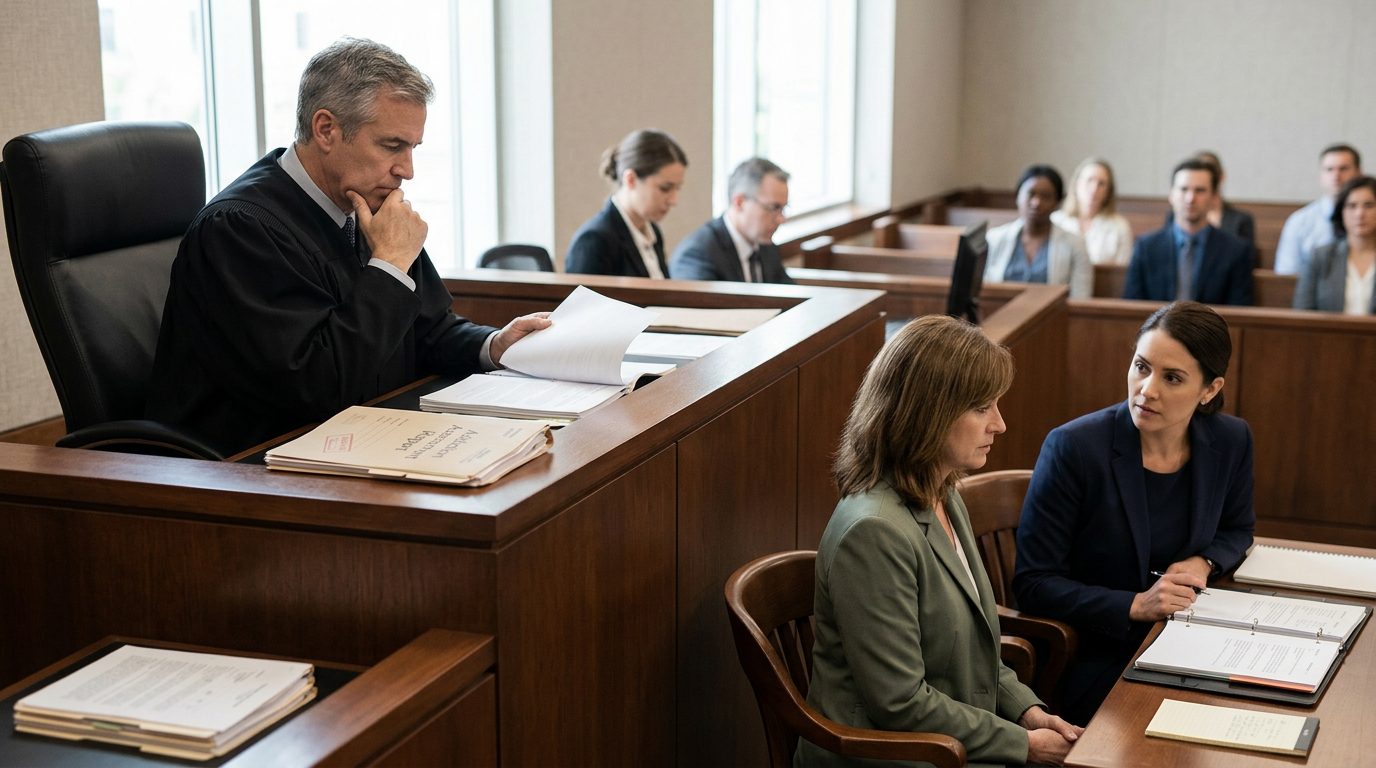
At the hearing, a judge reviews the evidence and decides whether the legal conditions are met. The person named has the right to be present at the hearing, unless the court finds a knowing, intelligent, and voluntary waiver or that presence is inconsistent with his or her best interests or is likely to be injurious to self or others, under Fla. Stat. § 397.6957.
A respondent may not be ordered into treatment without a clinical assessment. Fla. Stat. § 397.6957 reads: “(b) A respondent may not be involuntarily ordered into treatment under this chapter without a clinical assessment being performed, unless he or she is present in court and expressly waives the assessment.” Testimony is taken under oath, the proceedings are recorded, and the respondent may refuse to testify.
The person named also has the right to a lawyer at every stage. If the person wants a lawyer and cannot afford one, the person has the right to court-appointed counsel, under Fla. Stat. § 397.681. The Second District has also held that a Marchman Act respondent has a constitutional right to counsel in Hillsborough County v. Albrechta.
In J.C. v. State, the Fifth District said that the court failed to follow the applicable statute by essentially functioning as the absent petitioner. That holding comes from the Fifth District. The Fourth District later certified conflict with it in J.J.J. v. D.G., so it is not a statewide rule.
No one can promise how a particular judge will rule. The outcome depends on the evidence and the judge’s findings.

Talk to a Florida Marchman Act Attorney About Your Situation
If you are watching a loved one’s use put them at risk, and a doctor’s concern has left you unsure what to do next, you do not have to sort out the law alone. Robinson Casey focuses on Marchman Act petitions and guardianship matters for families in Miami-Dade and across South Florida.
Who can file a Marchman Act petition in Florida?
Under Florida law, for an adult, the spouse or legal guardian, any relative, a service provider, or an adult who has direct personal knowledge of the respondent’s substance abuse impairment and his or her prior course of assessment and treatment may file.
Can a doctor’s report alone create a court order?
No. A report can support a petition, but a judge must hold a hearing and make the findings.
Can a Marchman Act respondent get a lawyer?
Yes. The respondent has the right to counsel at every stage of the proceeding, which he or she may waive only if present and the court finds the waiver is knowing, intelligent, and voluntary. A respondent who cannot afford private counsel has the right to court-appointed counsel, and if the court believes the respondent needs or desires counsel, the court shall appoint it without regard to the respondent’s wishes.
Richard J. Casey III, Esq. is the responsible lawyer for this page. Your first consultation with Robinson Casey is free and confidential, with no obligation to continue. Call (561) 849-4149 or contact us online to talk about what you are seeing with your loved one.
How Robinson Casey Can Help Your Family
Marchman Act Petitions
We guide families through the petition process for a loved one struggling with substance abuse, from the first questions to the court filing.
Guardianship Matters
Our attorneys handle guardianship cases, including emergency temporary, plenary, limited, and mental health guardianship.
Involuntary Commitment for Addiction
We help families understand involuntary commitment options and what each step may mean for their loved one.
Clear Next Steps
Our team explains your options in plain language so you can decide what to do next with confidence.
Important: Medical Opinions Are Not the Whole Story
A doctor's recommendation is only one part of a Marchman Act case. Whether a court will order treatment depends on the facts, the required court proceedings, and the evidence presented. Talk with an attorney about your specific situation before you act.
Common Questions Families Ask
What is a Marchman Act petition?
It is a court filing used in Florida to request help for an adult whose substance abuse impairs his or her safety or wellbeing.
How does guardianship differ?
Robinson Casey explains the differences between plenary, limited, and emergency temporary guardianship.
Can a doctor's report alone decide the case?
Medical records and professional opinions matter, but they are weighed within a court process. Bring your questions to a confidential consultation.
What happens at the first meeting?
Our free first consultation is confidential and comes with no obligation to continue. We listen, review your concerns, and explain your options.