
Marchman Act Attorney · Florida
Marchman Act Custody and an Arrest: Know the Questions to Ask
Robinson Casey focuses exclusively on Marchman Act petitions and guardianship matters. This page offers general information, not legal advice for your situation.
By Richard J. Casey III, Esq. · Published October 12, 2026
Short answer: a Marchman Act custody and a criminal arrest are different steps. The sections below offer general information about the Marchman Act in Florida. This page offers general information about questions involving the Marchman Act and an arrest in Florida, and it is not legal advice for any specific situation.
Why Marchman Act Custody Is Not Always an Arrest
Under Florida’s protective custody statute, detention for a person’s own protection is “not to be considered an arrest for any purpose.” If you’re reading this for a loved one, you’re probably looking for plain answers. That’s a key point for families. Custody under this law is a separate step from a criminal arrest. Whether a separate arrest or charge also applies depends on the facts of the case, and this page can’t tell you how those facts apply to your family member.

Who Can Take a Person Into Custody Under the Marchman Act
A law enforcement officer may use protective custody measures when a person appears to meet the involuntary admission criteria. The protective custody circumstances statute names two triggers: the person is brought to the attention of law enforcement, or the person is in a public place.
Those criteria appear in the involuntary admission criteria statute. A person may meet them when there is a good-faith reason to believe the person is substance abuse impaired, or has a substance use disorder with a co-occurring mental health disorder. The impairment must also have caused a loss of self-control with respect to substance abuse. The statute lists further conditions, so this summary is not the full test. Other requirements may apply, and the court decides based on the evidence.
Officers aren’t the only people who can act. Under the emergency delivery statute, an applicant, a spouse or guardian, or a law enforcement officer may deliver a person named in the certificate for emergency admission to a hospital or treatment facility for emergency assessment.
What Happens at Intake and Assessment After Custody
After custody, the statute describes taking the person to a hospital or a licensed detoxification or addictions receiving facility. The protective custody statute says protected persons “must be assessed by the attending physician within the 72-hour period and without unnecessary delay.” If an adult is held in a jail or other detention facility instead, the officer in charge must notify the nearest appropriate licensed service provider “within the first 8 hours after detention.”
The officer must also write a report on the circumstances of custody. That report goes into the patient’s clinical record. A service provider generally may not hold a person for more than 72 hours of observation under the observation limit, unless a listed exception applies. Those exceptions include a court-granted extension after a hearing, withdrawal or medical needs, and a weekend or holiday. During transport, an officer must restrain a person “in the least restrictive manner available and appropriate under the circumstances” under the transport statute.
These are the statute’s stated limits, not a complete timeline. Facility procedures and the court’s schedule also apply, so actual timing varies from case to case.
Criminal Arrest and Charges Are a Separate Track
The statute says this detention is not an arrest, and it sets a rule about records. Under the same protective custody statute, “no entry or other record may be made to indicate that the person has been detained or charged with any crime.” Separately, the rights of individuals statute says people not accused of a crime “may not be detained or incarcerated in jails, detention centers, or training schools of the state, except for purposes of protective custody in strict accordance with this chapter.”
A criminal arrest is a different question. Whether a criminal charge applies depends on what happened, and criminal cases follow their own rules. This page doesn’t cover those rules.
Court Review, Hearings, and What the Court May Order
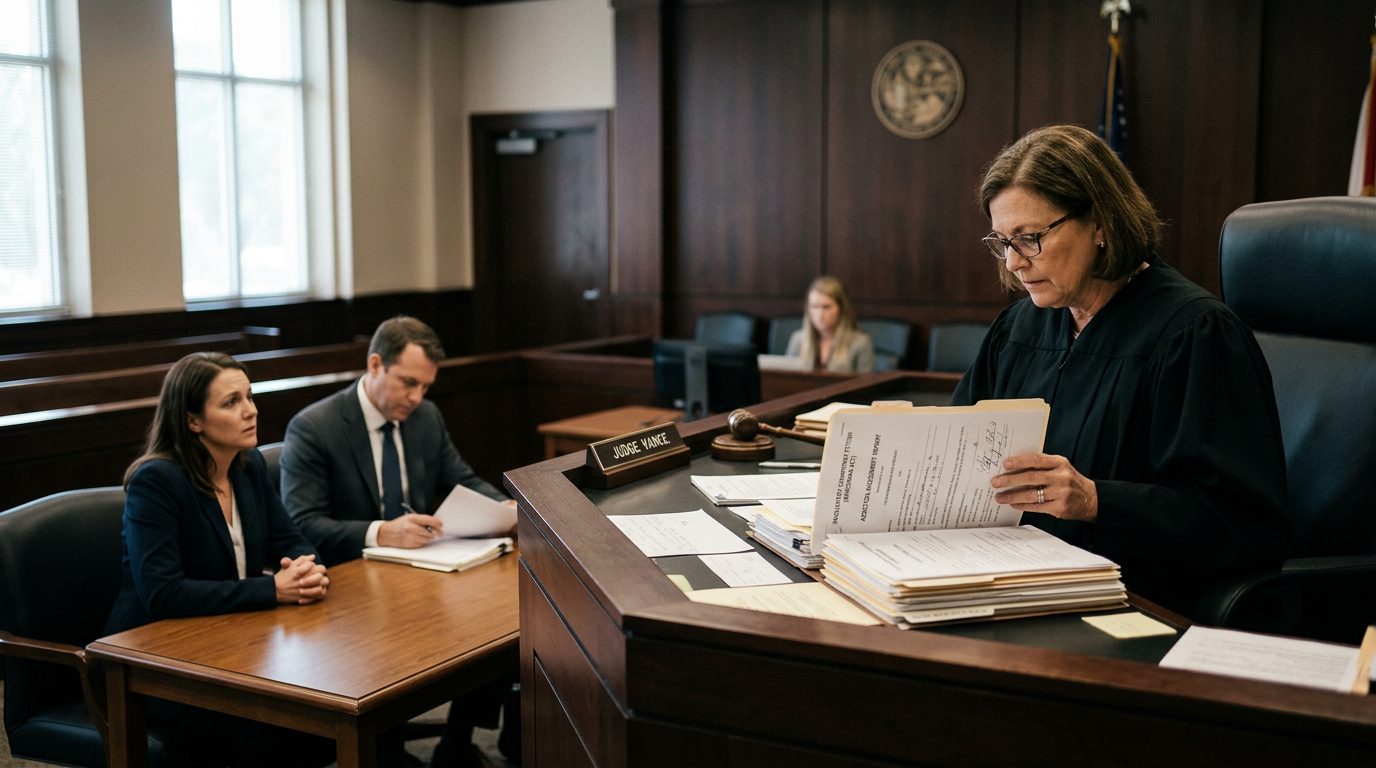
A Marchman Act case goes before a judge, and the court decides whether to order treatment. Under the treatment order statute, if the court finds the conditions proved by clear and convincing evidence, it may order treatment for a period “not to exceed 90 days.” Whether an order issues, and its terms, depend on the court’s discretion and the evidence.
The hearing statute says a respondent may not be ordered into treatment without a clinical assessment, unless the respondent is present and expressly waives it. The court must hear all relevant evidence, which can include testimony from family members familiar with the respondent’s prior history. Testimony is under oath, and the respondent may refuse to testify.
The respondent has a right to counsel at every stage under the right to counsel statute. A respondent who wants counsel and cannot afford it has the right to court-appointed counsel. How that right applies in a particular case is for the court to determine.
Other requirements may apply, and the court decides questions about a particular filing.
How the Marchman Act Compares to the Baker Act
The Marchman Act addresses substance use impairment, while the Baker Act is a separate Florida law. This page covers only the Marchman Act. Mental health can still come into the picture. The involuntary admission criteria refer to a substance use disorder with a co-occurring mental health disorder. Which law fits a particular person is a question for the facts and the court. Both names can come up in the same conversation, so it helps to keep them apart.

Talk With Robinson Casey About Your Family’s Situation
Knowing the steps helps you ask better questions, and the court decides each case. For the wider process, read the involuntary commitment for addiction guide.
Frequently Asked Questions
Is Marchman Act custody the same as a criminal arrest? The statute says protective detention is “not to be considered an arrest for any purpose.” Whether a separate criminal arrest or charge applies depends on the facts.
How long can someone be held? The statute limits a service provider’s observation to 72 hours, unless a listed exception applies. Actual timing depends on the statute, the facility, and the court’s schedule.
Who must be notified after custody? For a minor, the officer must notify the nearest relative. For an adult, the officer must notify the nearest relative or known emergency contact, unless the adult asks for no notification.
Does the person have a right to a lawyer? Yes, under the right to counsel statute. A respondent may waive counsel only if present and the court finds the waiver knowing, intelligent, and voluntary.
Robinson Casey is a Florida law firm that limits its practice to Marchman Act and guardianship matters. This page is general information, not legal advice. If your family member has been taken into custody and you’re trying to make sense of what comes next, call (561) 849-4149 or request a consultation.
Why Families Contact Robinson Casey
Focused Practice
Robinson Casey limits its practice to Marchman Act petitions and guardianship matters in Florida.
Clear Explanations
We walk you through the general steps, the paperwork involved, and the questions the court may consider.
Direct Conversation
Tell us what has happened and we will explain what information matters most for your situation.
Do Not Wait to Get Answers
If a loved one has been taken into custody under the Marchman Act and also faces a police arrest, the two matters can raise different questions. Speak with a lawyer about your specific facts as soon as you can.
Questions to Write Down Before You Call
What Happened
Write down the date, time, and place, and who was involved. Notes help us understand the situation.
Where the Person Is Now
Note the facility or location where your loved one is being held and any contact information you have.
Papers You Received
Gather any notices, forms, or court documents you were given. Bring copies to your consultation.