
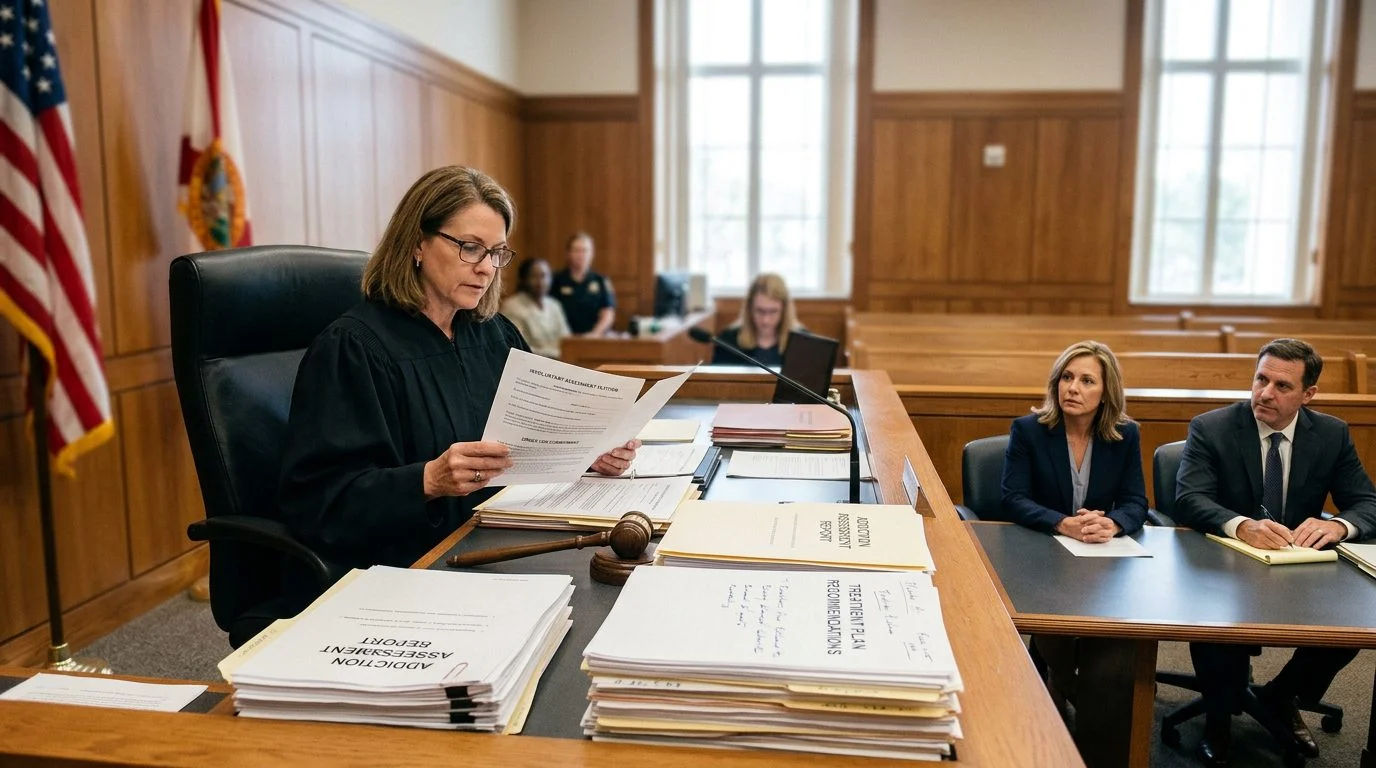
Marchman Act Attorney in South Florida
Guidance for Families Facing the Marchman Act
Robinson Casey focuses on Marchman Act petitions and guardianship matters for families in Miami-Dade and across South Florida. Call (561) 849-4700 to talk through your situation.
By Richard J. Casey III, Esq. · Published November 1, 2026
Families searching for a Marchman Act for addiction and mental illness Florida path usually face one hard question first: which statute fits. When substance use is the core problem, the Marchman Act is generally the path. When psychiatric crisis is the core problem, the Baker Act usually applies, and the two can overlap.
When Addiction and Mental Illness Are Both Driving the Crisis
When substance use is the central problem, the Marchman Act is generally the court path. When psychiatric crisis is central, the Baker Act usually applies.
Your loved one has been hospitalized again and again. They refuse care, skip medication and put themselves at risk. Money, rent and daily safety keep slipping. You keep picking up the pieces, and you aren’t sure which legal tool can help.
Clinicians often call this a dual diagnosis: a substance use disorder and a psychiatric condition that exist at the same time. The Marchman Act speaks to this directly. Its admission criteria cover a person with a substance use disorder and a co-occurring mental health disorder (Fla. Stat. § 397.675).
Each law has its own filings, criteria and timelines. Choosing the wrong track can slow down the help your loved one needs.
Not sure what your next step is?
Talk it through with our team — the first consultation is free, confidential, and carries no obligation.

What the Marchman Act Is and Who Can Petition
Your loved one is named as the respondent, and the case goes before a judge.
Family members can file. For an adult respondent, a petition may be filed by a spouse or legal guardian, any relative, a service provider, or an adult with direct personal knowledge of the substance use impairment and prior treatment (Fla. Stat. § 397.68112).
The petition goes to the clerk in the county where the person is located. The clerk may not charge a filing fee for the petition (Fla. Stat. § 397.681). A Florida appeals court has held that a petition filed in the wrong county did not take away the circuit court’s jurisdiction (J.P. v. J.N.).
Refusal alone is not enough. The statute says mere refusal to receive services does not by itself prove lack of judgment (Fla. Stat. § 397.675). Fla. Stat. § 397.675 requires that the person has lost the power of self-control with respect to substance abuse and also meets one more condition. That condition can be impaired judgment about the need for services. It can also be that, without care, the person is likely to suffer neglect that poses a real and present threat of substantial harm, and it is not apparent that the harm can be avoided through the help of willing, able, and responsible family members or friends or other services. Or there is a substantial likelihood that the person has inflicted, threatened or attempted to inflict, or, unless admitted, is likely to inflict physical harm on himself, herself, or another. The petition needs specific facts.
How the Firm Evaluates Which Statute Fits
Robinson Casey looks at the facts of each case before choosing a path. Our team starts with the main problem and the history behind it.
Intake questions usually cover these points:
- Which substances are involved, and when did use begin causing harm?
- How many hospitalizations or Baker Act holds has the person had, and where?
- What behavior worries you most: self-harm, violence, money loss or unsafe living?
- What treatment has your loved one accepted or refused?
- Is there a psychiatric diagnosis, and who treats it?
The answers point to one of three paths: a Marchman Act petition, a Baker Act path under Chapter 394, or a case with elements of both that needs coordinated handling. The right path depends on the facts of your case.
The Baker Act has its own rules. Its criteria focus on mental illness. A person may be taken to a receiving facility for involuntary examination if there is reason to believe they have a mental illness and, because of it, (a) they have refused voluntary examination after conscientious explanation and disclosure of the purpose of the examination, or cannot determine for themselves whether examination is necessary; and (b) without care or treatment they are likely to neglect themselves or refuse care, which poses a real and present threat of substantial harm that cannot be avoided through willing, able, and responsible family members or friends or other services, or there is a substantial likelihood they will cause serious bodily harm to themselves or others in the near future, as evidenced by recent behavior (Fla. Stat. § 394.463).
A Baker Act hold and a Marchman petition are separate proceedings. A hold does not automatically resolve a Marchman matter.
The Petition and Hearing: Step by Step
A Marchman case moves from petition to hearing to court order. The court sets key dates, and the general sequence is below.
- Consultation and records. Gather hospital discharge papers, Baker Act paperwork, medication lists and notes on incidents.
- Filing. The petition goes to the clerk in the county where your loved one is located.
- Notice and counsel. The court must schedule a hearing within 10 court working days unless a continuance is granted (Fla. Stat. § 397.68151). Your loved one has a right to counsel at every stage of the proceeding; however, he or she may waive that right if present and the court finds the waiver is made knowingly, intelligently, and voluntarily (Fla. Stat. § 397.681).
- Assessment and hearing. The court hears and reviews the results of the assessment completed by the qualified professional, and that clinical assessment must be sent to the clerk no later than the ordinary close of business on the day before the hearing (Fla. Stat. § 397.6957).
- Order. If the petitioner proves by clear and convincing evidence that the respondent is substance abuse impaired, has a history of lack of compliance with treatment, and that the respondent’s refusal to voluntarily receive care is based on judgment so impaired by reason of substance abuse that the respondent is incapable of appreciating his or her need for care and of making a rational decision regarding that need for care, the court shall either dismiss the petition or order the respondent to receive involuntary treatment services from his or her chosen licensed service provider if possible and appropriate (Fla. Stat. § 397.6957). If the conditions that justify involuntary treatment services are expected to still exist after 90 days of treatment, a renewal of the order may be requested before the 90-day period ends (Fla. Stat. § 397.697).
In an emergency, the court may enter an ex parte order for assessment and stabilization. A provider may hold the person for no more than 72 hours of observation unless an exception applies (Fla. Stat. § 397.6818).
One rule matters in Florida’s Fifth District. There, the petitioner carries the burden of proof, and a judge may not call and question the only witness to fill that gap (J.C. v. State). The Fourth District has reached a different result, so this is Fifth District law, not statewide law.
What the Family Should Expect and Prepare
Family testimony carries weight. The court hears evidence from family members who know the person’s history and how it relates to the current condition (Fla. Stat. § 397.6957).
Start a dated log now. Write down what happened, when it happened, and who saw it. Keep copies of hospital records, discharge papers and medication lists.
A qualified professional’s exam done within 30 days before filing can support the petition. If there was no assessment, or the person refused one, the petition must say so (Fla. Stat. § 397.68141).
Avoid confrontations that escalate the crisis. Describe facts, not labels. A calm, documented account is easier for the court to weigh.
Money, housing and daily care may need a separate tool. A petition to determine incapacity must state which rights the person cannot exercise, to the best of the petitioner’s knowledge, or must say so if the petitioner has insufficient experience to make that judgment (Fla. Stat. § 744.3201). Guardianship may fit when those decisions need legal authority.
Why Families Work With Robinson Casey
Robinson Casey limits its practice to Marchman Act petitions and guardianship matters.
Richard J. Casey III, Esq. is the responsible lawyer for this page. Our team also includes support staff who help families gather documents and keep the file organized.
Our work covers Marchman Act petitions, involuntary commitment for addiction, and guardianship matters, including emergency temporary, plenary, limited and mental health guardianship.
Your first consultation is free, confidential and comes with no obligation to continue (“consulta inicial gratuita, confidencial y sin compromiso”).
Some matters may be referred to another lawyer or firm. If that applies to your family, we will tell you.
Not sure what your next step is?
Talk it through with our team — the first consultation is free, confidential, and carries no obligation.
Frequently Asked Questions
Can a relative file a Marchman petition if my loved one refuses treatment?
Yes, a relative can file. Refusal alone is not enough, so the petition needs facts showing impairment and risk.
Is a Baker Act hold the same as a Marchman Act case?
No. They are separate proceedings with different filings, timelines and courts, though they can overlap.
Does my loved one get a say?
Yes.
Does my loved one have a right to a lawyer?
Yes. Florida’s Second District has held that due process supports a right to counsel in these cases (Hillsborough County v. Albrechta).
How long can a court order last?
A treatment order can run up to 90 days, and a renewal may be requested before that period ends.
Can the court also handle money or housing?
A Marchman order addresses treatment. Money, housing and daily care may require a guardianship matter, which is a separate court process.

Talk to Our Team About Your Family’s Next Step
If your loved one keeps ending up in hospitals, refuses care, and can’t stay safe with money or housing, you may be weighing a Marchman petition. Call Robinson Casey at (561) 849-4700 or schedule a consultation to review your family’s facts.
Why Families Turn to Robinson Casey
Focused Practice
Our attorneys focus on Marchman Act petitions and guardianship matters, so your case is handled by a team that works in these areas every day.
Confidential First Consultation
Your first consultation is free and confidential, with no obligation to continue.
Support for the Whole Family
We understand how stressful addiction and mental health crises are for relatives, and we explain each step in plain language.
Direct Access to Our Office
Call (561) 849-4700 to reach our office and speak with someone about your questions.
Don't Face This Alone
Families dealing with addiction, mental illness, or a loved one who cannot make safe decisions often have many urgent questions at once. Our team can help you understand your options and what to prepare.
Our Marchman Act and Guardianship Services
Marchman Act Attorney
We represent petitioners and families in Marchman Act proceedings for involuntary assessment and treatment of substance use disorders.
Involuntary Commitment for Addiction
We guide families through the court process for involuntary commitment when a loved one's substance use puts them at risk.
Emergency Temporary Guardianship
We help families seek immediate court protection when a person cannot care for themselves or manage their affairs.
Guardianship and Mental Health Guardianship
We handle plenary, limited, and mental health guardianship matters, tailored to the level of support the court and your loved one need.