
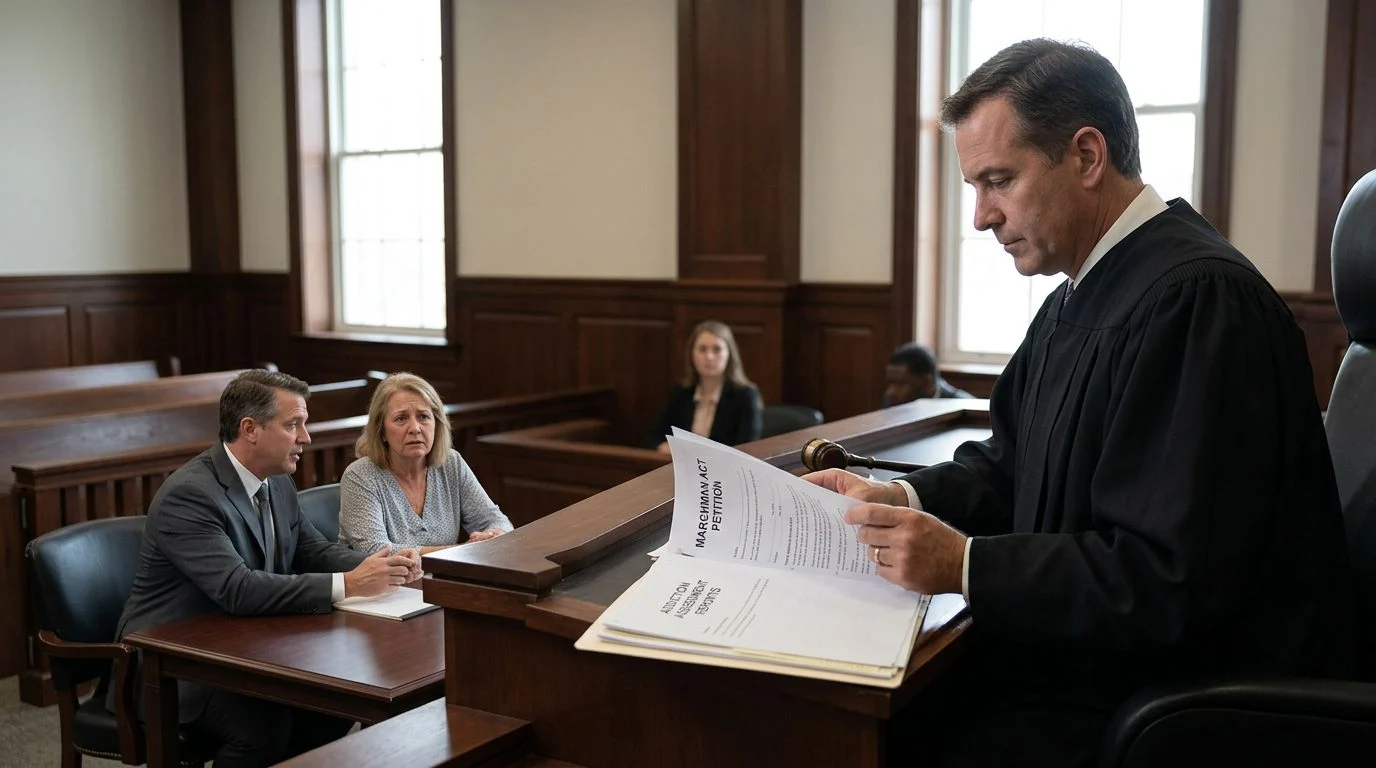
Marchman Act Petitions | South Florida and Statewide
Your Adult Child Is Out of State. You Still Have Options.
Robinson Casey focuses on Marchman Act petitions and guardianship matters for families in Miami-Dade, across South Florida and statewide. Richard J. Casey III, Esq. is responsible for this page. Free first consultation: confidential, with no obligation to continue.
By Richard J. Casey III, Esq. · Published October 29, 2026
Your Adult Child Is Out of State and Your Options Feel Thin
A Florida court can act on a Marchman Act petition when the adult is located in a Florida county. The petition goes to the clerk of the court in that county. If your child is in another state, that rule is the first question you need answered.
You have likely tried treatment, interventions, and firm boundaries. Then came the call from a hospital, a jail, a motel, or the silence that lasted too long. Each crisis feels like the last chance, and each one ends without lasting help.
This page explains a marchman act petition adult child out of state Florida in plain language. It is general information. The details of your child’s situation matter, and they can change the answer.
If your adult child has been hospitalized, arrested, or has disappeared in another state, you do not have to face the legal path alone. Our team is ready to talk through your situation with you. Talk it through with our team — the first consultation is free, confidential, and carries no obligation.

What a Marchman Act Petition Is and Who Can File One
A Marchman Act petition asks a court to order involuntary assessment and, if the legal criteria are met, treatment for an adult with a substance use problem. The Florida Department of Children and Families says the Marchman Act allows involuntary assessment, stabilization, and treatment for adults and youth severely impaired by substance abuse.
Florida courts hear these petitions, and the adult is named the respondent (§ 397.681). For an adult, the statute lists who may file: a spouse or legal guardian, any relative, a service provider, or an adult with direct personal knowledge of the impairment and of the person’s prior assessment and treatment (§ 397.68112). A parent is a relative, so a parent falls within a listed category. That is not a promise of how the court will rule.
The petition must name the adult and the petitioner. It must state their relationship and the facts that support the need for services (§ 397.68141).
Can a Florida Petition Reach an Adult Child Living in Another State?
Yes, if the adult can be found in a Florida county. The statute ties filing to the county where the person is located, so location is the starting point (§ 397.681).
Whether a Florida petition can reach a child in another state turns on where the child is found and what the facts show. Parents who are out of state face practical hurdles:
- Notice: copies of the petition and hearing notice go to the adult and to the adult’s attorney, if known (§ 397.68151).
- Coordination takes extra steps.
- Timing: the hearing is set within 10 court working days unless a continuance is granted.
The Criteria a Court Looks At Under the Marchman Act
The court looks for a good faith reason to believe the adult is substance abuse impaired. It also looks for a reason to believe the adult has lost the power of self-control about substance use (§ 397.675).
The adult must have lost the power of self-control with respect to substance abuse, and either needs services but cannot appreciate that need, or is likely to neglect or refuse to care for himself or herself in a way that poses a real and present threat of substantial harm, and it is not apparent that such harm may be avoided through willing, able, and responsible family members or friends or other services, or there is a substantial likelihood of physical harm to himself, herself, or another (§ 397.675). Mere refusal to get services is not, by itself, evidence of lack of judgment.
A petition can also be filed for an adult who was placed under protective custody or had an emergency admission within the past 10 days. It also covers an adult assessed by a qualified professional within 30 days (§ 397.68111).
What the Petition Needs: Evidence and Affidavit
The petition needs specific facts, not general fears. Gather what you can before you talk with a lawyer:
- Dates and details of each overdose, relapse, or crisis
- Emergency room, hospital, or jail records you already have
- Treatment history, including programs tried and how they ended
- Names of people who saw the behavior firsthand
- A dated log of calls, messages, and incidents
A petition may include a report from a qualified professional who examined the adult within 30 days before filing. If the adult was never assessed or refused an evaluation, the petition must say so (§ 397.68141).
Your sworn statement can be a written declaration. It reads: “Under penalties of perjury, I declare that I have read the foregoing [document] and that the facts stated in it are true” (§ 92.525). Fla. Stat. § 92.525 reads: “(2) A written declaration means the following statement: “Under penalties of perjury, I declare that I have read the foregoing [document] and that the facts stated in it are true,” followed by the signature of the person making the declaration, except when a verification on information or belief is permitted by law, in which case the words “to the best of my knowledge and belief” may be added.” A person who knowingly makes a false declaration is guilty of a third-degree felony. Accuracy matters.
In D.H. v. K.J.R., the Second District held that an ex parte order was entered in error where the petition did not establish a good faith reason to believe the statutory criteria were met.
How the Process Unfolds: Filing, Review, and Hearing
Most cases move from petition to court review to hearing, with deadlines at each step.
- Consultation and fact review. We look at where your child is, the history, and any pending matters.
- Filing. The petition goes to the clerk in the county where the adult is located (§ 397.681).
- When emergency circumstances exist, the court may rely solely on the petition and, without appointing an attorney, enter an ex parte assessment and stabilization order under § 397.6818. A provider may hold the adult for no more than 72 hours of observation, unless an exception applies (§ 397.6818).
- If the respondent does not appear at the hearing and the court reasonably believes the respondent meets the commitment criteria and that a substance abuse emergency exists, and the respondent’s location is known, the court must continue the case for no more than 10 court working days. Witnesses may testify remotely under oath, but a remote witness must give the parties all relevant documents by the close of business the day before the hearing (§ 397.6957).
- Outcome. If the conditions are proved by clear and convincing evidence, the court may order involuntary treatment services for up to 90 days (§ 397.697).
In Miami-Dade, the Miami-Dade Clerk of Court directs adult involuntary treatment petitions to the Probate Court.
Not sure what your next step is?
Talk it through with our team — the first consultation is free, confidential, and carries no obligation.
Your Fears, Answered Plainly
Your fears are reasonable. A Marchman Act petition is a legal route to assessment and possible treatment. It is not a promise of safety or recovery.
- Overdose or death: A court order can start assessment and stabilization. It cannot ensure your child stays safe.
- Incarceration: The statute sets up a petition for involuntary treatment services.
- Homelessness: Discharge planning must address follow-up appointments, medications, living arrangements, transportation, and recovery support (§ 397.6977).
- Losing hope: You should not carry this alone. Your child has the right to counsel at every stage, unless the respondent knowingly, intelligently, and voluntarily waives it while present and the court finds the waiver valid (§ 397.681). The Second District has held that a Marchman respondent has a constitutional right to counsel.
Frequently Asked Questions
Can I file if my child lives in another state?
Florida law points filing to the county where the adult is physically located. Your child’s location decides the starting point.
Does my child get a lawyer?
Yes. A respondent has the right to counsel at every stage, unless the respondent knowingly, intelligently, and voluntarily waives it while present and the court finds the waiver valid. If the court believes the respondent needs or desires counsel, the court shall appoint one, regardless of the respondent’s wishes (§ 397.681).
What if my child is already in jail or a hospital?
Current custody shapes the next steps. We review that during the consultation.
Why Families Work With Robinson Casey
Robinson Casey focuses on Marchman Act petitions and guardianship matters.
Richard J. Casey III, Esq. is the responsible lawyer for this page. Our support staff handle intake and office coordination, so calls and paperwork move through one team. Our practice also includes emergency temporary, plenary, limited, and mental health guardianship, and involuntary commitment for addiction.
Our first consultation is free, confidential, and carries no obligation to continue. If your child’s matter may need to go to another lawyer or firm, we will tell you.

Talk With Robinson Casey About Your Child’s Situation
If your child is out of state after an overdose, a hospital stay, an arrest, or a disappearance, you are probably looking for a legal path that works. You do not have to sort through it alone. Call us at (561) 849-4149 or schedule a consultation to talk through your child’s situation.
How Robinson Casey Approaches Your Family's Case
Location-Aware Filing
When your adult child is living outside Florida, where they are physically located affects where a petition may be filed. We review those details with you at the start.
Careful Petition Preparation
We help you gather the information and records a Marchman Act petition requires, so the filing is clear and organized.
Plain-Language Guidance
Court proceedings are stressful. We explain each step in terms you can follow and answer your questions as the case moves forward.
Focus on Your Family
Our team understands that behind every petition is a family worried about a loved one's health and safety.
Don't Wait Until the Crisis Deepens
If your adult child is struggling with addiction and you are worried about their safety, the sooner you speak with a lawyer, the more time you have to plan. Reach out to talk through your situation.
Matters Robinson Casey Handles
Marchman Act Petitions
Petitions for involuntary assessment and treatment of an adult child struggling with substance use, including cases where the adult child is outside Florida.
Involuntary Commitment for Addiction
Guidance on the commitment process for adults whose substance use places them or others at risk.
Emergency Temporary Guardianship
Court-supervised protection when an adult faces an urgent need for decision-making support.
Plenary, Limited and Mental Health Guardianship
Guardianship options matched to the level of support an adult needs, from broad to narrowly defined authority.