
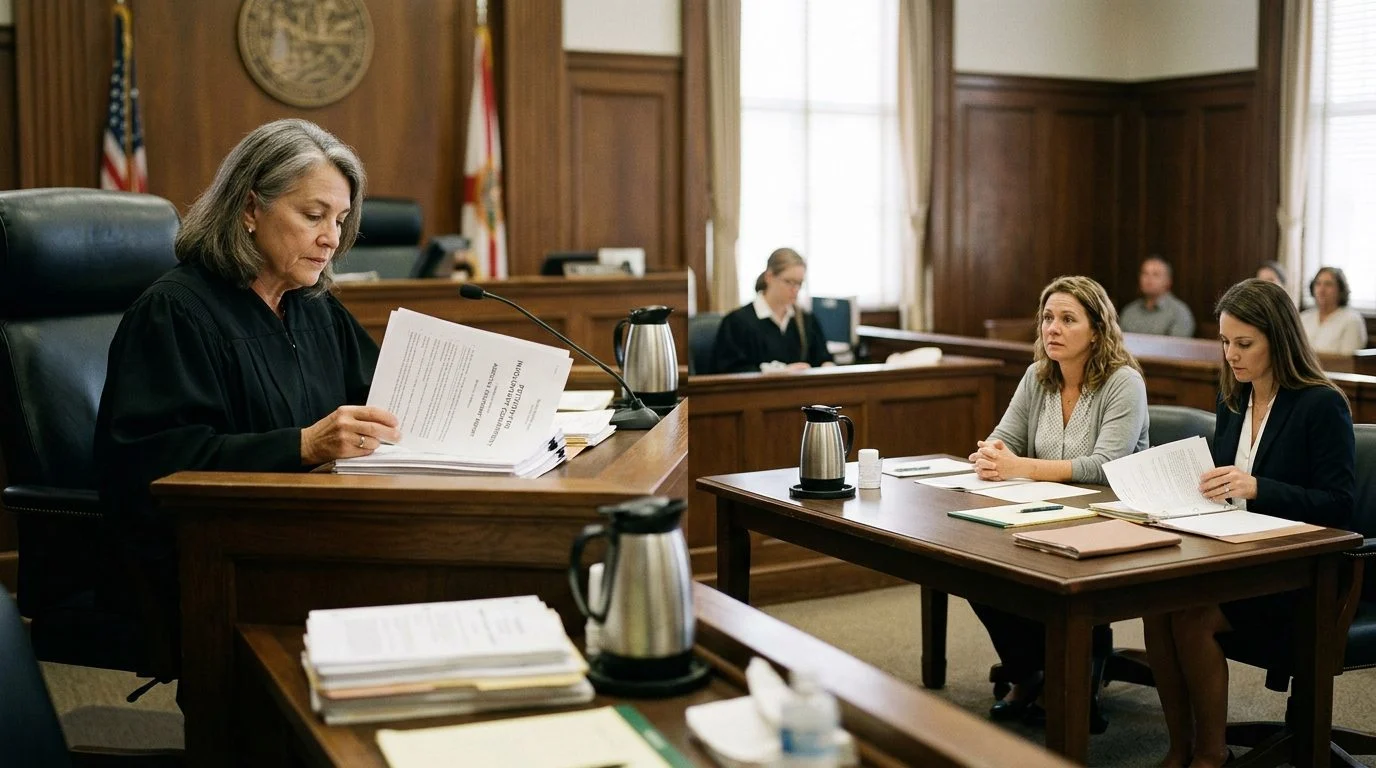
Marchman Act Petitions · South Florida
The Marchman Act Respondent Won't Attend the Hearing. Now What?
Court papers, a missed appearance and a loved one out of reach can all feel overwhelming. Here is how the process typically moves forward and where a South Florida attorney can step in.
Casey III, Esq. · Published November 9, 2026
If your loved one has been named in a Marchman Act petition and refuses to go to court, you may feel stuck between a court date and a person who won’t walk through the door.
If your loved one does not attend a hearing, a Florida court can still move a Marchman Act case forward. The court can reset the hearing, order an assessment, and in some cases direct law enforcement to bring the person in for evaluation.
Why a Respondent Refuses to Attend, and What the Hearing Is For
A respondent often refuses because they deny the problem, distrust the process, or don’t understand what the hearing is for. Under Fla. Stat. § 397.681, the alleged impaired person is named as the respondent.
The Marchman Act is Florida’s civil process for seeking involuntary assessment and treatment of a person with substance abuse impairment. The petition must give a good faith reason to believe the person meets the criteria for involuntary admission.
The hearing is where the court decides what happens next. The court hears all relevant evidence, including testimony from family members who know the respondent’s history, and the assessment results (Fla. Stat. § 397.6957). If you filed the petition, or you are watching a loved one refuse court, your part may be sharing what you know and being ready to testify.
If your loved one has been named in a petition and will not go to court, you do not have to work out the next step alone, and we can talk it through with you. Talk it through with our team — the first consultation is free, confidential, and carries no obligation.

Notice and Service: Can the Hearing Go Forward Without the Respondent?
A missed hearing and a service problem are different, and the court looks at which one happened. The court must schedule the hearing within 10 court working days unless a continuance is granted. A copy of the petition and notice must go to the respondent and the petitioner, among others (Fla. Stat. § 397.68151).
Service follows a set path. The clerk issues a summons. Unless the chief judge allows private process servers, the clerk must send it to a law enforcement agency within 6 hours after it is issued.
Location also matters. A petition must be filed in the county where the person is located, and the clerk may not charge a fee to file it.
Keep copies of the petition, the notice of hearing, and any proof of service. Write down the date you received each one. Ask the clerk whether proof of service is in the file.
What the Court Can Order When the Respondent Does Not Appear
It must be carried out while the hearing is pending. If it is not carried out by the first hearing date, it is void.
Limits apply. In Hillsborough County v. Albrechta, the court addressed the right to counsel. In D.H. v. K.J.R., the Second District held that a petition without a good faith reason to believe the criteria were met could not support an ex parte order. The same court noted, without deciding, a tension between those orders and the right to counsel.
The statute sets a timing requirement: the court must schedule the hearing on the petition within 10 court working days unless a continuance is granted. Track those dates.
Your Loved One’s Rights at the Hearing
Under Fla. Stat. § 397.681, your loved one has the right to counsel at every stage of a judicial proceeding on a petition for involuntary treatment for substance abuse impairment, unless they waive that right while present and the court finds the waiver is made knowingly, intelligently, and voluntarily. If the court believes they need or want a lawyer, the court must appoint one without regard to their wishes. Under Fla. Stat. § 397.681(2), a respondent has the right to counsel at every stage of a judicial proceeding relating to a petition for involuntary treatment for substance abuse impairment, and a respondent who desires counsel and is unable to afford private counsel has the right to court-appointed counsel.
The respondent must attend unless they knowingly waive that right, or the court finds that attending is inconsistent with their best interests or likely to be injurious to self or others. Testimony is under oath and recorded, and the respondent may refuse to testify. The court must hear and review all relevant evidence, including the results of the assessment completed by the qualified professional, and it may also order drug tests (Fla. Stat. § 397.6957).
The petitioner carries the burden of proof and must prove the case by clear and convincing evidence. In J.C. v. State, the Fifth District reversed an order where the judge questioned the only witness while the petitioner was absent. The Fifth District reaffirmed that point in C.W.R.K. v. Stewart Marchman Act Behavioral Healthcare under the 2023 statute.
The Fourth District disagreed in J.J.J. v. D.G. and certified conflict. According to the opinion in C.W.R.K. v. Stewart Marchman Act Behavioral Healthcare, the trial court failed to follow the governing statute when, in the absence of the petitioner, it called and questioned the health care professional who executed the involuntary services certificate. If you filed, plan to attend and be ready to present your side.
Law Enforcement’s Role After a Missed Hearing
Law enforcement acts on a court order. If the respondent does not appear and the court reasonably believes the respondent meets the commitment criteria and that a substance abuse emergency exists, the court may issue an ex parte order that is valid for 90 days. If the respondent’s location is known at the time of the hearing, the court must continue the case for no more than 10 court working days and may direct an officer to take the respondent into custody and deliver them for evaluation (Fla. Stat. § 397.6818).
Your role is to give accurate information about where your loved one is. That helps the court act on a known location.
After custody, a service provider may hold the respondent for no more than 72 hours of observation. Exceptions apply, such as an extension granted after a hearing or a need for detox or medical care (Fla. Stat. § 397.6818). An officer transporting a person pursuant to this chapter must restrain them in the least restrictive manner available and appropriate under the circumstances (Fla. Stat. § 397.341).
If someone is in immediate danger, call 911 right away. Then contact a lawyer about the court process, which runs on its own track.
Keeping Your Loved One Safe at Home While the Case Moves
Safety at home comes first, and it starts before the court date. Keep prescription medications, alcohol, and other substances out of easy reach. Keep a phone nearby, and agree in advance on who to call if things get worse.
Write down a dated log of concerning events, missed calls, and statements. A log like this gives you accurate details for the court and for your lawyer.
Don’t try to force your loved one into a car or to court. A physical struggle can turn dangerous fast. If there is an immediate threat, call 911.
Home safety steps don’t replace the court process, and they don’t change the court’s schedule. Keep every date on your notice.
Not sure what your next step is?
Talk it through with our team — the first consultation is free, confidential, and carries no obligation.
Records, Questions, and What to Gather Before Court
Gather the petition, the notice of hearing, any proof of service, and any assessment or treatment records you have. A petition may include an assessment done within 30 days before filing. If there was no assessment, or the respondent refused one, the petition must say so (Fla. Stat. § 397.68141).
Court records under Chapter 397 are confidential. The clerk may not publish personal identifying information on a docket or in a public file (Fla. Stat. § 397.6760).
Substance use treatment records have separate federal limits. Substance use treatment records from programs conducted, regulated, or directly or indirectly assisted by a U.S. federal department or agency have separate federal limits. Without consent, they generally cannot be used against the patient in any civil, criminal, administrative, or legislative proceeding conducted by a federal, state, or local authority unless a court order issues after a showing of good cause (42 U.S.C. § 290dd-2). Talk with a lawyer before you share those records. Talk with a lawyer before you share those records.
Questions for the clerk: What is the hearing date? Is proof of service in the file? Was the ex parte order carried out? Questions for the petitioner or treatment provider: Has an assessment been completed or scheduled? What happens next if your loved one does not appear? Bring these answers to your lawyer.
Frequently Asked Questions
Will the respondent be taken into custody?
Law enforcement takes a respondent into custody when a court order directs it, usually once the respondent’s location is known.
Does a missed hearing end the case?
Not by itself. A qualified professional’s failure to include a treatment recommendation, like a recommendation of no treatment, results in the petition being dismissed (Fla. Stat. § 397.6957).
Does the respondent have a right to a lawyer?
Yes, at every stage of the proceeding, and the court can appoint one even over the respondent’s wishes.

How Robinson Casey Helps the Person Named and How to Reach Us
Robinson Casey focuses on Marchman Act petitions and guardianship matters, and it serves families across South Florida and statewide. Our team includes support staff who help families keep track of paperwork, dates, and notices.
Our lawyers can explain the Marchman Act process and the rights of the person named in the petition. Richard J. Casey III, Esq. is the responsible lawyer for this page. Every case turns on its own record, so no outcome can be promised.
This page covers Florida law only. If your loved one has been named in a petition and will not go to court, call (561) 849-4700 or contact Robinson Casey. Your first consultation is free, confidential, and carries no obligation to continue.
How Robinson Casey Helps Families Through the Hearing
Review of the petition and notices
We go through the petition, the filed papers and any notice of hearing so you understand what the court has asked for and what comes next.
Guidance on the respondent's absence
When a respondent does not appear, we explain how the court may proceed and what options are available to your family.
Clear, direct communication
You will hear from our team in plain language, with the information you need to make decisions during a stressful time.
Focused on Marchman Act and guardianship matters
Robinson Casey focuses on Marchman Act petitions and guardianship matters for families across South Florida and statewide.
Do not wait on court papers
Notices tied to a Marchman Act petition can include instructions and dates that matter. A missed hearing can change how the case proceeds, so speak with a lawyer as soon as you receive them.
Steps to Take Right Now
Gather the court papers
Keep every document you have received, including the petition, notices and any order, in one place.
Write down the key details
Note the hearing date, time, courtroom and the names of anyone who has contacted you about the case.
Share what you know
Tell us about your loved one's situation, recent events and any contact you have had with the court or law enforcement.
Speak with a lawyer
Call Robinson Casey at (561) 849-4700 to discuss your family's situation and the options available.