
Marchman Act Guide | South Florida and Statewide
How Florida Courts Decide Involuntary Commitment for Addiction Under the Marchman Act
Robinson Casey limits its practice to Marchman Act petitions and guardianship matters, helping families across South Florida and statewide understand the legal grounds and the court process.
By Richard J. Casey III, Esq. · Published October 26, 2026
Florida Involuntary Commitment Grounds: What the Marchman Act Requires
Answer: In Florida, the grounds for involuntary commitment for addiction come from the Marchman Act. A court can order involuntary admission only if it finds the statutory criteria are met.
If you are worried about a family member’s drinking, drug use, or prescription misuse, this page explains what a Florida court looks for. It covers substance use only. It is general information, not advice about your specific case.
Watching someone you love refuse help while things get worse is hard, and you don't have to sort out the law alone. Call (561) 849-4149 or request a free, confidential first consultation to talk through your family's facts. Talk it through with our team — the first consultation is free, confidential, and carries no obligation.

The short answer: the grounds under Florida’s Marchman Act
The Marchman Act is the part of Chapter 397 of the Florida Statutes that deals with involuntary treatment for substance use. Under the current text, a person meets the criteria for involuntary admission if there is a good faith reason to believe the person is substance abuse impaired, or has a substance use disorder and a co-occurring mental health disorder, and, because of such impairment or disorder, has lost the power of self-control with respect to substance abuse and meets one of the additional conditions in the statute. Fla. Stat. 397.675 sets out that test.
The impairment must also cause a specific problem. The three core ideas are:
- The person has lost the power of self-control over substance use.
- The person cannot appreciate the need for care, or is likely to neglect themselves without it. Fla. Stat. § 397.675 reads: “(b) Without care or treatment, is likely to suffer from neglect or refuse to care for himself or herself; that such neglect or refusal poses a real and present threat of substantial harm to his or her well-being; and that it is not apparent that such harm may be avoided through the help of willing, able, and responsible family members or friends or the provision of other services, or there is substantial likelihood that the person has inflicted, or threatened to or attempted to inflict, or, unless admitted, is likely to inflict, physical harm on himself, herself, or another.” Fla. Stat. § 397.675 reads: “(2)(a) Is in need of substance abuse services and, by reason of substance abuse impairment, his or her judgment has been so impaired that he or she is incapable of appreciating his or her need for such services and of making a rational decision in that regard, although mere refusal to receive such services does not constitute evidence of lack of judgment with respect to his or her need for such services.” Fla. Stat. § 397.675 reads: “(b) Without care or treatment, is likely to suffer from neglect or refuse to care for himself or herself; that such neglect or refusal poses a real and present threat of substantial harm to his or her well-being; and that it is not apparent that such harm may be avoided through the help of willing, able, and responsible family members or friends or the provision of other services, or there is substantial likelihood that the person has inflicted, or threatened to or attempted to inflict, or, unless admitted, is likely to inflict, physical harm on himself, herself, or another.”
- Without help, the person poses a real risk of serious harm to self or others. Fla. Stat. § 397.675 reads: “(b) Without care or treatment, is likely to suffer from neglect or refuse to care for himself or herself; that such neglect or refusal poses a real and present threat of substantial harm to his or her well-being; and that it is not apparent that such harm may be avoided through the help of willing, able, and responsible family members or friends or the provision of other services, or there is substantial likelihood that the person has inflicted, or threatened to or attempted to inflict, or, unless admitted, is likely to inflict, physical harm on himself, herself, or another.”
For the full overview of how these pieces fit together, read our Marchman Act pillar guide. The sections below take each ground in turn.
Ground one: loss of power of self-control over substance use
The first element asks whether the person has lost self-control with respect to substance use. The statute uses the phrase “loss of the power of self-control.” It is one part of the test, not the whole test.
In plain terms, a petitioner might describe patterns like these:
- Using again and again, even after the use caused job, money, or health problems.
- Promising to stop, then using again within hours or days.
- Using more than planned, even when the person clearly wants to cut back.
These are examples of what a petitioner may describe. They are not a checklist. The court looks at the whole picture, and the facts matter more than labels. Family members who keep notes of specific dates, events, and quotes often describe the problem more clearly than general statements do.
Ground two: refusal of voluntary treatment or inability to decide
The second element has two paths. Under the first path, the person needs substance abuse services. Because of impairment, the person’s judgment is so weak that they cannot see that need or make a rational choice about it. The statute adds that mere refusal of services is not, by itself, evidence of lack of judgment. Fla. Stat. § 397.675 reads: “(b) Without care or treatment, is likely to suffer from neglect or refuse to care for himself or herself; that such neglect or refusal poses a real and present threat of substantial harm to his or her well-being; and that it is not apparent that such harm may be avoided through the help of willing, able, and responsible family members or friends or the provision of other services, or there is substantial likelihood that the person has inflicted, or threatened to or attempted to inflict, or, unless admitted, is likely to inflict, physical harm on himself, herself, or another.”
This is where many families get stuck. A loved one may say, “I’m fine,” and turn down every offer of help. That refusal matters, but it does not decide the case alone. The court asks why the person refuses. Is it a choice they can make clearly, or is the addiction blocking their judgment?
A prior offer of help, and how the person reacted, can be relevant evidence. A family member who arranged an assessment, offered a program, or asked the person to talk to a doctor may give the court useful facts about that response.
Ground three: likelihood of serious harm to self or others, or neglect
The second path of the second element is about harm. Without care, the person is likely to neglect or refuse to care for themselves. That neglect must pose a real and present threat of substantial harm to their well-being. The court also asks whether the harm can be avoided through willing, able, and responsible family members or friends, or through other services. Fla. Stat. § 397.675 sets out the criteria for involuntary admission for substance abuse impairment.
The statute also covers a substantial likelihood that the person has inflicted, threatened, or attempted to inflict physical harm on themselves or another. It also covers a likelihood of harm unless the person is admitted.
The harm finding also depends on timing. Section 397.675 requires a “real and present threat” of substantial harm, so a petition should describe the facts that show that threat. Families often describe events such as:
- A dangerous incident while the person was impaired, such as driving under the influence.
- A medical emergency tied to alcohol or drug use.
- Threats or violence toward a family member, or self-harm.
These are examples of what a court may consider. Each case depends on its own facts.
How the process moves: petition, assessment, and hearing
When someone refuses help, the usual path starts with a written petition. A petition for involuntary treatment can be filed when the person reasonably appears to meet the admission criteria. It can also be filed after recent protective custody or emergency admission, or after an assessment by a qualified professional within 30 days. Fla. Stat. 397.68111 lists these routes, including protective custody or emergency admission within the previous 10 days.
For an adult, a petition may be filed by a spouse or legal guardian, any relative, a service provider, or an adult with direct personal knowledge of the impairment and prior care. Fla. Stat. 397.68112 sets out who may petition.
The petition goes to the clerk of the court in the county where the person is located. The clerk may not charge a fee for filing it. Fla. Stat. § 397.681 provides that a respondent has the right to counsel at every stage of a judicial proceeding relating to a petition for involuntary treatment for substance abuse impairment, which the respondent may waive if present and the court finds the waiver is knowing, intelligent, and voluntary. The court must schedule a hearing within 10 court working days unless it grants a continuance. Fla. Stat. 397.68151 sets that timeline.
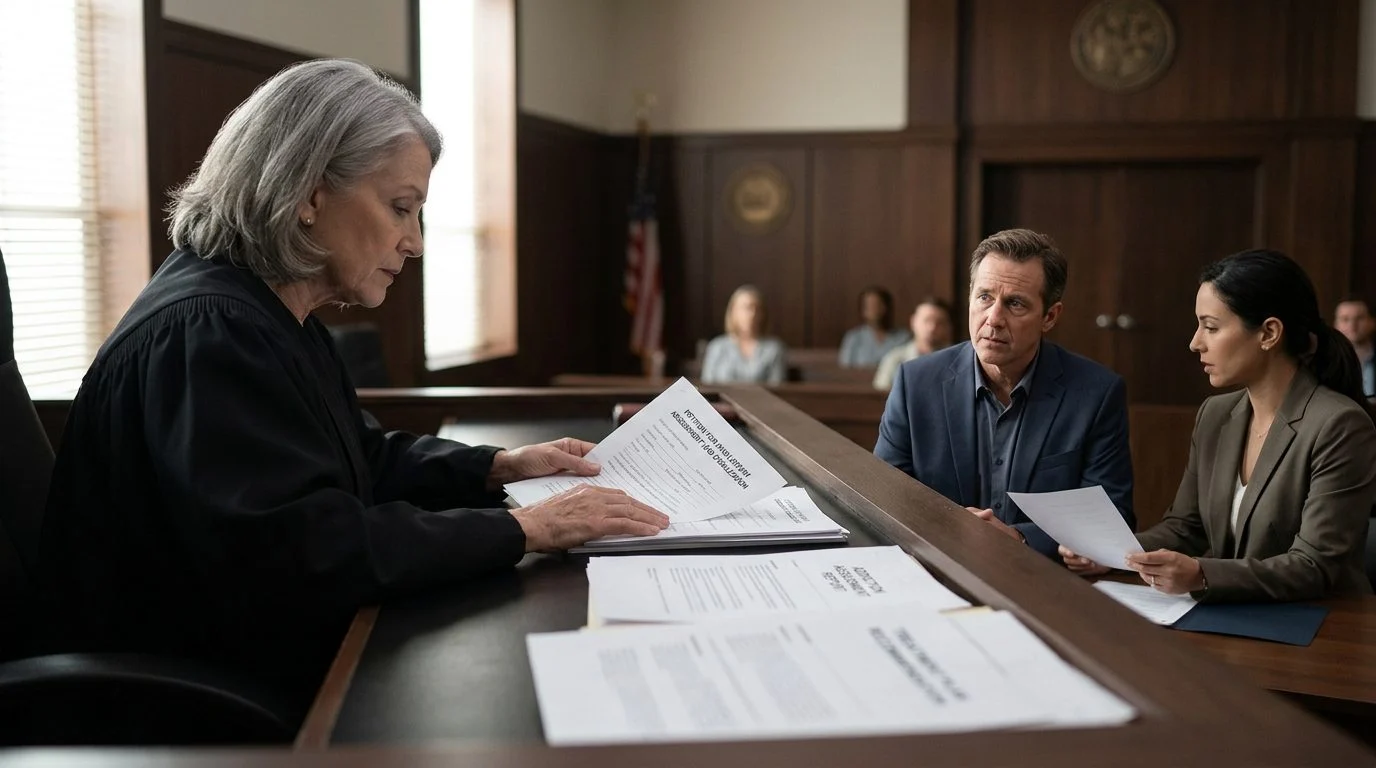
At the hearing, the court reviews relevant evidence. That can include testimony from family members who know the person’s history. It also includes the results of a clinical assessment. Testimony is taken under oath. Fla. Stat. 397.6957 provides that the respondent must be present at a hearing on a petition for involuntary treatment services unless the court finds that he or she knowingly, intelligently, and voluntarily waives the right to be present or, after receiving proof of service and evaluating the circumstances of the case, that presence is inconsistent with his or her best interests or is likely to be injurious to self or others.
The person has rights in this process, including the right to counsel under Fla. Stat. 397.681 and the right to refuse to testify at the hearing under Fla. Stat. 397.6957. If the court finds the conditions proven by clear and convincing evidence, it may order treatment for a period not to exceed 90 days. Fla. Stat. 397.697 states this limit.
The result depends on what the court finds from the evidence. No one can promise how a particular case will turn out.
Not sure what your next step is?
Talk it through with our team — the first consultation is free, confidential, and carries no obligation.
When the Marchman Act applies to your situation
The Marchman Act is Florida law. If your loved one lives outside Florida, read our out-of-state Marchman Act page first.
If the person is a minor or teenager, our minor and teen Marchman Act page covers that situation. Spanish-speaking readers can use our Spanish-language Marchman Act page, which includes its own required statements.

Key takeaways and the next step
The grounds for involuntary commitment in Florida are the Marchman Act’s criteria. In short:
- The person has lost self-control over substance use.
- A petition must be filed with the clerk of the court in the county where the person is located, and the clerk may not charge a fee for filing it.
Watching a family member refuse help while the situation worsens is exhausting. You may be carrying that worry alone. Our team at Robinson Casey can talk through the facts of your situation. Call (561) 849-4149 or request a consultation. The first consultation is free, confidential, and carries no obligation to continue.
This page is written by Richard J. Casey III, Esq., who is responsible for its content.
Frequently asked questions
What is the main legal ground for involuntary commitment for addiction in Florida?
The main ground is the Marchman Act test in Fla. Stat. 397.675. A court looks for loss of self-control over substance use, plus a related judgment or harm problem.
Does refusing treatment alone prove someone needs a court order?
No. The statute says mere refusal of services is not by itself evidence of lack of judgment.
Who can file a Marchman Act petition for an adult?
A spouse, legal guardian, relative, service provider, or an adult with direct personal knowledge may file.
Is there a filing fee for the petition?
The clerk may not charge a fee for filing the petition, under Fla. Stat. 397.681.
Why Families Start With Robinson Casey
Focused Practice
Robinson Casey limits its practice to Marchman Act petitions and guardianship matters, so the firm's work centers on these proceedings.
Free First Consultation
Your initial consultation is free, confidential, and carries no obligation to continue.
Speak With Our Team
Call (561) 849-4149 to talk through your family's situation with the firm's team.
South Florida and Statewide
The firm represents families in Miami-Dade, across South Florida, and throughout Florida.
Important: General Information, Not Legal Advice
Every Marchman Act and guardianship matter turns on its own facts. Reading this guide does not create an attorney-client relationship. This page is the responsibility of Richard J. Casey III, Esq. Results in any matter cannot be predicted or promised, and a prospective client may not obtain the same or similar results.
Matters Robinson Casey Handles
Marchman Act Petitions
Petitions for involuntary assessment, stabilization, and treatment for substance use under Florida's Marchman Act, Chapter 397 of the Florida Statutes.
Guardianship Matters
Plenary, limited, and emergency temporary guardianship, along with mental health guardianship, for families who need court-supervised decision-making support.
Involuntary Commitment for Addiction
An overview of how the court evaluates the statutory grounds and how the petition process moves forward from filing through hearing.
Talk With Robinson Casey About Your Family's Situation. Your First Consultation Is Free, Confidential, and Carries No Obligation to Continue.
Related practice areas
- Marchman Act Person Moved Out of State Florida