
Florida Guardianship & Marchman Act
How to File an Ex Parte Order in Florida
Navigate emergency court relief with clear guidance on filing procedures, timing, and what judges require.
By Richard J. Casey III, Esq. · Published October 05, 2026
How to File an Ex Parte Order in Florida: Step-by-Step Guide
An ex parte order is a court order issued by a Florida judge without the other party present or having received notice, used when immediate action is necessary to prevent harm or irreparable injury. These orders are temporary and typically followed by a full hearing where both sides can present evidence. In addiction crises and emergency guardianship matters, understanding how to file an ex parte order can be the first step toward getting someone the help they need.
If you're facing an addiction or mental health crisis and need emergency court intervention in South Florida, our team can guide you through the ex parte filing process—reach out to discuss your situation. Talk it through with our team — the first consultation is free, confidential, and carries no obligation.

What Is an Ex Parte Order in Florida?
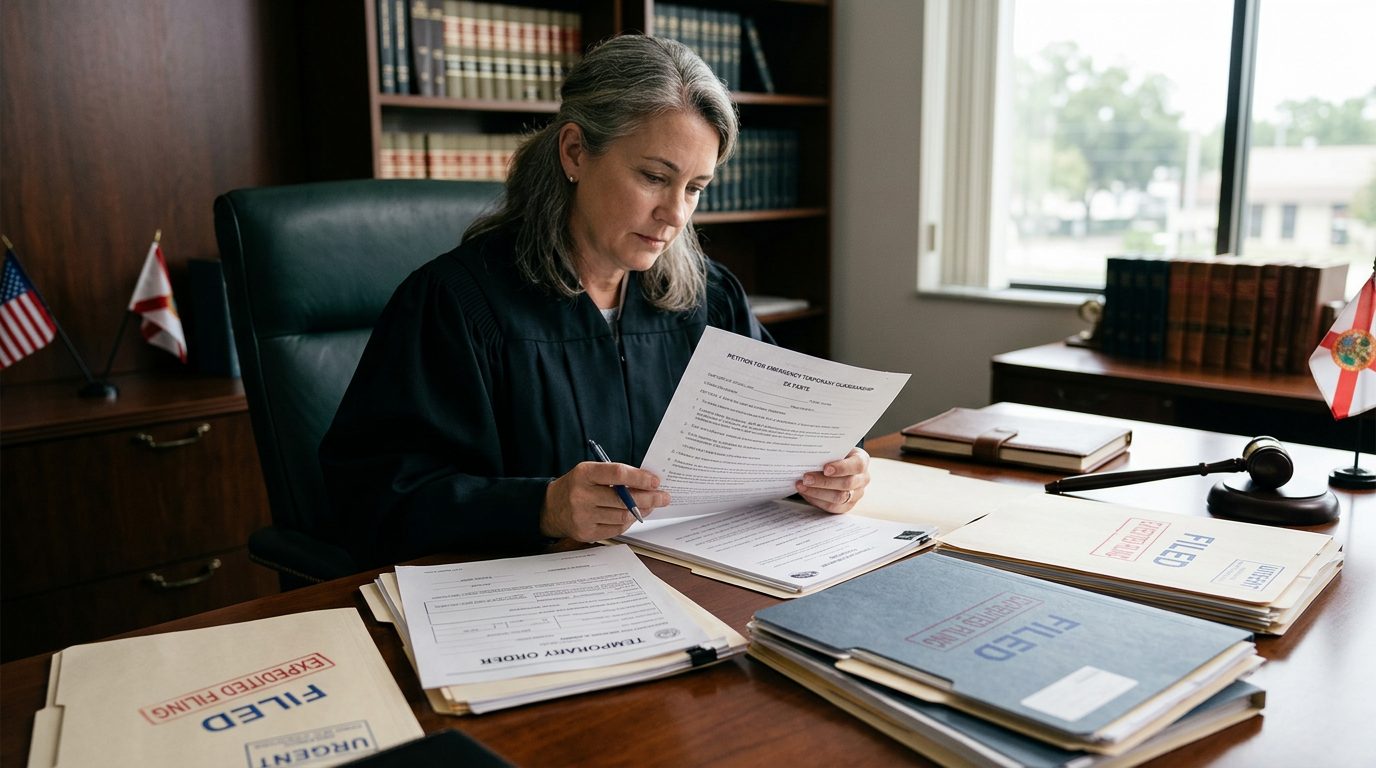
An ex parte order is an emergency court order granted without advance notice to or presence of the other party. The judge issues it based solely on your petition, affidavit, and supporting documents. Ex parte orders are common in Marchman Act petitions and emergency temporary guardianship cases when time is critical.
These orders are temporary by design. Once granted, a full hearing must be scheduled—usually within 5 to 14 days—where the other party can present their side of the story. The judge then decides whether to continue, modify, or dissolve the order based on evidence from both parties.
When Do You Need an Ex Parte Order?
You may seek an ex parte order when immediate danger or irreparable harm is present and waiting for a standard court hearing would cause serious injury. Common situations include:
- Addiction crisis: A family member is in acute substance abuse danger and poses a risk to themselves or others, requiring emergency involuntary commitment for addiction.
- Mental health emergency: Someone is experiencing a psychiatric crisis and lacks the capacity to make safe decisions.
- Immediate threat: The respondent (the person the order targets) may flee, hide assets, destroy evidence, or harm themselves or others if given notice.
- Lack of cooperation: You cannot locate the respondent or secure their cooperation in time to file a standard petition.
What Proof Do You Need for an Ex Parte Order?
To obtain an ex parte order, you must submit a sworn affidavit with specific, detailed facts—not general allegations. Vague language is a leading reason courts deny ex parte relief.
Your affidavit should include:
- Specific facts showing immediate danger or irreparable harm: Describe concrete events, dates, behaviors, or statements that demonstrate the emergency. For example, “On [date], respondent consumed [substance] and threatened to [specific action]” is stronger than “respondent has a substance abuse problem.”
- Medical or professional documentation: If available, include evaluations from physicians, mental health professionals, or addiction specialists that support the need for intervention.
- Evidence of prior attempts: Show what you’ve already tried to address the situation (prior conversations, treatment referrals, calls to crisis services).
- Explanation of why notice is impractical or harmful: Explain why giving the respondent advance notice would defeat the purpose of the order. For example, “If respondent learns of this petition, he will flee the state” or “Respondent is in acute crisis and cannot be safely contacted.”
- For Marchman Act cases: Evidence that the person is substance abuse impaired, has lost the power of self-control over substance use, and either has impaired judgment or poses a risk of harm to themselves or others.
- For guardianship cases: Evidence of incapacity (cognitive decline, inability to manage affairs, vulnerability to exploitation) and the need for immediate protective action.
Why Would an Ex Parte Order Be Denied?
Courts deny ex parte orders when the evidence falls short of the legal standard. Common reasons include:
- Insufficient evidence of immediate danger: The affidavit describes a serious problem but not an emergency requiring same-day action.
- Conclusory language: The affidavit states conclusions (“respondent is dangerous”) without specific facts to support them.
- Failure to explain why notice is harmful: You don’t clearly articulate why the other party cannot be given advance notice.
- Procedural defects: Forms are incomplete, missing signatures, lack notarization, or contain other filing errors.
- Wrong legal threshold: The judge determines the matter doesn’t meet the standard for ex parte intervention—for example, a custody dispute without imminent danger.
- Alternative remedies available: The judge believes a temporary restraining order or other less drastic measure would suffice.
Step-by-Step Process for Filing an Ex Parte Order in Florida
Step 1: Gather Documentation and Evidence
Collect all materials supporting your emergency claim. This may include medical records, police reports, text messages, witness statements, prior court orders, or evaluations from treatment providers. Organize these chronologically so the judge can quickly understand the crisis.
Step 2: Prepare the Affidavit
Draft a sworn affidavit in your own words, detailing specific facts and dates. Have it notarized. The affidavit is the heart of your ex parte petition—it must be compelling, factual, and clear about why immediate action is necessary.
Step 3: Draft the Proposed Ex Parte Order
Prepare the order you want the judge to sign. Use the correct Florida court form for your matter type (Marchman Act, guardianship, etc.). Include the specific relief you’re seeking (admission for evaluation, appointment as guardian, etc.).
Step 4: Complete All Required Pleadings
Depending on your case type, you may need:
- A petition or complaint
- An affidavit in support of ex parte relief
- A proposed ex parte order
- A certificate of service or statement explaining why service has not yet occurred
- Supporting medical or professional evaluations
- Any prior court orders relevant to the case
Step 5: File with the County Clerk of Court
Identify the correct county and circuit court. Most ex parte matters in Marchman Act and guardianship cases are filed in the civil or family law division of the circuit court. Submit original documents and required copies to the clerk. Pay the applicable filing fee (fees vary by county and matter type).
Step 6: Obtain File-Stamped Copies
Ask the clerk for stamped copies for your records and for service on the other party once the order is granted.
Step 7: Provide Copies to the Judge
Ask the clerk how emergency matters are routed to judges in your county. Some counties have an emergency judge on duty; others require you to submit documents directly to the assigned judge’s office. Follow local procedures.
Step 8: Attend Any Immediate Hearing
If the judge schedules an immediate ex parte hearing (rare but possible), be prepared to testify under oath about the emergency circumstances.
Step 9: Prepare for the Full Hearing
After the ex parte order is granted, a full hearing is scheduled. Prepare your evidence and arguments for that hearing, where the other party will be present and can contest the order.
Not sure what your next step is?
Talk it through with our team — the first consultation is free, confidential, and carries no obligation.
Required Documents and Forms
The exact forms depend on your case type. For a Marchman Act petition, you’ll use forms specific to involuntary commitment proceedings. For guardianship, you’ll use guardianship petition forms. All must comply with Florida Rules of Civil Procedure and any local rules in your county.
Essential documents include:
- Petition or complaint (correct form for your matter)
- Affidavit in support of ex parte relief
- Proposed ex parte order
- Certificate of service or explanation of why service is not yet possible
- Supporting medical or professional documentation
- Prior court orders (if any)
- Verification that all documents meet Florida court rules
Filing with the Clerk of Court
Identify the correct county—typically where the respondent resides or where the crisis occurred. Determine the appropriate division (civil, family law, mental health). Submit original and required copies to the clerk, pay filing fees, and obtain file-stamped copies.
Ask the clerk about any local rules or special procedures for emergency matters. Some counties have expedited processes for ex parte filings. Confirm your judge assignment and any requirements for emergency submissions.
What Are the Disadvantages of Ex Parte Orders?
While ex parte orders provide urgent relief, they come with drawbacks:
- One-sided presentation: The judge hears only your version of events.
- Temporary duration: The order lasts only until the full hearing, typically 5–14 days.
- Risk of reversal: At the full hearing, the other party may present evidence that leads the judge to modify or dissolve the order.
- Burden of proof: You must present compelling evidence of immediate harm; the judge has discretion to deny the request.
- Potential for appeal: The other party can appeal the ex parte order or the final order after the full hearing.
- Procedural complexity: Strict compliance with rules and forms is required; errors can result in dismissal.
- Emotional toll: The urgency and adversarial nature can be stressful for families already in crisis.
The 33-Day Rule in Florida
In Marchman Act involuntary commitment cases, Florida law includes a critical safeguard: a person admitted involuntarily must be released or transferred to voluntary status within 33 days unless a petition for continued involuntary commitment is filed.
This rule protects individuals from indefinite detention. If the treatment facility believes longer care is necessary, it must file a petition before day 33. If no petition is filed, the person must be discharged or moved to voluntary treatment. This deadline is a key procedural checkpoint in addiction emergency cases.
What Happens After the Ex Parte Order Is Granted?
Once the judge signs the ex parte order, it takes effect immediately. You must then:
- Serve the other party with notice of the order and the scheduled full hearing date.
- Attend the full hearing, where both parties present evidence.
- Prepare for the judge’s decision at the full hearing—the order may be continued, modified, or dissolved.
- Understand appeal rights: Either party may appeal the final order within the applicable time frame.
If you're facing an addiction or mental health crisis and need emergency court intervention in South Florida, our team can guide you through the ex parte filing process—reach out to discuss your situation. Talk it through with our team — the first consultation is free, confidential, and carries no obligation.
Common Mistakes to Avoid
- Vague affidavit language: Use specific dates, times, and behaviors instead of general conclusions.
- Failing to explain why notice is harmful: Be explicit about why advance notice would defeat the purpose.
- Incomplete forms or missing signatures: Double-check all documents for completeness and proper notarization.
- Filing in the wrong county or court: Verify jurisdiction before filing.
- Insufficient supporting documentation: Attach all available evidence (medical records, evaluations, prior orders).
- Delaying service on the other party: Serve promptly after the order is granted to avoid procedural problems.
- Underestimating the full hearing: Prepare thoroughly; the other party will contest the order.
When to Seek Legal Guidance
Filing an ex parte order involves strict procedural requirements and high stakes. Consider seeking legal help if:
- You’re unsure whether your situation meets the legal threshold for ex parte relief.
- You need assistance drafting the affidavit or preparing supporting documents.
- You’re unfamiliar with Florida court procedures or your county’s local rules.
- The matter involves a Marchman Act petition or guardianship—areas with specialized requirements.
- You want representation at the ex parte hearing or the full hearing.
- You want to ensure all procedural steps are completed correctly and on time.

FAQ
What is the difference between an ex parte order and a temporary restraining order?
An ex parte order is issued without notice to the other party in emergency situations. A temporary restraining order (TRO) is a specific type of ex parte relief, often used in domestic violence or injunction cases. All TROs are ex parte, but not all ex parte orders are TROs.
How long does it take to get an ex parte order in Florida?
If filed during business hours, you may receive a decision the same day or within 24 hours. The exact timeline depends on judge availability and local procedures.
Can an ex parte order be appealed?
Yes. The other party can appeal the ex parte order, and either party can appeal the final order issued after the full hearing.
Do I need a lawyer to file an ex parte order?
You can file pro se (on your own), but the procedural complexity and high stakes make legal representation valuable, especially in Marchman Act and guardianship cases.
What happens if the ex parte order is denied?
If denied, you can file a standard petition and request a hearing where both parties are present. You may also file a motion to reconsider if circumstances change.
If you’re navigating an addiction or mental health emergency in South Florida and need guidance on filing an ex parte order—whether for a Marchman Act petition or emergency guardianship—Robinson & Casey can help you understand your options and move forward with confidence. Reach out to discuss your situation and learn how we can support your family during this critical time.
Time-Sensitive Filing
Ex parte orders are issued without notice to the other party and are meant for genuine emergencies. Courts require clear evidence of immediate harm or danger. Filing procedures and deadlines vary by county and court type.
Key Steps in the Ex Parte Filing Process
Prepare Your Petition & Affidavit
Draft a detailed written petition stating the facts, the relief you seek, and why immediate action is necessary without notice to the other party. Include a sworn affidavit with specific evidence of the emergency.
File With the Court
Submit your petition and affidavit to the appropriate Florida court (circuit court for guardianship matters, for example). Include all required forms and supporting documentation for your county.
Present to the Judge
The judge reviews your filing and may schedule an immediate hearing or decide on the papers alone. Be prepared to answer questions about the emergency and why notice to the other party would cause harm.
Obtain the Order & Serve Notice
If granted, the ex parte order is issued immediately. You must then serve the other party with notice of the order and typically a follow-up hearing date, as required by Florida law.
What Robinson & Casey Brings to Your Filing
Precise Petition Drafting
We prepare petitions and affidavits that clearly establish the emergency and meet Florida court standards, increasing the likelihood of approval.
Fast Turnaround
Ex parte matters demand speed. We prioritize emergency filings and work within tight timelines to get your petition before a judge quickly.
Knowledge of Local Court Rules
Each Florida county has specific procedures and forms. We know the requirements in Miami-Dade, Broward, Palm Beach, and across South Florida.
Immediate Guidance
When you're facing an emergency involving guardianship, Marchman Act commitment, or mental health intervention, we're ready to advise you on next steps.