
Marchman Act Petitions | Miami-Dade and South Florida
Helping Families Facing Polysubstance Use Take the Next Step
Robinson Casey focuses on Marchman Act petitions and guardianship matters for families in Miami-Dade, South Florida and across Florida. Start with a free, confidential first consultation with no obligation to continue.
By Richard J. Casey III, Esq. · Published October 31, 2026
If your adult child uses more than one substance and keeps getting worse, a Florida court may be able to order assessment and treatment. The Marchman Act is the state law that lets a family ask a judge for that help. This page explains how the petition works and what the court needs to see.
What the Marchman Act Is and Who It Covers
Polysubstance use is not a separate track. The statute speaks of substance abuse impairment in general terms and does not name one drug. A petition can describe the full pattern, such as alcohol mixed with opioids, stimulants, or benzodiazepines. Describe each substance, how often it was used, and what it led to.
Who may file? For an adult, Fla. Stat. § 397.68112 allows a spouse or legal guardian, any relative, a service provider, or an adult with direct personal knowledge of the person’s impairment and prior treatment. A parent is a relative, so a parent may file. This page covers adult children, ages 18 and older.
If your adult child keeps ending up in crisis, you don't have to carry this alone, and Robinson Casey is ready to talk through whether a Marchman Act petition fits your family. Talk it through with our team — the first consultation is free, confidential, and carries no obligation.

What Florida Requires Before a Court Can Order Treatment
A judge needs a good-faith reason to believe your adult child is impaired and has lost self-control because of it. The criteria appear in Fla. Stat. § 397.675. The person must have lost the power of self-control with respect to substance abuse. The person must also either need services and be unable to see that need, or be likely to neglect themselves in a way that poses a real threat of substantial harm, and it is not apparent that this harm may be avoided through the help of willing, able, and responsible family members or friends or the provision of other services; or there is a substantial likelihood that the person has inflicted, threatened, or attempted physical harm on themselves or someone else, or, unless admitted, is likely to inflict it.
The statute also says that simple refusal of services is not, by itself, proof of impaired judgment.
The petition itself must name your child and you, state your relationship, and give the facts behind your belief. Under Fla. Stat. § 397.68141, a recent assessment by a qualified professional, done within 30 days before filing, can go with the petition. If there was no assessment, or your child refused one, the petition must say so.
Start a written file now. Include dates of overdoses and ER visits, arrests, missed work, housing loss, and past treatment with how it ended. Write facts, not labels. Each case depends on its own facts, and the judge decides based on the evidence.
How the Petition Process Works, Step by Step
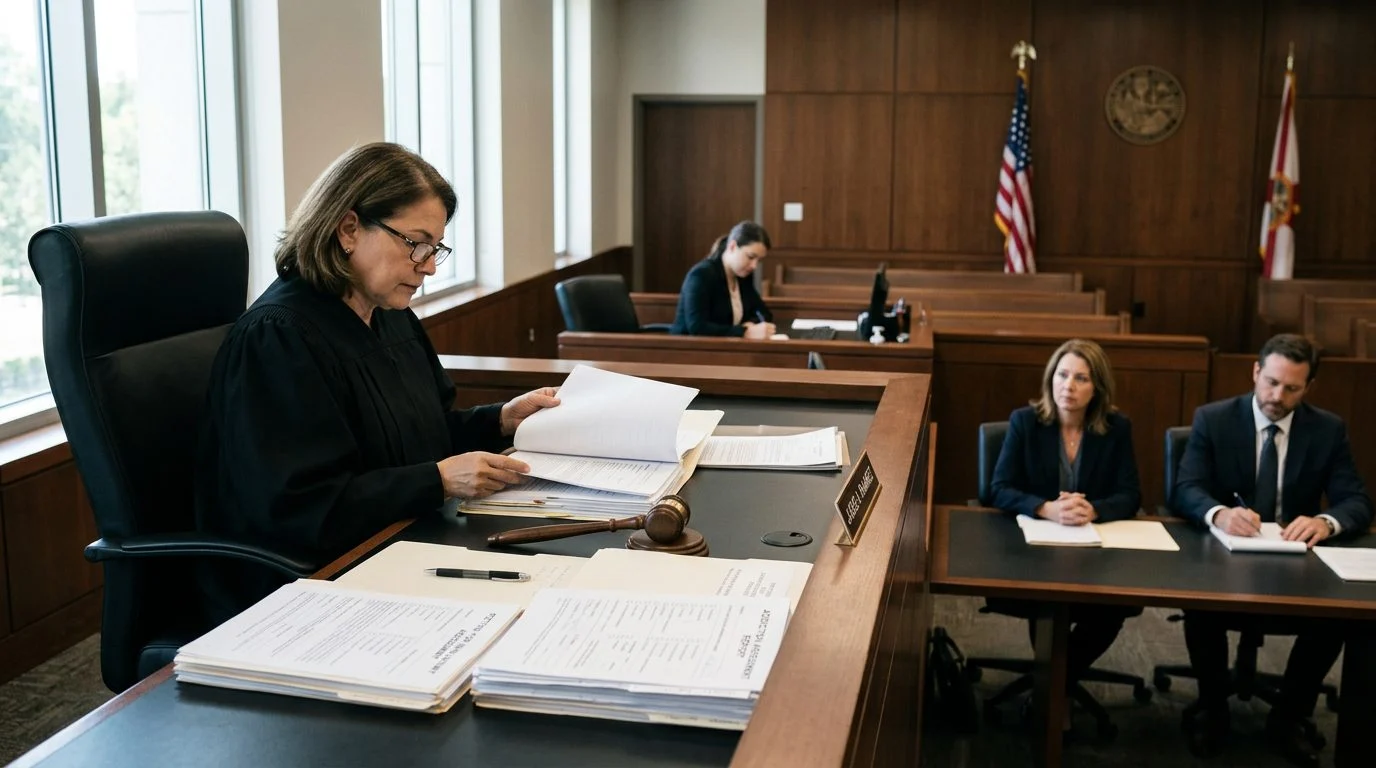
A Marchman Act petition moves through a consultation, filing, a hearing date, an assessment, and a hearing. The court must schedule a hearing on the petition within 10 court working days unless a continuance is granted (Fla. Stat. § 397.68151).
- Consultation and timeline. You list each substance, the dates, and the events that led you to act.
- Filing. In one Florida appeals court decision, the filing of a petition in the wrong county did not divest the circuit court in Putnam County of jurisdiction (J.P. v. J.N.).
- Counsel and hearing date. The court decides whether to appoint a lawyer. A Florida appeals court has held that a respondent has a constitutional right to counsel (Hillsborough County v. Albrechta). The court must set the hearing within 10 court working days unless it grants a continuance (Fla. Stat. § 397.68151).
- Emergency path. If an emergency exists, the court may act on the petition alone and enter an ex parte (one-sided) assessment order (Fla. Stat. § 397.6818). A provider may hold the person for no more than 72 hours of observation, unless a listed exception applies.
- The court hears all relevant evidence, including testimony from family members familiar with the person’s prior history, and may also order drug tests (Fla. Stat. § 397.6957). Your child may refuse to testify.
How Long a Marchman Act Order Lasts in Florida
An initial court order for involuntary treatment can last up to 90 days. The court must find the conditions proven by clear and convincing evidence (Fla. Stat. § 397.697). If the conditions are expected to exist after 90 days of treatment, a renewal of the involuntary services order may be requested before the end of the 90-day period. The court may then order up to an additional 90 days (Fla. Stat. § 397.6975).
Early release is possible. If no renewal is filed, the person is discharged automatically at the end of the 90 days (Fla. Stat. § 397.6977).
Planning starts early. Discharge planning must include and document the person’s needs and the actions to address them, covering at a minimum follow-up behavioral health appointments, how to get prescribed medications, living arrangements and transportation, and recovery support (Fla. Stat. § 397.6977). Raise each of these with the provider before discharge day.
What Petition Help From Robinson Casey Covers
Robinson Casey helps families prepare and file Marchman Act petitions. The firm limits its practice to Marchman Act petitions and guardianship matters, so this work is its core focus. Help includes:
- Case review. We review your documents and your child’s substance use history, including more than one substance and the harm you have seen.
- Drafting and filing. We prepare the petition and supporting papers for the proper Florida circuit court.
- Hearing preparation. We prepare you for the assessment, the hearing, and any testimony you may be asked to give.
- Communication. We help you communicate with the court, the treatment provider, and other family members.
The firm also handles guardianship matters, including emergency temporary guardianship, plenary guardianship, limited guardianship, and mental health guardianship.
Why Families Work With Robinson Casey
Richard J. Casey III, Esq., is the responsible lawyer for this page. Our team includes support staff who handle filings, scheduling, and document organization.
Each requirement on this page traces to the section that states it, so you can see what a judge must find.
We also say where the law is unsettled. In doing so, the court failed to follow the applicable statute by essentially functioning as the absent petitioner (J.C. v. State). A trial court that questions the only witness when the petitioner is absent has failed to follow the statute (J.C. v. State). A 2024 Fourth District ruling reached a different result on whether a judge may question a witness, so the rule is not settled statewide.
Not sure what your next step is?
Talk it through with our team — the first consultation is free, confidential, and carries no obligation.
Common Questions Parents Ask About Marchman Act Petitions
Most parents ask whether they can file, whether an arrest follows, and whether treatment must come first.
Can I file if my child refuses to cooperate or leaves home?
The county where your child is physically located when you file matters.
Will my child be arrested if I file?
The statute lets law enforcement take a person into custody for evaluation when a court orders it. The court decides that based on the petition.
Do I have to try treatment first?
If there was none, the petition must say so.
Does filing mean I have given up on my child?
A petition asks a court for an assessment. If the statute’s standards are met, it can lead to a treatment order for a set period.

Talk With Robinson Casey About Your Family’s Situation
A consultation can show whether a Marchman Act petition fits your family’s situation. You may be reading this after another late-night call, another ER visit, or another promise that did not hold. You may fear the next overdose more than anything. You want a legal path to proper treatment and do not want to manage this crisis alone.
Our first consultation is free, confidential, and carries no obligation to continue. Call (561) 849-4700 or request a consultation.
Why Families Contact Robinson Casey
A Focused Practice
Our work centers on Marchman Act petitions and guardianship matters, so every conversation is grounded in the procedures these cases involve.
A Confidential First Conversation
Your initial consultation is free, confidential and comes with no obligation to continue.
Support for the Whole Family
We understand that a loved one's polysubstance use affects everyone at home, and we take time to explain the options in plain language.
Responsive Support Staff
Our team helps you schedule a consultation and answers questions about getting started.
Don't Wait to Get Answers
A family emergency rarely waits for a convenient time. If you are worried about a loved one's polysubstance use, speak with our office about your situation as soon as you can.
Matters We Handle
Marchman Act Petitions
Guidance on filing a petition for assessment, stabilization and treatment for a family member struggling with substance use.
Involuntary Commitment for Addiction
Representation in proceedings where a court considers whether a person with substance use disorder should be taken into custody for evaluation and treatment.
Guardianship Matters
Help with plenary, limited and mental health guardianship, including emergency temporary guardianship when immediate protection is needed.
Marchman Act Attorney Support
Clear explanations of each step, from the initial petition through the hearing, so you know what to expect.