
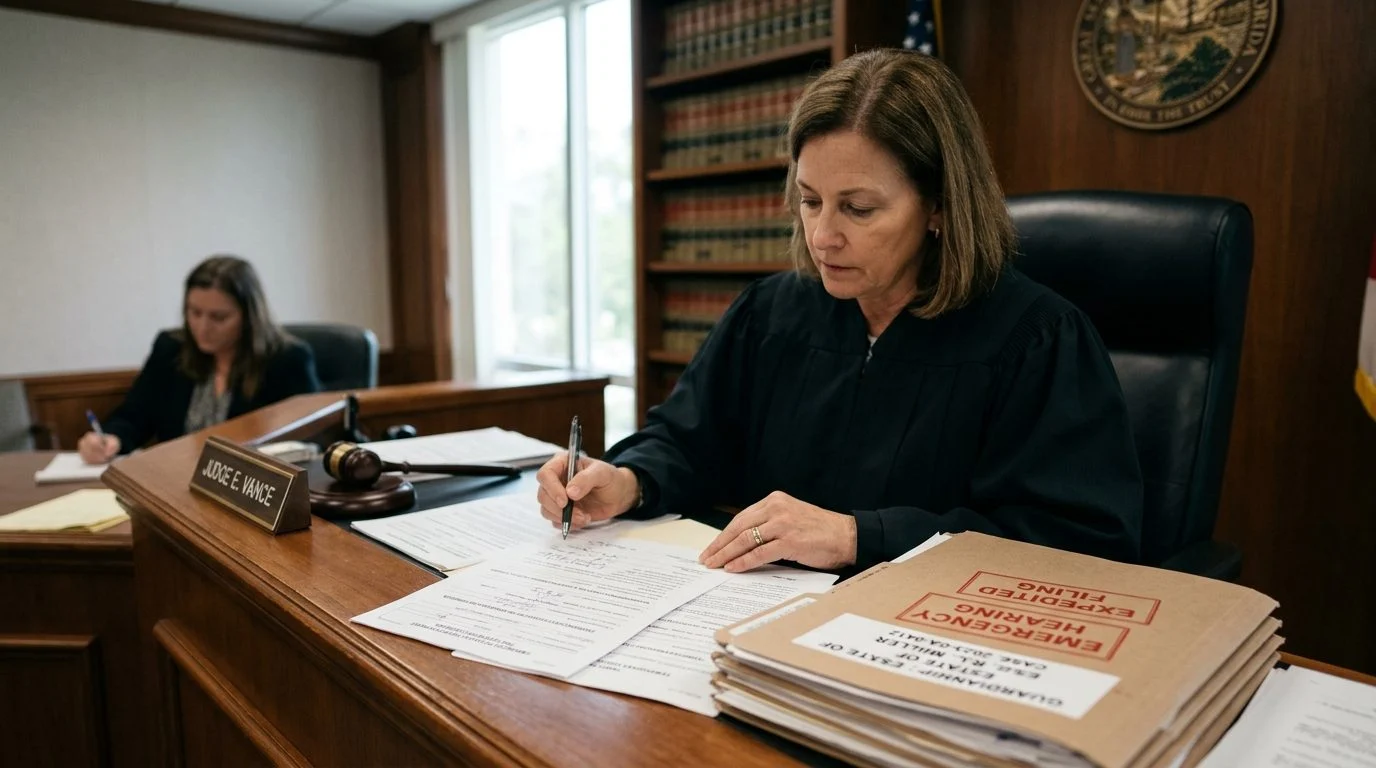
Emergency Temporary Guardianship | South Florida
What Can an Emergency Temporary Guardian Do in Florida?
Robinson Casey focuses on guardianship and Marchman Act matters for families in Miami-Dade, South Florida and across the state. Here is how emergency temporary authority works and why the court order matters.
By Richard J. Casey III, Esq. · Published October 24, 2026
An emergency temporary guardian in Florida can do only what the court’s order lists. A judge may appoint one, after a petition to determine incapacity is filed, for an adult who faces imminent danger that his or her physical or mental health or safety will be seriously impaired, or whose property is in danger of being wasted, misappropriated, or lost, unless immediate action is taken, before the full guardianship case is decided. The appointment is temporary, and the order sets the limits.
If you’re reading this because a parent, spouse, or other adult can’t make safe choices right now, you’re probably under pressure. You may not know what a court can give you, or what it can’t. This page explains the rules in plain words.
What an Emergency Temporary Guardian Is Under Florida Law
An emergency temporary guardian is a person a court appoints on an urgent basis. The court can act after a petition to determine incapacity is filed but before a guardian is named. Fla. Stat. § 744.3031 sets out this process.
The judge must find that there appears to be imminent danger. The danger must be to the person’s physical or mental health or safety, or to property that is in danger of being wasted, misappropriated, or lost. Immediate action must be needed.
Think of it as a stopgap. It lets the court act while the longer case moves forward. The petition itself must be verified and must state the extent of authority requested, either limited or plenary. See Fla. Prob. R. 5.648.
For the broader process, read our emergency temporary guardianship overview.
If someone you love can't make safe decisions right now, we can talk through whether an emergency temporary guardianship fits your situation. Talk it through with our team — the first consultation is free, confidential, and carries no obligation.

The Core Powers an Emergency Temporary Guardian Can Exercise
The court’s order controls. The rule says the order appointing the emergency temporary guardian must specify the powers and duties of the guardian. If the order doesn’t list a power, the guardian doesn’t have it.
Powers can cover the person, the property, or both. A judge might grant authority over daily safety, housing, or medical decisions. The same judge might limit the guardian to protecting money. The order decides which.
The powers and duties of the emergency temporary guardian must be specifically enumerated by court order, so the guardian acts only within the scope the court grants. The emergency temporary guardian must take an oath to faithfully perform the duties of a guardian before letters are issued. The good-faith and best-interests duties are set out in Fla. Stat. § 744.361. See Fla. Stat. § 744.361.
The most common mistake is assuming broad authority. Read the exact list of powers in the order.
Medical Care, Hospital Discharge, and Living Arrangements
A guardian can make medical or living decisions only if the order grants that power. Many families first learn this at a hospital.
Here is a common scenario. A hospital needs someone to sign for a safe discharge. The adult cannot decide, and no one has legal authority. Families facing this gap often ask an attorney which type of appointment fits their situation.
Florida law lets a court remove the right to make health care decisions and delegate that right to a guardian. See Fla. Stat. § 744.3215.
Placement is a separate limit. Without first getting specific authority from the court, a guardian may not commit the ward to a facility, institution, or licensed service provider without a formal placement proceeding. See Fla. Stat. § 744.3215.
Dementia-related decline creates the same urgency. A person may wander, skip medication, or be unsafe at home. The same rules apply. The guardian must make decisions that fit the order and the ward’s needs.
A guardian of the person must also consider the ward’s expressed desires. The guardian may not restrict the ward’s physical liberty more than reasonably necessary to protect the ward or another person from serious physical injury, illness, or disease. See Fla. Stat. § 744.361.
Protecting Finances and Property
An emergency guardian of the property can act to protect assets, within the order.
Families often seek urgent protection when someone is taking money or bills are going unpaid. The court decides whether to grant financial powers. They are not automatic in every appointment.
A guardian who controls property must protect and preserve it. A guardian who is given authority over any property of the ward must also keep clear, distinct, and accurate records of the administration of the ward’s property. See Fla. Stat. § 744.361.
Some property actions need more approval. Performing or refusing performance of the ward’s contracts is governed by § 744.441: a plenary guardian of the property, or a limited guardian within granted powers, may do so only after obtaining court approval on a petition for authorization to act. That approval comes through a petition for authorization to act. See Fla. Stat. § 744.441.
What an Emergency Temporary Guardian Cannot Do
A guardian cannot use a power the order does not list. That is the central limit.
The person keeps many rights. Florida law says a person determined incapacitated keeps the right to be treated with dignity and protected from abuse, neglect, and exploitation. The person also keeps the right to counsel, visitors, and privacy. See Fla. Stat. § 744.3215.
Some rights can be removed but not handed to a guardian. These include the right to vote, to travel, to have a driver license, and to seek or retain employment. See Fla. Stat. § 744.3215.
An emergency appointment is not a substitute for the full process. If long-term decisions are needed, the family needs a longer guardianship case.
How Long the Appointment Lasts and What Comes Next
Emergency authority expires 90 days after the appointment date, though it may be extended for an additional 90 days upon a showing that the emergency conditions still exist. It also ends when a guardian is appointed, whichever comes first. See Fla. Stat. § 744.3031.
The authority can be extended for another 90 days. The emergency conditions must still exist. A petition to extend must show that the original conditions still exist. It must be served on the ward’s attorney and on the emergency guardian. See Fla. Prob. R. 5.648.
Notice matters too. Notice of the petition and hearing must be served on the alleged incapacitated person and that person’s attorney at least 24 hours before the hearing. The exception is when the petitioner shows substantial harm would occur. See Fla. Stat. § 744.3031.
After the emergency period, the guardian must file a final report within 30 days. A court may not approve payment of the guardian’s final fees, or the attorney’s final fees, until that report is filed. See Fla. Stat. § 744.3031.
Under Fla. Stat. § 744.3031(9), a final report is due no later than 30 days after the emergency temporary guardianship expires.
Can an emergency temporary guardian make medical decisions in Florida?
Yes, but only if the court order grants that power. Florida law allows a court to delegate health care decision-making to a guardian.
How long does emergency temporary guardianship last in Florida?
Authority expires 90 days after appointment or when a guardian is appointed, whichever comes first. The court may extend it for another 90 days if emergency conditions still exist.
Does the incapacitated person get notice in Florida?
Yes. Notice must reach that person and the person’s attorney at least 24 hours before the hearing, unless the petitioner demonstrates that substantial harm to the alleged incapacitated person would occur if the 24-hour notice is given.
Not sure what your next step is?
Talk it through with our team — the first consultation is free, confidential, and carries no obligation.

Talk With Robinson Casey About Your Situation
If your parent is in a hospital and no one can sign for a safe discharge, or a relative’s money is at risk, the days ahead can feel impossible. You don’t have to sort out the court rules alone. Robinson Casey limits its practice to Marchman Act petitions and guardianship matters, serving families across South Florida and statewide. Richard J. Casey III, Esq. is the responsible lawyer for this page.
Our free first consultation is confidential, with no obligation to continue. Call (561) 849-4149 or use our contact page to talk through whether an emergency temporary guardianship fits your family’s facts.
How Robinson Casey Supports Families
Guardianship Petitions
Our attorneys focus on preparing and filing guardianship petitions, including emergency temporary, plenary, limited and mental health guardianships.
Clear Explanations
We explain each step of the process in plain language so you understand what to expect.
Compassionate Representation
Our team understands that these cases involve families in urgent and emotional circumstances.
Review the Court Order Carefully
A guardian's powers come from the order the court signs. Before acting on any authority, review exactly what the order grants and what it does not.
Matters an Emergency Temporary Order May Address
Health Care Decisions
Where the court grants this power, a guardian may be authorized to make health care decisions for the incapacitated person.
Living Arrangements
The order may address where the person lives and the care setting that best meets their needs, as the court directs.
Financial Matters
Some orders authorize a guardian to manage income, pay bills and protect property, within the limits the court sets.
Court Reporting
A guardian typically reports to the court on the ward's condition and the actions taken under the order.