
Marchman Act Attorney | Miami-Dade & South Florida
Marchman Act Petitions in Florida After an Overdose
Robinson Casey limits its practice to Marchman Act and guardianship matters for families in Miami-Dade, South Florida and across Florida. Learn how the petition process works and what it can and cannot do.
By Richard J. Casey III, Esq. · Published October 18, 2026
If someone you love has overdosed and keeps using, you may ask whether Florida law lets a family force treatment. In many cases, the answer runs through a Marchman Act petition filed with the court. This page explains how that route works, how it differs from waiting, and what the process can and cannot deliver. It is general information, not advice about your situation.
Why an Overdose Changes the Timeline
An overdose is a medical emergency, so call 911 first. Medical staff decide how the person is stabilized and what care comes next.
A court case moves on its own schedule. It does not replace emergency care. Hospital discharge plans, the person’s condition, and treatment choices belong to medical providers. The family and the court do not make those clinical calls.
Families often feel pressure to act within hours, and that pressure is real. Knowing the legal steps before a crisis helps you decide what to do first. The Florida Department of Health lists treatment options and recovery-support resources that families can use when a loved one uses substances.
If someone you love is still using after an overdose, you don't have to sort out the court process alone. Our team is ready to talk through your options with you. Talk it through with our team — the first consultation is free, confidential, and carries no obligation.

What the Marchman Act Is and Where It Fits
The Marchman Act is Florida’s civil process for involuntary assessment and treatment of substance use.
To qualify, the person must meet the criteria in Fla. Stat. § 397.675. There must be a good faith reason to believe the person is substance abuse impaired. Or the person has a substance use disorder and a co-occurring mental health disorder. That impairment must have caused the person to lose the power of self-control over substance use.
The statute also requires a second showing. Either the person’s judgment is so impaired that they cannot see their need for services, or they are likely to neglect themselves in a way that poses a real and present threat of harm. Refusing services alone does not prove impaired judgment.
This is a civil matter, not a criminal charge. A petition starts when someone files it with the court. For the full picture, read our guide on involuntary commitment for addiction.
Waiting for a Court Order: What That Path Looks Like
Waiting does not start a court process. A court order does not exist until someone files a petition and a judge acts on it. A family that waits is waiting for something that has not begun.
The gap is the real risk. The person may leave treatment, be discharged, or return to use while the family decides. How long that gap lasts depends on the facts of each case.
Each path has tradeoffs. Waiting avoids the court step but leaves the situation unchanged. Filing creates a court process with its own steps and timelines.
Even after an order exists, Florida law allows early release in some cases. A person may be discharged before the 90-day period ends if the likelihood of harm no longer exists. They may also be released if they no longer meet the criteria and agree to voluntary status (Fla. Stat. § 397.6971).
How a Marchman Act Petition Is Filed
For an adult, a spouse, legal guardian, relative, service provider, or adult with direct personal knowledge can file.
The petition goes to the clerk of the court in the county where the person is located. The clerk may not charge a filing fee (Fla. Stat. § 397.681). Location matters. In J.P. v. J.N., the Fifth District held that filing in the wrong county was a venue defect, not a loss of jurisdiction.
The petition must name the person and the petitioner, and state their relationship. It must also give the facts showing why the person is impaired and why harm is likely without court-ordered services (Fla. Stat. § 397.68141). If a qualified professional examined the person within 30 days before filing, that report can be attached. If the person was not assessed or refused, the petition must say so.
Richard J. Casey III, Esq. is the responsible lawyer for this page. Robinson Casey limits its practice to Marchman Act and guardianship matters and serves families across South Florida and statewide.
Emergency Admission by Law Enforcement
Florida law also allows emergency admissions, which can happen before any hearing. A person who meets the criteria may be admitted to a hospital, detox facility, or addictions receiving facility for emergency assessment. The facility needs a substance-specific certificate from a listed professional and a completed application (Fla. Stat. § 397.679). For an adult, a spouse, legal guardian, relative, or responsible adult with personal knowledge can ask for that certificate (Fla. Stat. § 397.6791).
In an emergency, the court may rely only on the petition and enter an ex parte order. That means an order issued without a hearing. The court may direct an officer to take the person in for evaluation (Fla. Stat. § 397.6818). The Lake County Clerk of Court explains that a judge may order law enforcement transport to an appropriate treatment facility.
The ex parte route has limits. A provider may not hold the person for more than 72 hours of observation unless an exception applies. In D.H. v. K.J.R., the court held that a petition without a good faith reason to believe the criteria were met could not support the ex parte order.
For a loved one who refuses care after an emergency, read about when a family member refuses treatment.
The Court Hearing and What Happens Next
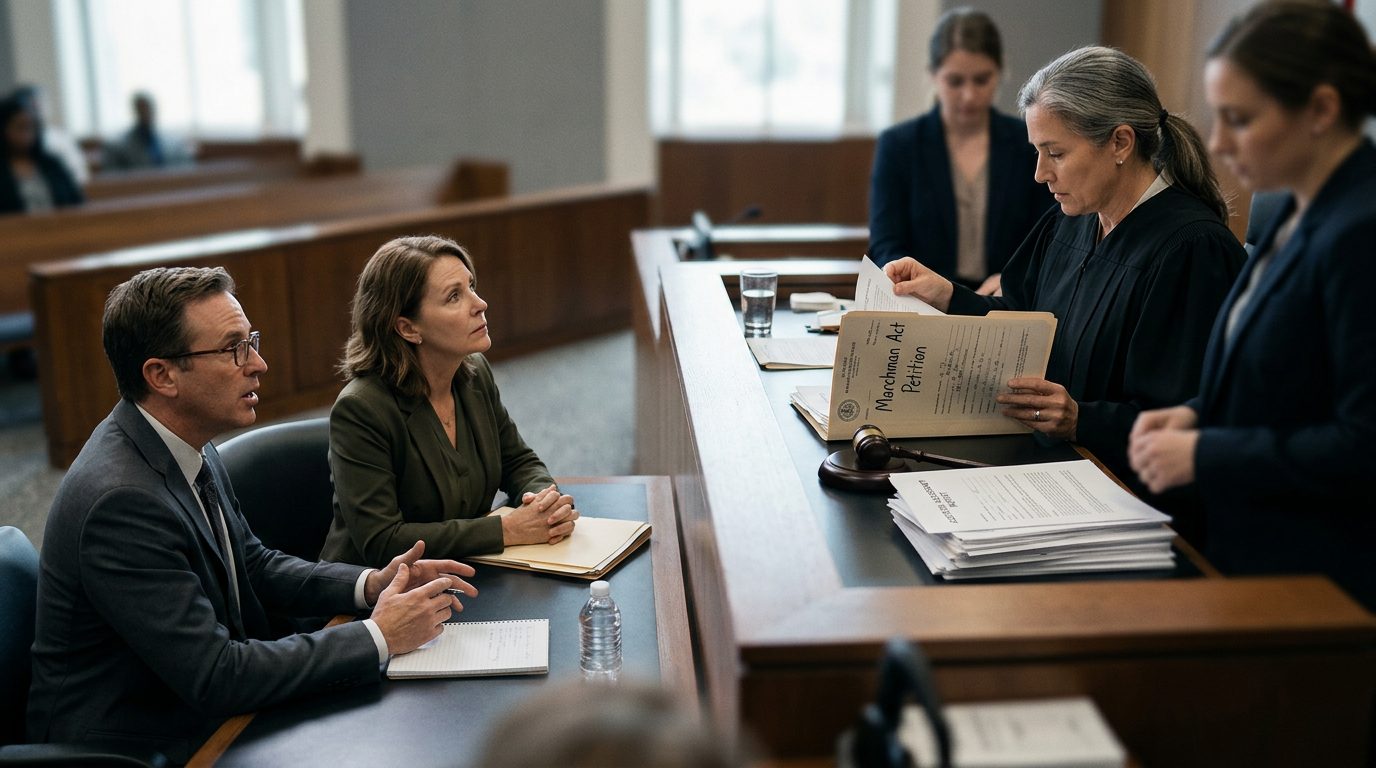
At the hearing, the judge decides whether the legal criteria are met. No one can predict that result from outside the courtroom.
The court must set the hearing within 10 court working days, unless it grants a continuance (Fla. Stat. § 397.68151). The person must attend unless the court finds a valid waiver. The court hears relevant evidence, including family members who know the person’s history, and may order drug tests (Fla. Stat. § 397.6957).
The petitioner carries the burden of proof. In J.C. v. State, the Fifth District reversed when a trial court acted as the absent petitioner by questioning the only witness. The court reaffirmed that rule in C.W.R.K. v. Stewart Marchman Act Behavioral Healthcare under the 2023 statute.
The Fourth District reached a different result in J.J.J. v. D.G. and noted a conflict. The 2024 amendments may also affect the question.
If the court finds the conditions proved by clear and convincing evidence, it may order treatment for up to 90 days (Fla. Stat. § 397.697).
Not sure what your next step is?
Talk it through with our team — the first consultation is free, confidential, and carries no obligation.
Rights and Protections for the Person Named in a Petition
The person named in a petition, called the respondent, has the right to counsel at every stage. A respondent who cannot afford a private lawyer may receive court-appointed counsel (Fla. Stat. § 397.681). The Second District has held that this right rests on due process in Hillsborough County v. Albrechta.
The respondent also receives a copy of the petition and the hearing notice. The respondent shall be informed by the court of the right to an independent assessment (Fla. Stat. § 397.6957).
Can a family member force someone into rehab?
A family member can file a petition, but only a judge can order involuntary treatment. The judge must find the statutory conditions proved by clear and convincing evidence.
How do I get someone involuntarily committed in Florida?
File a petition with the clerk in the county where the person is located. Describe the facts that support the statutory criteria, then the court reviews the petition and sets a hearing.

Key Takeaways and Next Steps
A court order comes from a petition and a hearing. Waiting means that process has not started.
- In an emergency, call 911 first.
- Petitions go to the clerk in the county where the person is located, with no filing fee.
- The respondent has a right to counsel.
- Hearings are set within 10 court working days unless continued.
You may be watching someone you love go through a crisis they did not choose. The decision in front of you may not wait long. You don’t need every answer before you reach out. Robinson Casey’s first consultation is free, confidential, and comes with no obligation to continue. Call (561) 849-4149 or use our contact page.
Overdose Is a Medical Emergency
Call 911 first. Emergency medical staff decide how the person is stabilized and what care comes next. Legal options can be considered afterward, but they do not replace emergency medical care.
Why Families Bring Their Case to Robinson Casey
Focused Practice
Our work is limited to Marchman Act petitions and guardianship matters, so our attention stays on these cases.
Free, Confidential First Consultation
Your first consultation is free, confidential and comes with no obligation to continue.
Direct Phone Access
Call (561) 849-4149 to talk with our team about your family's situation.
Support Staff Who Keep You Informed
Our assistants and office staff help you keep track of each step while Richard J. Casey III, Esq. explains the court process.
Common Paths Families Ask About
Marchman Act Petition
A petition asks the court to consider whether a person needs assessment and treatment for substance use. We explain what the filing involves.
Involuntary Commitment for Addiction
Commitment is the court process in which a judge decides whether a person should be placed in treatment. Each case turns on its own facts.
Guardianship Options
We review plenary, limited and mental health guardianship.
Emergency Temporary Guardianship
We discuss what that step can and cannot do.