
Marchman Act & Guardianship | South Florida and Statewide
Guidance for Your Family
Robinson Casey focuses exclusively on Marchman Act petitions and guardianship matters. Speak with Richard J. Casey III, Esq. about your family's situation in a free, confidential first consultation.
By Richard J. Casey III, Esq. · Published October 19, 2026
Under Fla. Stat. § 397.675, a person meets the criteria for involuntary admission if there is good faith reason to believe that the person is substance abuse impaired or has a substance use disorder and a co-occurring mental health disorder and, because of such impairment or disorder, has lost the power of self-control with respect to substance abuse, and also either is in need of substance abuse services and, because of substance abuse impairment, is incapable of appreciating that need and of making a rational decision about it, or is likely to suffer neglect or refuse care in a way that poses a real and present threat of substantial harm that cannot apparently be avoided through willing, able, and responsible family members or friends or other services, or has inflicted, threatened, or attempted physical harm, or, unless admitted, is likely to inflict physical harm on himself, herself, or another. A court can order assessment and treatment for a person who meets strict legal criteria. Florida calls this process the Marchman Act. This guide explains chapter 397 Florida involuntary admission substance use rules in plain English.
What Chapter 397 Covers and Why It Matters for Families
Chapter 397 covers substance abuse services in Florida. Its involuntary rules matter most when drug or alcohol use puts someone at risk. Families often reach this law in a crisis. A parent may see a child using dangerously. A spouse may fear for a partner who has stopped eating, sleeping, or going to work.
Many people assume that refusing treatment proves a person can’t decide for themselves. Mere refusal to receive services is not, by itself, evidence of lack of judgment about the need for services (Fla. Stat. § 397.675). Fla. Stat. § 397.675 reads: “(b) Without care or treatment, is likely to suffer from neglect or refuse to care for himself or herself; that such neglect or refusal poses a real and present threat of substantial harm to his or her well-being; and that it is not apparent that such harm may be avoided through the help of willing, able, and responsible family members or friends or the provision of other services, or there is substantial likelihood that the person has inflicted, or threatened to or attempted to inflict, or, unless admitted, is likely to inflict, physical harm on himself, herself, or another.”
The law has changed recently, so the current text controls.
If a loved one's drinking or drug use has you worried about their safety, our team can talk through your facts with you, and you don't have to face it alone. Talk it through with our team — the first consultation is free, confidential, and carries no obligation.

Where Part V Sits Within Florida’s Substance Abuse Statutes
Part V of Chapter 397 holds the involuntary process. The Marchman Act also allows voluntary admission, so involuntary treatment is one route among others.
Section 397.68111 says a petition may be filed when a person reasonably appears to meet the criteria. It also covers a person placed in protective custody or given an emergency admission within the previous 10 days, or assessed by a qualified professional within 30 days (Fla. Stat. § 397.68111).
The statute was amended in 2024 and 2025. Older web pages may quote earlier text. The petition rules are in Fla. Stat. § 397.68141, which notes that it was formerly s. 397.6951. The current petition section lists that number as a former one.
Who May File a Petition and What the Petition Must Say
For an adult, a petition may be filed by a spouse or legal guardian, any relative, a service provider, or an adult with direct personal knowledge of the person’s impairment and prior treatment (Fla. Stat. § 397.68112).
The petition must name the respondent and the petitioner. It must state their relationship, name the respondent’s attorney if known, and give the facts behind the request (Fla. Stat. § 397.68141). The facts must explain why the petitioner believes the person is impaired and has lost self-control. They must also show either a risk of physical harm or judgment so impaired that the person can’t see the need for care. Vague worry is not a stated reason.
A petition may include a report from a qualified professional who examined the person within 30 days before filing. If no assessment happened, or the person refused one, the petition must say so.
The petition goes to the clerk in the county where the person is located. The clerk may not charge a filing fee for it (Fla. Stat. § 397.681). Venue mistakes matter. According to the opinion in J.P. v. J.N., the filing of the petition in the wrong county did not divest the circuit court in Putnam County of jurisdiction.
The Criteria Courts Apply Under the Statute
Under Florida law, involuntary admission requires a good faith reason to believe that the person meets the criteria set out in the statute. The first part requires substance abuse impairment, or a substance use disorder with a co-occurring mental health disorder. That condition must have caused the person to lose the power of self-control about substance use.
The second part has two paths. In the first, the person needs substance abuse services, and impaired judgment keeps them from seeing that need or making a rational choice about it. In the second, the person is likely to neglect themselves or refuse care without help. That creates a real and present threat of substantial harm that does not appear avoidable through the help of willing, able, and responsible family members or friends or other services.
Who must prove these facts matters. As the opinion in J.C. v. State explains, the court failed to follow the applicable statute by essentially functioning as the absent petitioner. It reversed an order where the trial court questioned the only witness while the petitioner was absent. In C.W.R.K., the same court reaffirmed that rule in 2024 under the current statute.
A Fourth District decision, J.J.J. v. D.G., reached a different result on a similar question. It created a conflict with earlier Fifth District rulings, including R.S. and C.W.R.K. The rule is not uniform across Florida.
From Filing to Hearing: The Process in Plain Terms
After filing, the court decides whether the person has a lawyer or should get one. The hearing must be set within 10 court working days unless a continuance is granted (Fla. Stat. § 397.68151).
Emergencies move faster. The petition must describe the emergency and must include a request for an ex parte assessment and stabilization order (§ 397.68141). The court may rely on the petition alone and enter that order without appointing an attorney (Fla. Stat. § 397.6818). A provider may not hold the person longer than 72 hours of observation unless specific conditions apply. The Second District also held that an ex parte order must rest on petition facts giving a good faith reason to believe the criteria are met (D.H. v. K.J.R.).
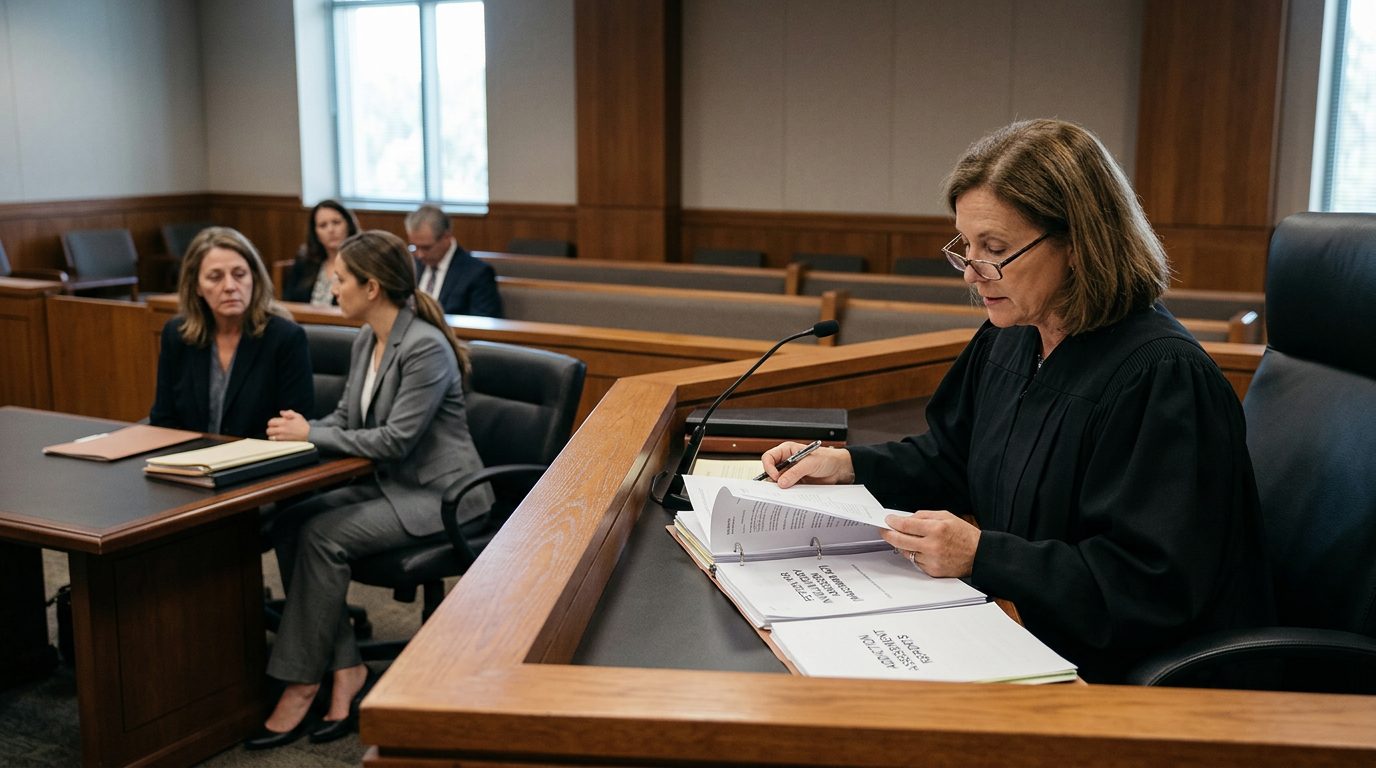
At the hearing, the respondent must attend unless the court finds that they knowingly, intelligently, and voluntarily waive the right to be present, or that their presence is inconsistent with their best interests or is likely to be injurious to self or others (§ 397.6957). Testimony is under oath, the proceedings are recorded, and the respondent may refuse to testify.
Under § 397.681, the respondent has the right to counsel at every stage of a judicial proceeding on a petition for involuntary treatment for substance abuse impairment. A respondent who can’t afford a private lawyer may have one appointed (§ 397.681). Under Fla. Stat. § 397.681, a respondent has the right to counsel at every stage of a judicial proceeding relating to a petition for involuntary treatment for substance abuse impairment. Timing depends on the facts of each case.
What the Statute Allows a Court to Order
If the court finds the conditions proved by clear and convincing evidence, it may order involuntary treatment services for up to 90 days (Fla. Stat. § 397.697). The service can come from a publicly funded provider. A privately funded provider may be used if the person can pay, or if someone acting for them shows willingness and ability to pay.
The court keeps authority after the order. It can monitor compliance, change the treatment, or start contempt proceedings for violating a valid order (§ 397.697).
Release can come early. Before the 90-day period ends, when the conditions justifying involuntary treatment services no longer exist, the individual must be released as provided in s. 397.6971 (§ 397.697). Examples include when the individual no longer needs treatment services, or when the individual no longer meets the criteria for involuntary admission and gives informed consent to transfer to voluntary treatment status. A renewal petition must be filed before the court-ordered services period expires, and if the court grants it, the court may order involuntary treatment services for a period not to exceed an additional 90 days (Fla. Stat. § 397.6975).
Discharge planning must cover follow-up appointments, how to get prescribed medications, housing and transportation, and recovery support (Fla. Stat. § 397.6977).
The court decides each case on its own record. No one can promise how it will rule.
Not sure what your next step is?
Talk it through with our team — the first consultation is free, confidential, and carries no obligation.

Talking Through Your Situation With Robinson Casey
If you’re reading this late at night because a family member keeps refusing help, you may be trying to understand a law you never expected to need. That’s a hard place to be, and you don’t have to sort it out alone.
Richard J. Casey III, Esq. is the lawyer responsible for this page. Robinson Casey limits its practice to Marchman Act petitions and guardianship matters for families in South Florida and statewide. The first consultation is free, confidential, and comes with no obligation to continue.
Frequently asked questions
Who can file a Marchman Act petition in Florida?
For an adult, a spouse or legal guardian, any relative, a service provider, or an adult who has direct personal knowledge of the respondent’s substance abuse impairment and prior course of assessment and treatment may file.
How long can an involuntary treatment order last?
An initial order can last up to 90 days. A provider may seek renewal for up to another 90 days.
Can someone be held before a hearing?
In an emergency, a court can enter an ex parte order. A provider may hold the person up to 72 hours of observation unless specific exceptions apply.
If a loved one’s drinking or drug use has you worried about their safety, call (561) 849-4149 or use the contact form to talk through the facts of your situation.
Why Families Contact Robinson Casey
Free, Confidential Consultation
Your first consultation is free and confidential, with no obligation to continue after we talk.
South Florida and Statewide
We represent families in Miami-Dade, across South Florida, and throughout Florida.
Supportive Office Team
Our team works with you throughout the process, from your first call to the steps that follow.
Do Not Wait Until It Becomes a Crisis
Substance use emergencies can move quickly. If you are worried about a loved one's safety or health, call our office to talk through your options before the situation escalates.
Involuntary Commitment for Addiction
Guidance on involuntary admission for substance use, including the court process and what to expect at each stage.
Emergency Temporary Guardianship
Urgent court petitions to protect a person who needs immediate decision-making support while a case is pending.
Plenary and Limited Guardianship
Full and limited guardianship petitions tailored to the level of support a family member needs.
Mental Health Guardianship
Guardianship matters for individuals whose mental health condition affects their ability to manage personal or financial decisions.