
Marchman Act & Guardianship | Miami-Dade & South Florida
Understanding the Marchman Act Process for Your Spouse
Learn the stages a case typically moves through, from the first filing to the steps that follow, so you know what to expect.
Casey III, Esq. · Published November 8, 2026
Where You Are Right Now, and Why a Timeline Helps
The Marchman Act is a Florida law that lets a court order assessment and, when the legal criteria are met, treatment for an adult who can’t or won’t get help on their own. If that describes your home today, this Marchman Act timeline for spouses Florida guide shows the order of events and the waiting periods that matter.
Your spouse’s drinking or drug use has likely made money tight, mornings unpredictable, and your children anxious. You may feel that every week of waiting costs your family something. That fear is real, and knowing the steps can make the next move feel less blind.
This page does not predict how any case will end. For the broader overview, see our Marchman Act attorney guide.
If you're carrying your household alone right now, we can walk through your dates, documents, and deadlines with you. Talk it through with our team — the first consultation is free, confidential, and carries no obligation.

Step 1: The First Crisis and What to Write Down
Start with safety. If anyone is in immediate danger, call 911 first. The Marchman Act process is a court process, not an emergency response.
Once things are calm, start a written record. Write down dates, times, what happened, who was present, and any injuries, threats, or property damage. A petition must state the facts behind your belief, so specific details matter more than general descriptions.
Also note the effects on your children. Record missed school, fear at home, and changes in their routine. Keep bills, late notices, and records of money taken or borrowed. Write down any past treatment, hospital stays, or times your spouse refused help. Those facts shape how the court views the situation.
Timing: This comes before any filing. Start the record now, not on the day of the hearing.
Step 2: Can a Spouse File, and What the Petition Must Show
Yes, a spouse can file. For an adult, a petition may be filed by the respondent’s spouse or legal guardian, any relative, a service provider, or an adult who has direct personal knowledge of the substance abuse impairment and prior assessment and treatment. The “respondent” is the person named in the petition. Fla. Stat. § 397.68112
The petition must name you and your spouse and state your relationship. It must give the reason you believe your spouse is substance abuse impaired and has lost the power of self-control. A Marchman Act petition must include factual allegations showing the reason for the belief that your spouse is substance abuse impaired, the loss of self-control, and either a likelihood of physical harm to self or others or impaired judgment. The petition must also describe facts showing either a likelihood that your spouse will physically harm themselves or others, or that substance abuse has so impaired your spouse’s judgment that they cannot appreciate the need for care. Fla. Stat. § 397.68141 A report from a qualified professional who examined your spouse within 30 days before filing can be attached. If your spouse was never assessed or refused an evaluation, the petition must say so.
Your standing is clear. Filing, though, does not decide the outcome. A judge decides after a hearing.
Step 3: From Filing to Custody and the Initial Assessment
The court first decides whether your spouse has a lawyer or should get one. When a petition is filed, the court must determine whether your spouse has an attorney or whether appointing one is appropriate. Fla. Stat. § 397.681
Here is the order of events:
- Day 0: The petition is filed with the clerk.
- Up to 72 hours: A service provider may not hold your spouse for observation longer than 72 hours. Exceptions include a court-granted extension after a hearing, signs of withdrawal or a need to be detoxified or treated for a medical condition (which extends observation no later than the scheduled hearing date, absent a court-approved extension), or an observation period ending on a weekend or holiday. Fla. Stat. § 397.6818
- Within 10 court working days: The hearing is scheduled, unless a continuance is granted. Fla. Stat. § 397.68151
No decision is final until the court acts. Keep the household routine steady and your records current in the meantime.
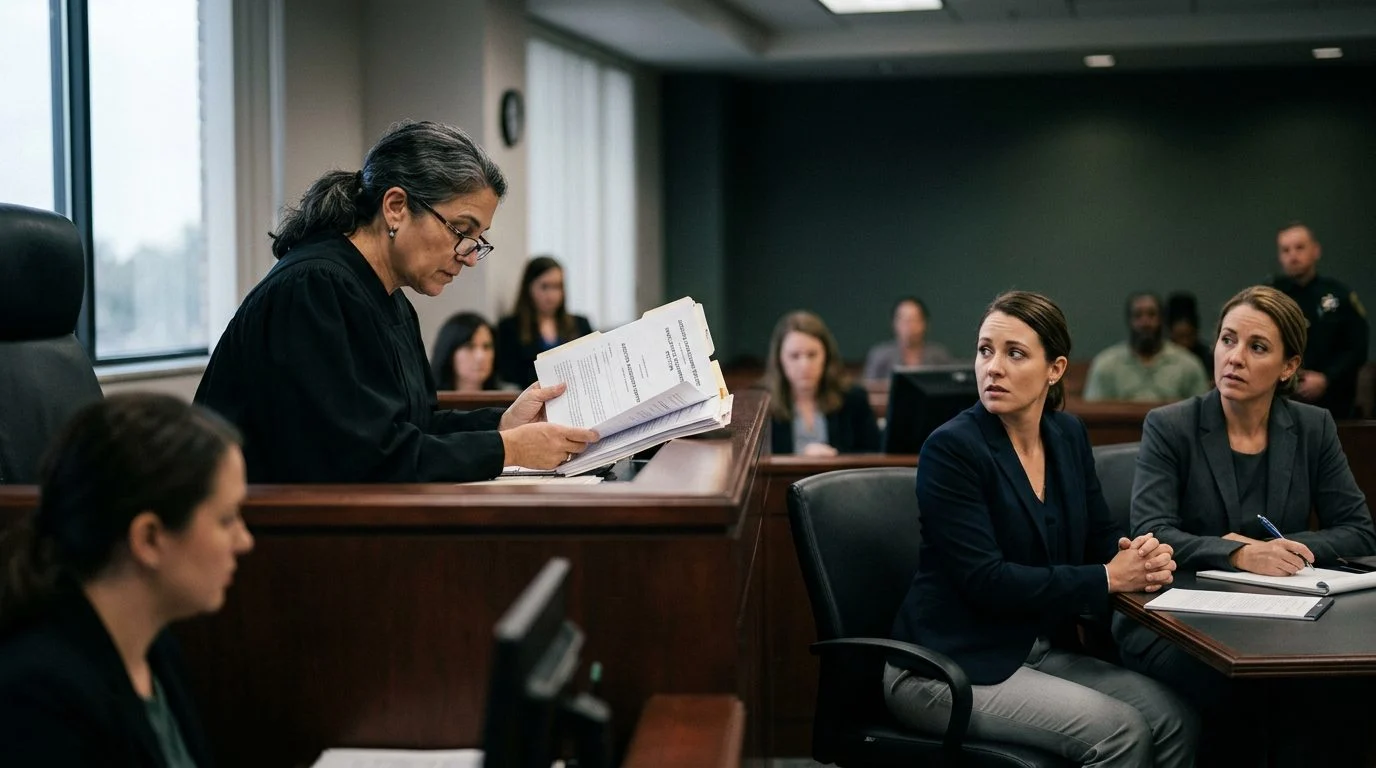
Step 4: The Hearing Date and What Happens in Court
The hearing is where the judge weighs the evidence. Your spouse must attend unless the court finds a valid waiver, or finds that attending is inconsistent with their best interests or likely to be harmful. Fla. Stat. § 397.6957
The court hears all relevant evidence. That can include testimony from family members who know your spouse’s history. The court may also order drug tests. Testimony is taken under oath, and the proceedings are recorded. Fla. Stat. § 397.6957
Expect questions about specific incidents, dates, and how the behavior has affected the household. Stick to what you saw, heard, or lived through.
Courts disagree on one point. C.W.R.K. v. Stewart Marchman Act Behavioral Healthcare The Fourth District reached the opposite result in J.J.J. v. D.G. and certified a conflict.
If your spouse does not appear, the court may reissue an ex parte order. Related reading is at what happens when an adult skips the hearing.
Step 5: After the Hearing, Treatment Orders and Review Dates
After a hearing, the court may order involuntary treatment only if the conditions are proved by clear and convincing evidence. The order may last up to 90 days. Fla. Stat. § 397.697 The court keeps jurisdiction to enter further orders while the order is in effect. Whether a case reaches any of these steps depends on the facts.
Here is what comes after:
- Order issued: Treatment for up to 90 days. Fla. Stat. § 397.697
- The hearing must be held within 10 court working days, and not more than 15 days after filing. Fla. Stat. § 397.6975 reads: “The hearing is conducted pursuant to ss. 397.6957 and 397.697 and must be held before the circuit court unless referred to a magistrate.” If granted, the court may add up to another 90 days. Fla. Stat. § 397.6975
- Before the 90-day period (or any extension) ends: Your spouse may be discharged early. This can happen if your spouse no longer meets the criteria for involuntary admission and gives informed consent to move to voluntary treatment; if your spouse was admitted because of a likelihood of physical harm to self or others and that likelihood no longer exists; if your spouse was admitted for needing assessment and stabilization or treatment while unable to decide about that need, and either that inability no longer exists or further treatment will not bring significant improvement; if treatment is no longer needed; or if the provider’s director finds your spouse beyond the provider’s safe management capabilities. Fla. Stat. § 397.6971
Our guide to job and firearm consequences covers those details.
Not sure what your next step is?
Talk it through with our team — the first consultation is free, confidential, and carries no obligation.

Talk With a Florida Marchman Act Attorney About Your Timeline
The next step in this Marchman Act timeline for spouses Florida is a conversation about your own dates, documents, and deadlines. You shouldn’t have to carry that planning alone while the household is under strain.
Does filing a petition mean my spouse is forced into treatment?
Filing starts a court process. A judge decides after a hearing whether the legal criteria are met.
How long does a Marchman Act treatment order last?
The statute allows treatment for a period not to exceed 90 days. If the conditions are expected to exist after that, a renewal may be requested under § 397.6975 before the 90-day period ends. Fla. Stat. § 397.697
Which county handles the petition?
The petition is filed in the county where your spouse is located. Fla. Stat. § 397.681
If you’re holding your family together and wondering what comes next, call (561) 849-4700 or request a consultation with Richard J. Casey III, Esq., the responsible lawyer for this page. Your first consultation is free, confidential, and without obligation to continue.
How Robinson Casey Supports Spouses
Focused Marchman Act Practice
Robinson Casey focuses on Marchman Act petitions and guardianship matters, helping families across South Florida and statewide.
Guardianship Experience
Our attorneys handle emergency temporary, plenary, limited, and mental health guardianship matters for families facing difficult decisions.
Clear Communication
We explain each step of the process in plain language so you understand what is happening in your spouse's case.
Support for Families
Our team works with spouses and family members who are navigating court proceedings during a stressful time.
Ask Questions Early
Court dates and treatment decisions can move quickly. Speaking with an attorney early helps you understand the process before a hearing takes place.
The Typical Stages of a Marchman Act Case
1. Filing the Petition
A petition is filed with the court to begin the process. Gathering accurate information about your spouse's situation at this stage helps your attorney prepare.
2. Court Review and Hearing
The court reviews the petition, and a hearing is held. A judge decides after the hearing whether the legal criteria have been met.
3. Treatment Order
If the court enters an order, it sets the terms of treatment. Your attorney can explain what the order requires and what it means for your family.
4. Renewal and Next Steps
Some cases require further court action when treatment needs continue. Your attorney can review the options and help you plan the next steps.